


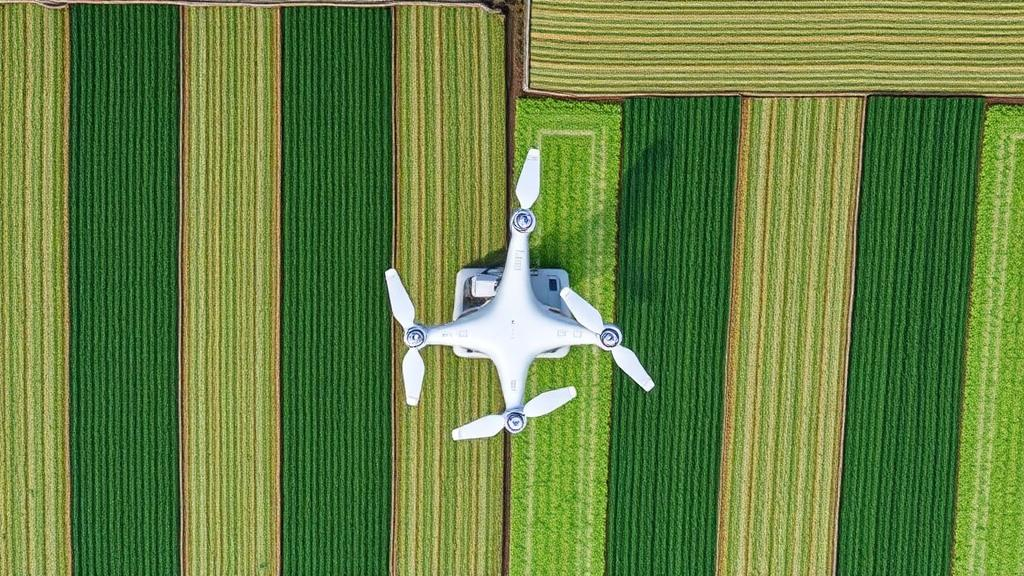
For decades, the most valuable information a drone can gather over a farm has been locked behind a price barrier. Consumer-grade unmanned aerial vehicles capture crisp red, green, and blue photographs, but the early biochemical fingerprints of plant stress sit outside that visible window, in the Red Edge and near-infrared bands that only dedicated multispectral cameras can record. Those sensors cost between 5,000 and 20,000 US dollars once calibration targets and trained operators are included, an entry barrier that lands hardest on smallholder farmers, precisely the growers who stand to gain the most from precision agriculture. A new study published in the Journal of Agriculture and Food Research proposes a software answer to that hardware problem: a deep neural network, dubbed TC-SA-UResNet, that reconstructs five multispectral bands from a single ordinary RGB image.
The stakes are considerable. Crop pathogens, pests, and environmental stressors cut annual yields by 21 to 40 percent in major staple crops, with food-deficit regions absorbing a disproportionate share of the loss and a global economic impact estimated above 220 billion US dollars per year. Ground scouting is labor-intensive, covers only a fraction of the production area, and offers no warning before stress symptoms become visible. Reflectance shifts in the 680 to 730 nanometer Red Edge band, by contrast, precede measurable chlorophyll loss, and the normalized difference red edge index has been shown to flag stressed vegetation 13 to 16 days ahead of broadband indices. Capturing those signals routinely, however, has remained out of reach for most of the world’s growers.
The research team, led by Laurensia Simanihuruk of Sepuluh Nopember Institute of Technology together with collaborators in Indonesia and Malaysia, validated their framework on a demanding real-world testbed: ten heterogeneous cocoa agroforestry typologies in Divo, Côte d’Ivoire. The underlying dataset, collected with a DJI Phantom 4 Multispectral flying at 80 meters altitude, comprises 1,272 co-registered RGB-multispectral image pairs spanning 7,632 individual frames. Multi-storey canopies, intercropped shade trees, senescent foliage, and intricate shadow patterns create exactly the kind of spectral complexity that breaks the assumptions of earlier reconstruction methods, which were mostly tuned on laboratory benchmarks with uniform illumination and homogeneous materials.
The architecture’s central insight is biophysical rather than purely computational. Vegetation reflectance follows a causal sequence: pigment absorption shapes the visible bands, the chlorophyll transition defines the Red Edge response around 730 nanometers, and cellular scattering together with water content drives the near-infrared plateau at 840 nanometers. On the Ivorian dataset, the correlation between the RGB input and the near-infrared target is a weak 0.43, while the correlation between Red Edge and near-infrared reaches 0.76, the strongest cross-band relationship in the data. A network that maps RGB directly to near-infrared therefore discards the very band that predicts its target best. TC-SA-UResNet instead routes reconstruction through a Triple Cascaded Decoder: one stream regenerates the visible bands, a second produces the Red Edge band, and a third generates near-infrared using features transferred from the Red Edge decoder through a Learnable Feature Injection module whose transfer gates start at zero and open only when they reduce the loss.
Attention mechanisms refine the cascade at two scales. A Spectral Attention module based on cross-attention lets each location in the near-infrared decoder read every location of the Red Edge decoder, which matters where a shadowed cocoa crown carries weak local evidence. Inside each decoder block, a Channel-wise Dual Attention module weights both channels and spatial locations, while a Global-Local Channel Attention module applies a separate gate per channel at each pixel, allowing fine-grained spectral discrimination. At the bottleneck, an Atrous Spatial Pyramid Pooling module captures context at dilation rates of 6, 12, and 18 pixels, and a Squeeze-and-Excitation block recalibrates the 256 feature channels before decoding begins. A ResNet-50 encoder pretrained on ImageNet supplies the hierarchical features shared by all three decoder streams.
Perhaps the most distinctive contribution is the training objective. Standard pixel losses and structural similarity terms say nothing about whether a reconstructed spectrum is physically plausible for vegetation, and a network can record low error while producing an impossible vegetation index. The authors’ Biophysical Spectral Consistency Loss adds four constraints: it matches the Pearson correlation between reconstructed Red Edge and near-infrared to that of the reference pair, compares the reconstructed NDVI field against the reference, preserves the shape of the spectral curve by matching reflectance steps between adjacent bands, and penalizes any NDVI value straying outside the physical interval from minus one to one. Correlation-guided weighting allocates the largest loss share, roughly 44 percent, to the near-infrared decoder, the band hardest to infer from visible light.
The evaluation was designed to prevent the spatial leakage that plagues many UAV studies. Rather than randomly shuffling frames, which risks near-duplicate images appearing in both training and test sets, the team split the data by plot: six plots for training, two for validation, and two entirely unseen plots for testing, ensuring the model faced canopy structures and illumination conditions it had never encountered. Against three baselines re-implemented from their original publications, a single-decoder U-Net, a dense prediction framework from Zhao and colleagues, and a two-step generative adversarial network, the proposed method achieved the highest structural similarity on the blue and near-infrared bands, the highest near-infrared coefficient of determination at 0.7898, and the smallest spectral angle of any architecture at 3.58 degrees. All 45 pairwise comparisons across bands and baselines reached statistical significance at p below 0.0001.
The ablation study reveals how each component earns its place. Swapping the vanilla encoder for ResNet-50 raised near-infrared R-squared from 0.7154 to 0.7725, and adding the biophysical constraints deliberately reshaped the optimization landscape before the ASPP-SE bottleneck and the full cascade recovered and surpassed all intermediate configurations. The authors are candid about trade-offs: near-infrared structural similarity of 0.7180 trails the blue band’s 0.9540, because near-infrared reflectance depends on internal leaf mesophyll structure that an RGB sensor simply cannot see, bounding the texture the network can recover. Yet the relative error tells a fairer story, with near-infrared at 13.7 percent against 13.4 percent for blue once each band’s error is normalized by its mean reflectance. Since vegetation indices are ratios of band differences to band sums, they depend on magnitude rather than texture, which explains why reconstructed NDVI reached a correlation of 0.9068 with the reference despite the lower structural fidelity.
The agronomic bottom line is nuanced but promising. Reconstructed NDVI achieved a mean absolute error of 0.0342, about 31 percent of one standard deviation of the measured quantity, with every reconstructed pixel falling inside the physical range, supporting vigour zoning within a flight, block ranking on a given date, and directional change detection across dates. The chlorophyll-sensitive indices NDRE and LCI fared less well, with R-squared values of 0.5379 and 0.5873, because both combine the two hardest bands and their uncertainties compound; they remain usable as screening layers to direct ground scouts toward weak zones but cannot support absolute nitrogen inference. The authors caution that the model was trained on one sensor, one crop, and a narrow clear-sky acquisition window, so transfer to other crops or imaging systems will require domain adaptation with paired observations rather than zero-shot deployment. Even with those caveats, the study marks a striking demonstration that the invisible half of the spectrum can be conjured, with measurable fidelity, from the cheap visible light every farmer’s drone already captures.
Subject of Research: Deep learning reconstruction of multispectral bands from RGB UAV imagery for cocoa agroforestry monitoring
Article Title: Triple Cascaded Spectral Attention U-ResNet for UAV RGB-to-multispectral reconstruction in cocoa agroforestry
Article References: Simanihuruk, L., Sarno, R., Sungkono, K. R., Putri, R. A., Anggraini, R. N. E., Wiratmoko, D., Larekeng, S. H., & Hitam, M. S. (2026). Triple Cascaded Spectral Attention U-ResNet for UAV RGB-to-multispectral reconstruction in cocoa agroforestry. Journal of Agriculture and Food Research, 31, Article 103333. https://doi.org/10.1016/j.jafr.2026.103333
Image Credits: AI Generated
DOI: 10.1016/j.jafr.2026.103333
Keywords: UAV remote sensing, multispectral reconstruction, deep learning, cocoa agroforestry, vegetation indices, NDVI, near-infrared, precision agriculture, smallholder farming, spectral attention, Côte d'Ivoire, crop stress detection
Cite Scienmag News
Alan Morgan. (October 5, 2026). AI Turns Cheap RGB Drone Photos Into Multispectral Crop Scans. Scienmag. https://scienmag.com/ai-turns-cheap-rgb-drone-photos-into-multispectral-crop-scans/
Alan Morgan. "AI Turns Cheap RGB Drone Photos Into Multispectral Crop Scans." Scienmag, 5 October 2026, https://scienmag.com/ai-turns-cheap-rgb-drone-photos-into-multispectral-crop-scans/. Accessed 5 October 2026.
Alan Morgan. "AI Turns Cheap RGB Drone Photos Into Multispectral Crop Scans." Scienmag. October 5, 2026. https://scienmag.com/ai-turns-cheap-rgb-drone-photos-into-multispectral-crop-scans/


