


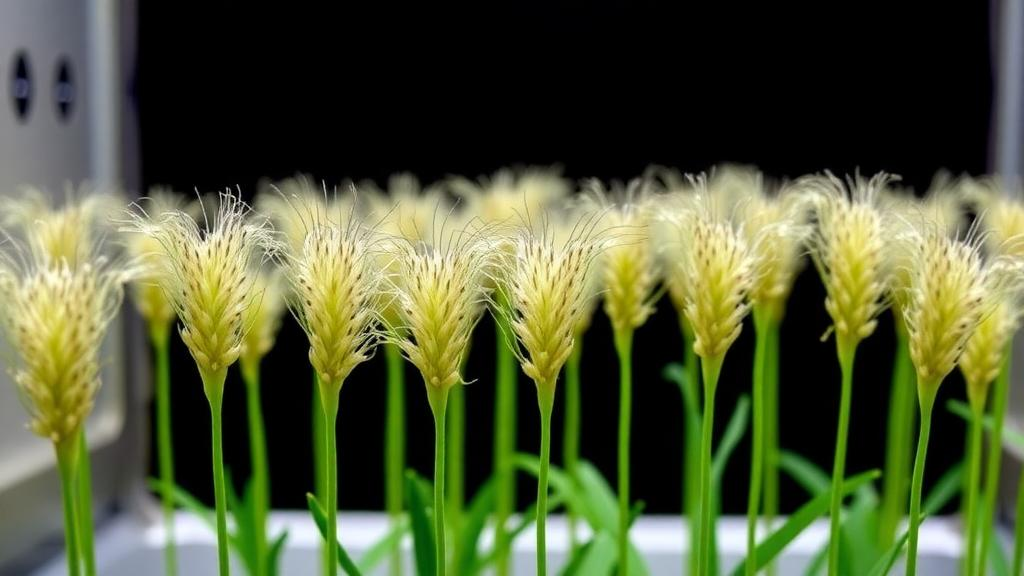
Taiwan oil millet, a humble grass that once sustained Indigenous communities in the island’s mountain terraces, has long been overlooked by modern science. Now, a research team in Taiwan has taken a decisive step toward transforming this semi-domesticated orphan crop into a powerful scientific tool and, potentially, a resilient crop of the future. In a study published in the journal Plant Methods, researchers led by Kun-Ting Hsieh of National Taiwan University report the establishment of an efficient, seedling-based regeneration system for Eccoilopus formosanus, the botanical name for Taiwan oil millet. The achievement matters because reliable regeneration through tissue culture is the essential gateway to genetic transformation, genome editing, and ultimately the domestication of a species that has never received the intensive breeding attention lavished on major cereals.
The core challenge the team faced is one that has stymied progress across many orphan crops: without an efficient tissue culture system, scientists cannot easily insert genes, edit genomes, or study gene function in a living plant. For most well-studied cereals such as rice, maize, and wheat, decades of optimization have produced robust protocols in which immature embryos—the young, undifferentiated plant tissue harvested from developing seeds—are coaxed into forming callus, a mass of regenerable cells, and then into whole plants. But immature embryos come with a heavy logistical price. They must be collected during a narrow window of seed development, which means researchers need a constant supply of flowering plants, careful timing, and considerable labor. For a crop like Taiwan oil millet, whose growth habits and flowering patterns are not well characterized in laboratory settings, this dependency creates a bottleneck that can stall research for years.
The Taiwanese team’s solution was elegant in its simplicity: use seedlings instead. Rather than harvesting immature embryos at a precise developmental moment, the researchers germinated mature seeds under controlled conditions and used the resulting young seedlings as the starting material for callus induction. This shift removes the strict developmental-stage constraints that plague embryo-based systems, allowing experiments to proceed year-round. Seeds can be stored, germinated on demand, and processed in batches, making the entire workflow scalable and accessible even to laboratories without specialized greenhouse facilities for maintaining large populations of flowering plants. The approach also sidesteps the seasonal limitations that would otherwise dictate when experiments could begin.
Importantly, the team did not start from scratch. They drew on insights from previously reported tissue culture systems in sorghum, a close C4 relative with a more established research infrastructure. By adapting sterilization procedures, callus induction media, and regeneration conditions that had proven successful in sorghum, the researchers gave themselves a rational starting point rather than an exhaustive trial-and-error search. This cross-species knowledge transfer is a strategy increasingly favored in orphan crop research, where funding and time are limited and lessons learned in better-studied relatives can dramatically shorten the path to a working protocol.
The optimization process touched every stage of the regeneration pipeline. Seed sterilization protocols had to be tuned to eliminate microbial contamination without damaging the delicate seedling tissue. Callus induction conditions were refined so that efficient callus formation occurred within just four weeks of culture initiation. The researchers also incorporated plant growth regulators, the hormone-like signaling molecules that steer plant cells between growth, differentiation, and organ formation, and found that their judicious use further improved regeneration efficiency. Once formed, the calli could be reduced in size and maintained their proliferative capacity through repeated subculturing, meaning that a single batch of starting material could sustain extended lines of experimentation rather than being exhausted after one round.
The headline numbers from the study are striking. The optimized protocol achieved a regeneration efficiency of 97.9 percent, meaning that nearly every callus that entered the regeneration phase gave rise to a complete plant. From the initial induction of callus to mature plants that had been acclimatized to soil, the entire process took between twelve and fourteen weeks. That timeline is competitive with established cereal systems and represents a practical pace for research programs that need to generate, evaluate, and propagate genetically modified or edited lines. Equally significant, the calli displayed stable regenerative capacity over extended culture periods, a property that guards against the gradual loss of regenerability that often undermines long-term tissue culture work in other species.
Why does all this matter beyond the laboratory bench? Taiwan oil millet is what agricultural scientists call an orphan crop: a species of local importance that has been largely ignored by commercial breeding and international research. Orphan crops are frequently adapted to marginal environments—poor soils, drought, high elevations—precisely because they were never selected for maximum yield under ideal conditions. As climate change intensifies pressure on global agriculture, there is growing interest in mining these resilient species for traits that could fortify food systems. Taiwan oil millet, cultivated traditionally by Indigenous peoples in Taiwan’s mountains, embodies that resilience. A working regeneration system is the first prerequisite for identifying the genetic basis of its hardiness and, if desired, introducing those traits into other crops or improving the millet itself through modern breeding.
The second major motivation is scientific rather than agricultural: C4 biology. Most plants, including rice and wheat, use the C3 photosynthetic pathway, in which a key enzyme often wastes energy by binding oxygen instead of carbon dioxide. C4 plants, which include maize, sorghum, sugarcane, and Taiwan oil millet, have evolved a biochemical and anatomical specialization that concentrates carbon dioxide around the carbon-fixing machinery, making photosynthesis dramatically more efficient in hot, bright conditions. Engineers and plant biologists have long dreamed of installing C4 traits into C3 staple crops to boost yields, but the underlying biology remains incompletely understood. A C4 grass that is small, tractable, and now amenable to tissue culture and, prospectively, genetic manipulation could serve as a model organism for dissecting C4 photosynthesis in ways that towering maize plants or slow-growing sugarcane cannot. Taiwan oil millet’s compact growth habit and newly established regenerability position it as exactly such a model.
The authors are explicit that the regeneration system is a foundation rather than a finished toolkit. Stable transformation and genome editing in plants depend on the ability to regenerate whole plants from cells that have taken up foreign DNA or undergone targeted edits. With a 97.9 percent regeneration rate and sustained callus proliferation now demonstrated, the path to developing those downstream systems in Taiwan oil millet is open. The team acknowledges the contributions of collaborators who provided and maintained the plant materials, including researchers at National Chiayi University and the Hualien District Agricultural Research and Extension Station, underscoring how much of this work rests on the careful stewardship of a crop that exists largely outside mainstream seed banks and commercial channels. The research was supported by Taiwan’s National Science and Technology Council.
The broader lesson of the study resonates across plant science. As genome editing tools such as CRISPR have become fast and inexpensive, the limiting step in improving neglected species is often not the editing itself but the plant biology surrounding it: getting cells to take up DNA, and getting edited cells to become plants. By demonstrating that a simple, scalable seedling-based approach can deliver near-complete regeneration in a previously intractable orphan grass, the Taiwanese team has offered a template that other researchers working on underutilized crops may follow. For Taiwan oil millet, a species that fed mountain communities for generations before fading from the fields, the work represents a chance at a second life—first as a window into one of nature’s most efficient photosynthetic machines, and perhaps eventually as a resilient grain returned to cultivation in a warming world.
Subject of Research: Development of a seedling-based tissue culture regeneration system for the orphan crop Taiwan oil millet to enable genetic studies, crop domestication, and C4 photosynthesis research
Article Title: Establishment of a seedling-based regeneration system for Taiwan oil millet (Eccoilopus formosanus) to support crop domestication and C4 biology
Article References: Hsieh, K.-T., Chuang, H.-Y., Hsu, C.-H., Chen, Y.-F., Li, W.-H., Lin, H.-C., Hsing, Y.-I. C., Hong, C.-Y., & Chang, M.-C. (2026). Establishment of a seedling-based regeneration system for Taiwan oil millet (Eccoilopus formosanus) to support crop domestication and C4 biology. Plant Methods. https://doi.org/10.1186/s13007-026-01599-2
Image Credits: AI Generated
DOI: 10.1186/s13007-026-01599-2
Keywords: Taiwan oil millet, Eccoilopus formosanus, tissue culture, plant regeneration, orphan crops, C4 photosynthesis, callus induction, plant growth regulators, genome editing, crop domestication, seedling-based culture, Plant Methods
Cite Scienmag News
Alan Morgan. (October 5, 2026). Scientists Crack Tissue Culture Barrier for Taiwan’s Orphan Millet, Paving Way for Crop Domestication. Scienmag. https://scienmag.com/scientists-crack-tissue-culture-barrier-for-taiwans-orphan-millet-paving-way-for-crop-domestication/
Alan Morgan. "Scientists Crack Tissue Culture Barrier for Taiwan’s Orphan Millet, Paving Way for Crop Domestication." Scienmag, 5 October 2026, https://scienmag.com/scientists-crack-tissue-culture-barrier-for-taiwans-orphan-millet-paving-way-for-crop-domestication/. Accessed 5 October 2026.
Alan Morgan. "Scientists Crack Tissue Culture Barrier for Taiwan’s Orphan Millet, Paving Way for Crop Domestication." Scienmag. October 5, 2026. https://scienmag.com/scientists-crack-tissue-culture-barrier-for-taiwans-orphan-millet-paving-way-for-crop-domestication/


