


In a groundbreaking development within the realm of battery technology, researchers have unveiled a revolutionary prototype: a flexible, seawater-compatible battery that could redefine energy solutions in marine environments. This innovative approach addresses a significant limitation of traditional batteries, which are typically rigid and unsuitable for wet environments. The challenge of harnessing sustainable, safe energy sources for applications in oceans and estuaries has prompted the scientific community to rethink conventional battery design, paving the way for advancements that could transform energy consumption in aquatic scenarios.
The new technology centers on the concept of a yarn-like battery that operates efficiently when submerged in seawater. The groundbreaking research is documented in the journal "ACS Applied Materials and Interfaces," presenting an exciting opportunity for integrating energy solutions into everyday marine life. This prototype adapts to its environment, providing electricity for lighting fishing nets, powering life jackets, and energizing mooring lines, enabling a range of potential applications that span from safety gear to innovative maritime technology.
At the core of this development is the use of materials that are both flexible and conductive, forming the backbone of this new electrochemical technology. Researchers have successfully exploited the natural properties of seawater, which contains essential ions that facilitate electrical conduction, making it an ideal electrolyte for battery operation. In this unique application, the battery’s electrodes were composed of carbon fiber, treated with advanced conductive coatings to maximize power output while ensuring structural integrity.
Using the electrically conductive coatings, the team designed a positive electrode (or cathode) using nickel hexacyanoferrate and a negative electrode (anode) constructed from polyamide material. The combination of these materials allows the battery to store and release energy efficiently even under the corrosive influence of saltwater. The subsequent twisting of these two electrode components into a yarn-like structure enhances their flexibility, enabling the battery to adapt to various shapes and forms—the very essence of modern wearable and weaveable technology.
A remarkable achievement of this work lies in the manufacturing process of the seawater battery, which involves intricate layering techniques. The cathode string is wrapped in a durable layer of fiberglass, ensuring protection from environmental conditions while still allowing seawater accessibility. The researchers then encased the entire assembly in a nonwoven, permeable fabric, which serves a dual purpose of safeguarding the electrodes while facilitating interaction with the salty electrolyte.
Performing extensive tests, the prototypes demonstrated exceptional resilience and stability. After undergoing rigorous bending operations—over a remarkable capacity of 4,000 bends—the battery retained its charge, proving its mechanical and electrical durability. This performance indicates a future where batteries are not only integrally embedded in textiles but can also withstand the physical rigors of a marine environment.
Further evaluations in seawater showcased that the battery sustained its initial charging efficiency and electricity storage capacity over an impressive 200 charge and discharge cycles. These findings illustrate not only the feasibility of integrating energy technologies into marine applications but also the potential for developing a new class of batteries that provide sustainable energy solutions without sacrificing flexibility or reliability.
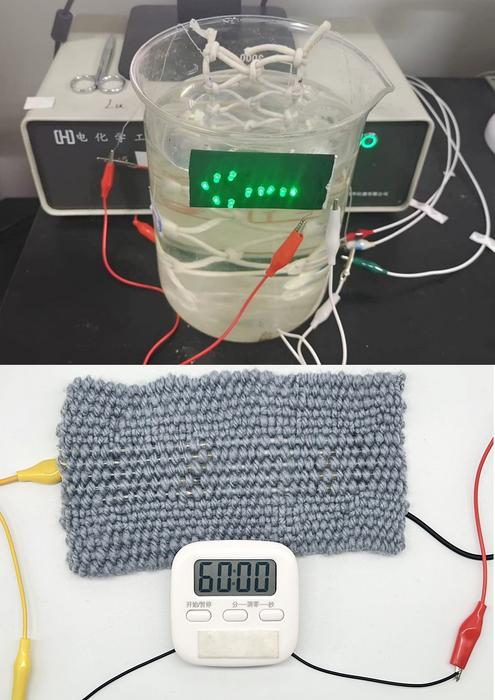
As part of their proof-of-concept, the researchers demonstrated practical applications of their innovation by knotting battery strands to create a fishing net filled with energy-storing capabilities. Following a soak in seawater for electrolyte absorption, the net was successfully charged and utilized to power a panel of ten LEDs. Similarly, a rectangular fabric sample was immersed in a sodium sulfate solution, demonstrating the battery’s functionality for over an hour, a promising capability for various marine scenarios.
The potential uses for this technology are groundbreaking. Envisioning its application in fishing nets and safety gear opens up a world of possibilities for harnessing renewable energy sources that can change the face of maritime operation and safety standards. This yarn-like battery blends seamlessly into the fabric of everyday marine activities, bringing forth innovations that ensure both efficiency and safety for explorers, fisherfolk, and maritime security personnel alike.
Such products could revolutionize the collaboration of technology and nature, enabling not just a sustainable approach to energy, but also contributing to safer marine conditions. Fishing nets equipped with these energy-storing capabilities could illuminate underwater activities, enhancing safety for nighttime operations while sustaining an eco-friendly profile that aligns with environmental conservation efforts.
In a world increasingly conscious of the environmental impact, this research highlights a forward-thinking approach to utilizing abundant natural resources. By capitalizing on the saltiness of seawater, a readily available and sustainable material, the researchers present a compelling argument for shifting the paradigm around energy storage. The marine version of a rechargeable battery epitomizes the potential for innovation by integrating advanced materials science with practical applications, fostering a brighter future ahead.
The broader implications extend beyond the marine landscape, as these advancements may influence the development of similar technologies for other adaptable, flexible electrical needs in our evolving society. As the integration of electronics into textiles and everyday objects becomes more prominent, these pioneering efforts reaffirm the trajectory toward a greener and smarter future.
Ultimately, the researchers have not only acknowledged the funding sources that supported this compelling project but heralded a new era in energy solutions. The collaboration among academic, governmental, and sport administration institutions demonstrates a unified push toward progress, aspiring to enlighten and power our world through innovation and scientific inquiry.
This revolutionary development suggests that future generations need not depend solely on traditional, rigid battery solutions. Instead, they could benefit from a world where energy is seamlessly integrated into the very fabric of their daily lives, providing not just portable solutions but also a pathway toward sustainability that respects the natural environment.
This collaboration of interdisciplinary efforts could be the catalyst that ignites further innovations in battery technology, ensuring that humanity stays ahead of energy needs while minimizing environmental impact.
As the journey of this innovative seawater battery advances, further study and application will undoubtedly draw attention, inspiring a tidal wave of interest in the safe, efficient, and flexible battery solutions needed for the future of energy consumption and sustainability.
Keywords
Batteries, Seawater, Flexible Electronics, Electrodes, Marine Applications, Electrochemistry, Textile Engineering, Renewable Energy, Sustainable Technology.
Cite Scienmag News
Faith Mcneil. (January 21, 2025). Developing a Fabric Battery for Innovative Applications in Seawater. Scienmag. https://scienmag.com/developing-a-fabric-battery-for-innovative-applications-in-seawater/
Faith Mcneil. "Developing a Fabric Battery for Innovative Applications in Seawater." Scienmag, 21 January 2025, https://scienmag.com/developing-a-fabric-battery-for-innovative-applications-in-seawater/. Accessed 1 September 2026.
Faith Mcneil. "Developing a Fabric Battery for Innovative Applications in Seawater." Scienmag. January 21, 2025. https://scienmag.com/developing-a-fabric-battery-for-innovative-applications-in-seawater/


