


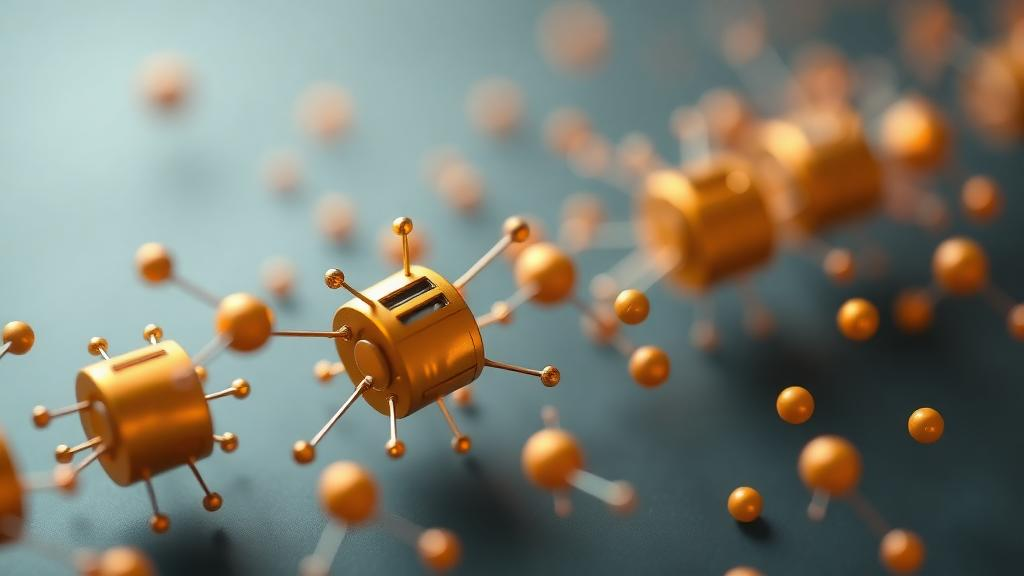
A swarm of microscopic particles drifting through an electric or magnetic field may not look like a machine, but a new Perspective published in Advanced Science argues that this is exactly how scientists should think about them. The article, authored by Ruchi Patel and Bhuvnesh Bharti of Louisiana State University, lays out a framework in which field-driven active colloids—particles roughly 0.1 to 10 micrometers across that propel themselves under externally applied fields—are treated not as isolated autonomous swimmers but as components of a distributed micromachine. In this view, the particles supply motion, while the fields, imaging systems, and feedback algorithms supply the power, sensing, and control that conventional robots package inside a single chassis.
The argument begins with a fundamental physics problem. At molecular and nanometer scales, matter is dominated by thermal fluctuations, viscous dissipation, and stochastic collisions, which make persistent directed motion and programmable reconfiguration inherently difficult. At macroscopic scales, materials operate in a more deterministic, inertia-dominated regime where dynamics can be controlled externally with high precision. Colloids sit squarely between these limits. They are large enough to be visualized, manipulated, and programmed in real time under a microscope, yet small enough that Brownian motion remains intrinsically coupled to their transport and collective organization. That coexistence of fluctuation and control, the authors contend, is precisely what makes colloids the natural bridge between molecular-scale design and macroscale actuation.
The distributed-micromachine framework deliberately departs from the usual robotic blueprint. A macroscopic robot integrates four modules—power, sensing, control, and function—within one platform, with onboard batteries, sensors, processors, and actuators communicating through real-time feedback loops. Miniaturizing that architecture to the microscale fails for basic reasons: onboard power, sensing, and computation become extremely difficult to shrink, while low Reynolds number hydrodynamics and thermal noise continuously perturb trajectories. Instead, the authors propose that the modules be partitioned across the system. External electric and magnetic fields deliver energy, imaging provides sensing, feedback algorithms impose control, and the resulting particle motion or collective reconfiguration produces function. Crucially, a population of colloids contains enormous microscopic degrees of freedom, yet only a handful of globally tunable field parameters—amplitude, frequency, phase, gradient—are available to steer them. The central design problem is therefore to identify a reduced set of task-relevant variables that can be both observed and regulated, rather than to control every particle individually.
Programmable motion is the first pillar of this framework. Early chemically powered Janus colloids demonstrated that broken symmetry can convert local energy dissipation into persistent propulsion through self-diffusiophoresis and self-electrophoresis, but their trajectories were hard to modulate after fabrication. Field-driven particles shift the energy input and trajectory regulation to the outside world. Under alternating current electric fields, induced-charge electrophoresis enables controlled linear propulsion of metallodielectric particles, and tuning the particle’s patch geometry and the field’s strength and frequency can switch the propulsion mode itself—transforming straight paths into helical trajectories with controllable pitch, diameter, handedness, and speed. Magnetic actuation adds another layer: time-varying fields drive rolling near surfaces and rotation away from substrates, and recent work has revealed hybrid regimes where linear, arc-like, and trochoidal trajectories emerge from the interplay of magnetic torque, viscous drag, Brownian rotation, and substrate coupling. Because particles with different shapes, magnetic moments, and response frequencies react differently to the same field, the authors describe a strategy of physical multiplexing, in which particle heterogeneity encodes distinct transfer functions from one global input to many particle-level responses.
Field-mediated control also extends from single trajectories to collective states. In AC electric fields, the interplay between dipolar attractions and induced-charge electrophoresis generates non-reciprocal interactions that drive metastable active clusters capable of transitioning between translational, rotational, and helical collective states while continuously reorganizing. Magnetic microswimmers assembled from superparamagnetic particles exhibit non-reciprocal body deformations that couple directly to controllable swimming. These advances point toward reconfigurable collective microbots whose motion, interactions, and functionality can be programmed in real time through externally imposed control landscapes.
Translating these capabilities beyond the laboratory, however, faces three bottlenecks that the Perspective frames as design requirements. The first is energy delivery. Electric fields act not only on the particles but on the ions and interfaces of the suspending fluid, so propulsion is sensitive to conductivity, ionic strength, and frequency; when the field’s switching timescale is mismatched with double-layer charging or electrohydrodynamic flow development, energy is screened, dissipated, or wasted as parasitic flow. Joule heating further constrains operation in conductive biological fluids and saline water. Magnetic fields avoid driving ionic currents, but they introduce their own coupling constraints: when the driving frequency exceeds a particle’s ability to follow, phase lag destroys synchronization and propulsion efficiency collapses. Multicoil arrays, optimized field geometries, and ultra-low-frequency fields can improve delivery, but they raise new questions of instrumentation, scalability, and safety.
The second bottleneck is material compatibility. Fouling does not merely block particle surfaces; it changes how the field couples to the particle. Adsorbed proteins, natural organic matter, or polyelectrolytes can shift the slip plane, modify charge regulation, and alter Maxwell–Wagner relaxation times, producing unpredictable dielectrophoresis or trapping particles in complex media. In biological fluids, biomolecular adsorption can promote aggregation or suppress motion entirely, while non-biodegradable components pose barriers for drug delivery. The authors survey emerging strategies—antifouling coatings such as hydrogels, PEG, and zwitterionic polymers; bioactive designs including enzyme-functionalized and cell-membrane-coated surfaces; and biodegradable matrices such as PLGA, chitosan, and alginate—and propose a simple criterion: whether a particle retains its field response, colloidal stability, and task-specific binding function after exposure to the relevant medium.
The third bottleneck is sensing and imaging. Optical microscopy excels in transparent laboratory media but fails in tissue, porous matrices, and opaque environmental samples, and the challenge is not merely seeing particles but resolving the state variables relevant to control—position, orientation, cargo state, collective configuration—at timescales faster than their uncontrolled evolution. Multimodal approaches such as optical coherence tomography, ultrasound, MRI, and photoacoustic imaging extend observation into harder environments, each with trade-offs in depth, resolution, and speed. Delayed or noisy localization can cause field updates to act on outdated states, a mismatch that matters because Brownian fluctuations and collective rearrangements evolve on timescales comparable to image acquisition.
Despite these constraints, field-driven colloids are beginning to convert controlled motion into task-oriented function, which the authors organize into three classes: targeted navigation and delivery, selective uptake and recovery, and collective organization and reconfiguration. In biomedical demonstrations, magnetically driven helical micropropellers have penetrated the dense vitreous humor of the eye using a slippery perfluorocarbon coating, with optical coherence tomography confirming localization near the retina, while magnetically maneuvered particles have navigated the tortuous dentinal tubule network in root canal treatment, delivering antimicrobial hyperthermia from their iron-containing layer and then being recovered. In environmental remediation, gold-patched ZIF-8 metal-organic framework particles driven by AC electric fields accelerated the uptake of perchlorate, sulfide, and fluoride, and helical nickel particles coated with cesium-selective nickel ferrocyanide showed a roughly 21-fold enhancement in radio-cesium adsorption kinetics when tumbling under rotating magnetic fields. In materials assembly, active-passive colloidal mixtures form motile clusters that continuously split and merge, semiconductor microparticles switch between field-driven assembly and disassembly by frequency, and closed-loop feedback has steered hundreds of anisotropic particles through glassy configurations into nearly defect-free crystals.
The Perspective’s most provocative distinction is between trajectory-closed and task-closed control. Most current feedback demonstrations regulate variables easily obtained from imaging—position, orientation, swarm morphology—while the functional state of the machine remains open loop: a particle may reach its target without knowing whether its cargo was released or its pollutant captured. The authors argue that autonomy at colloidal scales must be externalized across the particle-field-imaging-controller architecture, and they chart a roadmap in which machine learning serves as a complement to physical understanding rather than a replacement. Reinforcement learning has already enabled a magnetic colloidal microrotor to transport nonmagnetic cargo and navigate mazes after training in simulation, and vision-based feedback has guided microellipsoids across patterned surfaces. But learned controllers demand large datasets, transfer poorly across configurations, and rarely optimize functional variables such as adsorption saturation or treatment completion. The decisive advance, the authors conclude, will not be the miniaturization of every robot component, but the ability to identify, observe, and control the small number of collective and functional variables that a microscopic task actually requires—turning swarms of field-energized particles into genuinely programmable, task-completing micromachines.
Subject of Research: Field-driven active colloids as distributed micromachines bridging physics, control, and function across length scales
Article Title: Field‐Driven Active Colloids as Distributed Micromachines: Bridging Physics, Control, and Function Across Length Scales
Article References: Patel, R., & Bharti, B. (2026). Field‐Driven Active Colloids as Distributed Micromachines: Bridging Physics, Control, and Function Across Length Scales. Advanced Science, Article e78065. https://doi.org/10.1002/advs.78065
Image Credits: AI Generated
DOI: 10.1002/advs.78065
Keywords: active colloids, microrobotics, magnetic actuation, electric fields, active matter, feedback control, colloidal assembly, drug delivery, environmental remediation, machine learning, self-propulsion, reconfigurable materials
Cite Scienmag News
Denise Maddox. (October 5, 2026). Tiny Field-Driven Particles Are Being Recast as Distributed Micromachines. Scienmag. https://scienmag.com/tiny-field-driven-particles-are-being-recast-as-distributed-micromachines/
Denise Maddox. "Tiny Field-Driven Particles Are Being Recast as Distributed Micromachines." Scienmag, 5 October 2026, https://scienmag.com/tiny-field-driven-particles-are-being-recast-as-distributed-micromachines/. Accessed 5 October 2026.
Denise Maddox. "Tiny Field-Driven Particles Are Being Recast as Distributed Micromachines." Scienmag. October 5, 2026. https://scienmag.com/tiny-field-driven-particles-are-being-recast-as-distributed-micromachines/


