


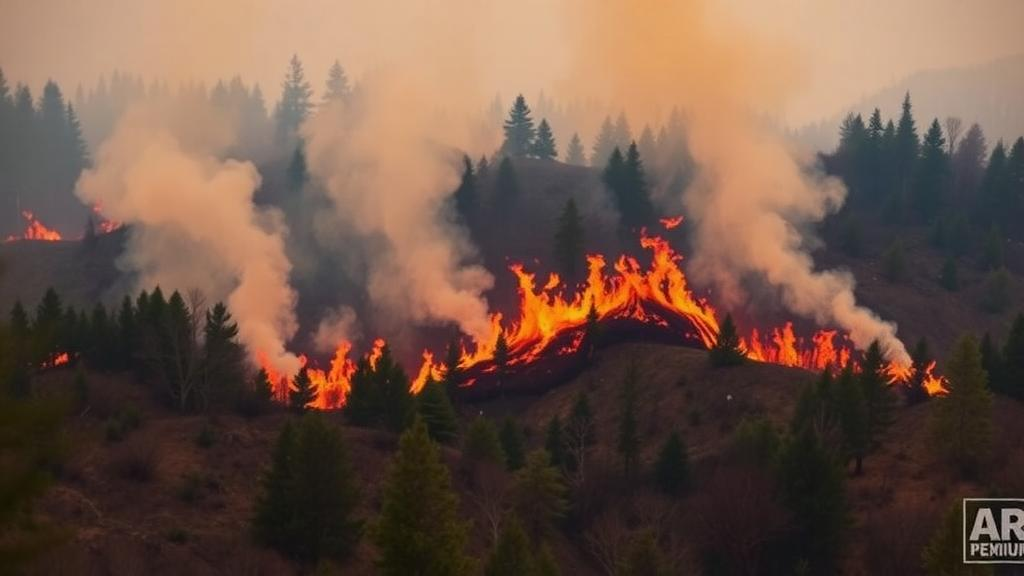
When a wildfire finally burns out, the danger is often only beginning. Charred hillsides shed their soil, rainstorms send debris flows roaring through canyons, and flash floods sweep ash and sediment into neighborhoods that survived the flames. Power grids, water systems and roads that were damaged or cut off can turn a single fire into a cascade of crises that unfold for months afterward. A new $2 million research project led by the University at Buffalo and funded by the U.S. National Science Foundation is setting out to understand these cascading disasters in a way that wildfire planning has rarely attempted: as an interconnected system rather than a series of separate events.
The award, part of NSF’s Fire Science Innovations through Research and Education program, runs from September 2026 through August 2029 and brings together a multidisciplinary team from the University at Buffalo, the University of California, Berkeley, Northeastern University and the U.S. Department of Energy’s Pacific Northwest National Laboratory. The study, titled Collaborative Research: FIRE-WUI: REKINDLE: Resilient Engineering through Knowledge Integration for NetworkeD Lifelines and Ecosystem, will focus on communities in the wildland-urban interface, the zone where housing, power lines and other human development meet or intermingle with forests, grasslands and other natural vegetation. These are precisely the places where the destructive potential of wildfire and its aftermath is growing fastest.
As wildfires become more frequent and severe across the American West and beyond, wildland-urban interface communities face escalating risks that extend well beyond the immediate destruction of the fire itself. Burned landscapes lose the vegetation and soil structure that once absorbed rainfall, making them dramatically more prone to debris flows and flash floods during subsequent storms. At the same time, fires and their secondary hazards can inflict significant disruptions on lifeline infrastructure, including power grids, water systems and transportation networks. Current approaches to wildfire resilience planning, however, typically consider these interconnected risks in isolation, which makes it difficult to see how they interact with one another and how people actually respond when multiple hazards strike in sequence.
REKINDLE is designed to close that gap by combining artificial intelligence, infrastructure modeling and social science to assess wildfire-related risks together and to identify concrete ways to bolster public safety and community resilience. Sayanti Mukherjee, PhD, the project’s lead principal investigator and an associate professor in UB’s Department of Industrial and Systems Engineering, explained the central problem the team hopes to solve. People are familiar with wildfire risk, she noted, but what is often overlooked are the additional hazards and cascading effects that can follow. A region affected by wildfire can become more vulnerable to subsequent hazards like debris flows and flash floods, and when those events cut off roads or interrupt power or water service, the impacts can quickly compound for communities already struggling to recover.
Mukherjee, who is also an affiliate faculty member with UB’s Department of Electrical and Computer Engineering and the Institute for Artificial Intelligence and Data Science, is joined by co-principal investigator Susan Spierre Clark, PhD, of UB’s Department of Environment and Sustainability. The broader investigative team includes Auroop R. Ganguly, PhD, of Northeastern University; Marta González, PhD, and Anna Serra-Llobet, PhD, of UC Berkeley; and Andre Coleman, PhD, and Sam Chatterjee, PhD, of Pacific Northwest National Laboratory. This mix of expertise in engineering, environmental science, data science and social systems reflects the project’s core premise: that understanding cascading wildfire disasters requires simultaneously modeling the physical hazards, the engineered networks they damage and the human decisions those damage cascades trigger.
Through REKINDLE, researchers will investigate how wildfires and the hazards they set in motion can compromise key infrastructure, producing disruptions that ripple through the essential services people depend on for daily life and well-being. Clark emphasized that the team wants to understand not only how infrastructure systems are affected, but how those disruptions shape household decisions and community response. Bringing those pieces together, she said, can help communities build resilience, restore critical infrastructure and recover faster from future disasters. The framing matters because infrastructure failures are rarely just technical problems; a closed road can prevent evacuation, a lost power connection can disable water pumping, and a prolonged outage can determine whether a family can remain in or return to a damaged neighborhood.
Artificial intelligence will play a central role in the technical core of the project. The researchers plan to build a physics-informed, geospatial-AI model that fuses Earth observation data with wildfire expertise to generate maps showing where wildfires and related hazards such as debris flows and flash floods are most likely to occur. By anchoring machine learning in physical processes, the team aims to produce hazard predictions that are both data-driven and scientifically interpretable, an increasingly important consideration for tools intended to inform emergency management decisions. In parallel, the researchers will deploy machine learning models to trace how failures could propagate across interconnected power, water and transportation systems, capturing the dependency structures that turn a localized fire damage into a region-wide service disruption.
The human dimension of the cascade will receive equal attention. Using household surveys, focus groups and simulation games, the research team will examine how infrastructure failures affect families’ livelihoods and their ability to recover from cascading disasters. These social science methods are intended to reveal how households weigh risks, make evacuation and recovery decisions, and cope when multiple services fail at once. The team will then use these findings to help determine where investments in stronger infrastructure could deliver the greatest protective impact before a fire occurs, and how recovery efforts should be prioritized in the aftermath. Mukherjee noted that deciding where to invest resources, whether through hardening infrastructure or increasing community engagement and outreach, will be an important part of the project, and that AI and optimization can help assess different strategies and pinpoint where investments would have the most value. That kind of insight, she said, can support emergency managers, infrastructure operators and environmental planners in making more informed decisions for their communities.
To keep the work grounded in real conditions, the researchers will build and test REKINDLE through case studies in the Los Angeles and Montecito regions of California, both of which have experienced major wildfires and devastating post-fire debris flows in recent years. Montecito in particular has become a sobering reference point for cascading wildfire hazards, having seen destructive debris flows sweep through burned terrain after intense rainfall. The research team will collaborate with government agencies, utility providers and community stakeholders throughout the project to help ensure that the tools they develop reflect the practical needs of the people and institutions that will ultimately use them, from county emergency planners deciding where to pre-position resources to utilities weighing which assets to reinforce first.
The project also carries a substantial education and workforce development mission. Researchers will create wildfire-focused educational materials for students ranging from middle school through graduate school, introducing a new generation to the science of wildfire resilience and the related hazards that follow fires. Undergraduate and graduate students will have opportunities to gain hands-on experience through internships with industry partners and national laboratories, building career pathways in a field where demand for expertise continues to grow. The team will make its educational resources and research data publicly available so that other researchers, practitioners and communities can build on the work. If REKINDLE succeeds, its integrated view of fire, flood, infrastructure and human response could reshape how at-risk communities plan for the full arc of a wildfire disaster, not just the day the flames arrive.
Subject of Research: AI-based modeling of cascading wildfire hazards and infrastructure resilience in wildland-urban interface communities
Article Title: University at Buffalo to lead $2 million National Science Foundation project on wildfire resilience
Article References: University at Buffalo to lead $2 million National Science Foundation project on wildfire resilience. (n.d.). Original publication
Image Credits: AI Generated
DOI: Not provided
Keywords: wildfire, cascading disasters, artificial intelligence, infrastructure resilience, wildland-urban interface, debris flows, flash floods, National Science Foundation, University at Buffalo, geospatial AI, community resilience, lifeline infrastructure
Cite Scienmag News
Violet Maxwell. (October 4, 2026). AI-Powered Project Aims to Predict the Deadly Chain Reactions Wildfires Leave Behind. Scienmag. https://scienmag.com/ai-powered-project-aims-to-predict-the-deadly-chain-reactions-wildfires-leave-behind/
Violet Maxwell. "AI-Powered Project Aims to Predict the Deadly Chain Reactions Wildfires Leave Behind." Scienmag, 4 October 2026, https://scienmag.com/ai-powered-project-aims-to-predict-the-deadly-chain-reactions-wildfires-leave-behind/. Accessed 4 October 2026.
Violet Maxwell. "AI-Powered Project Aims to Predict the Deadly Chain Reactions Wildfires Leave Behind." Scienmag. October 4, 2026. https://scienmag.com/ai-powered-project-aims-to-predict-the-deadly-chain-reactions-wildfires-leave-behind/


