


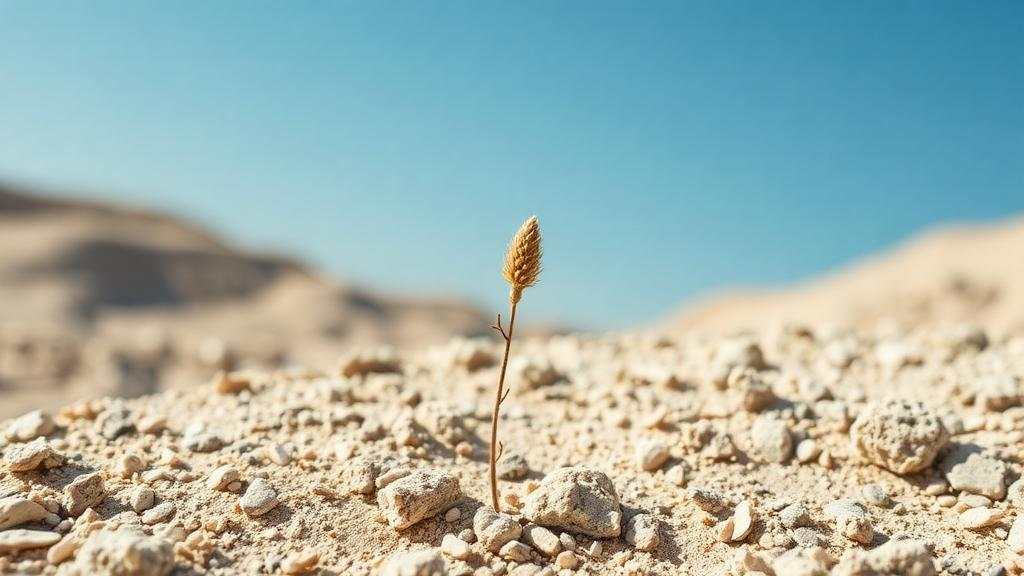
On the parched gypsum-marl hills of northwestern Türkiye, where most plants would wither within days, a slender member of the flax family not only survives but thrives as a strict endemic found nowhere else on Earth. A new study published in Plant Biosystems has taken the closest look yet at how Linum mucronatum subsp. gypsicola manages this feat, combining classical microscopy with cutting-edge elemental analysis to reveal a suite of structural and chemical adaptations that read like an engineering blueprint for life on one of the planet’s most inhospitable soils. The research, led by Ayşenur Kayabaş Avşar and colleagues at Çankırı Karatekin University, offers some of the most detailed evidence to date of how gypsophytes, plants specialized for gypsum substrates, rewire their anatomy and mineral chemistry to conquer extreme environments.
Gypsum soils are a botanical paradox. They are chemically peculiar, dominated by calcium sulfate, often low in the nutrients most plants crave, and physically punishing, drying out rapidly and offering little organic matter. Yet across the world’s arid regions, from the Chihuahuan Desert of North America to the Iberian Peninsula and the steppes of Central Anatolia, a remarkable guild of specialist plants has evolved to exploit these barren landscapes. What makes gypsum substrates especially fascinating to botanists is that many gypsophytes are strict endemics, confined to outcrops that may span only a few hillsides. Linum mucronatum subsp. gypsicola is a textbook example, restricted to gypsum-marl hills in northwestern Türkiye, where its survival strategies have remained largely unexplored until now.
The research team deployed an unusually comprehensive analytical arsenal. Light microscopy and scanning electron microscopy, or SEM, were used to chart the internal architecture of the plant’s roots, stems, and leaves at resolutions down to the micrometer scale. To go beyond structure alone, the researchers coupled the electron microscope with energy-dispersive X-ray analysis, known as SEM-EDX, which maps the elemental composition of tissues point by point. This was complemented by multi-elemental analyses of the plant’s vegetative parts and a full suite of soil chemical analyses from the collection site, allowing the team to compare what the substrate offers against what the plant actually accumulates. The approach links form to function in a way that few single-technique studies can achieve.
The anatomical findings paint a picture of a plant built for drought. In the roots, the researchers documented a strongly developed secondary xylem layer, the water-conducting tissue that thickens as woody plants mature. A robust secondary xylem provides both mechanical anchorage in crumbly, erodible gypsum-marl slopes and an expanded hydraulic network for scavenging scarce water from a substrate that sheds moisture quickly. Equally telling was the stem: its pith region, the soft central core found in many herbaceous plants, was markedly narrowed. A reduced pith conserves resources and may limit water loss through internal tissues, while lending the stem a tougher, more drought-resistant profile suited to arid exposure.
The leaves revealed perhaps the most striking adaptations of all. Microscopic examination showed a high stomatal density and, crucially, an amphistomatic structure, meaning stomata, the adjustable pores that regulate gas exchange, are present on both the upper and lower leaf surfaces. While amphistomy can increase photosynthetic capacity in high-light environments, it also demands tight regulation to prevent catastrophic water loss, and its combination with other xeromorphic traits suggests a finely balanced compromise between carbon gain and water conservation. The team also observed a well-organized arrangement of palisade parenchyma cells, the elongated photosynthetic cells packed beneath the upper epidermis, paired with a thin and loose spongy parenchyma below. This layered configuration maximizes light capture in intense steppe sunlight while the airy spongy tissue facilitates rapid internal gas diffusion, an arrangement frequently seen in plants of open, sun-baked habitats.
Beyond the anatomy, the elemental analyses clarified how the plant handles the unusual chemistry of its substrate. By quantifying macro- and micronutrients in the vegetative tissues and comparing them with soil measurements, the researchers showed how L. mucronatum subsp. gypsicola responds to substrate-derived nutrients, detailing the accumulation patterns that support its development on gypsum. The findings align with a growing international literature suggesting that gypsum specialists manage distinctive nutritional strategies, including notable accumulation of sulfur, an element abundant in calcium sulfate soils, and the capacity to gather excess nutrients as a constitutive buffer against the impoverished, grazed, and eroding landscapes they inhabit. Rather than merely tolerating gypsum chemistry, the flax appears to actively exploit it.
The study’s significance extends beyond a single species. Gypsum ecosystems host some of the most specialized floras on Earth, and understanding the mechanisms of plant survival on these substrates has become a priority for evolutionary ecologists. Recent comparative work has shown that gypsophiles from different continents often converge on similar elemental profiles, hinting at deep, repeatable solutions to the gypsum problem. By adding a micromorphological dimension, the Turkish team’s work connects that chemical story to physical structure, showing how water-conducting tissues, stomatal architecture, and photosynthetic cell arrangement work in concert with mineral accumulation to produce a genuinely integrated survival strategy.
There is also a conservation dimension. Endemic gypsophytes are inherently vulnerable: their restricted ranges, specialized habitat requirements, and the pressures of grazing, quarrying, and land-use change make them acutely sensitive to disturbance. Previous assessments of Turkish endemic Linum taxa have flagged conservation concern for several species in the genus. Documenting the precise anatomical and physiological requirements of L. mucronatum subsp. gypsicola provides a scientific foundation for protecting both the plant and its fragile gypsum habitat, since a specialist locked to a particular substrate cannot simply be transplanted elsewhere if its hills are degraded or destroyed.
Methodologically, the study also demonstrates the power of pairing SEM-EDX with conventional microscopy in plant science. The technique, increasingly used in medicinal plant research and comparative anatomy, allows researchers to visualize tissue architecture and elemental distribution simultaneously, revealing relationships that would be invisible to either method alone. As climate change intensifies aridity across the Mediterranean and Central Asian steppes, the adaptations documented in this unassuming flax, from its reinforced xylem to its dual-surface stomata, may inform broader efforts to understand, and perhaps even emulate, how plants cope with drought and marginal soils.
For now, the humble L. mucronatum subsp. gypsicola stands as a quiet marvel of evolutionary engineering, a plant that turned a geological curse into a biological refuge. Its gypsum hills, once dismissed as wasteland, are revealed as laboratories of adaptation, where every narrowed pith and densely packed stoma tells a story of survival refined over millennia. The research, supported by the TUBITAK 2209 Research Project Support Programme for Undergraduate Students, underscores how much remains to be learned from the world’s extreme habitats, and how the smallest plants often carry the biggest lessons about resilience on a changing planet.
Subject of Research: Anatomical and phytochemical adaptations of the endemic gypsophyte Linum mucronatum subsp. gypsicola to gypsum soils in Türkiye
Article Title: Micromorphological and phytochemical traits of the gypsophyte Linum mucronatum subsp. gypsicola (Linaceae) from Türkiye
Article References: Kayabaş Avşar, A., Polat, I., Abduljabbar Abdullah Allaw, H., Keçeli, T., & Çiçek, N. (2026). Micromorphological and phytochemical traits of the gypsophyte Linum mucronatum subsp. gypsicola (Linaceae) from Türkiye. Plant Biosystems, 160(4), Article 221. https://doi.org/10.1007/s44473-026-00235-0
Image Credits: AI Generated
DOI: 10.1007/s44473-026-00235-0
Keywords: gypsophyte, gypsum soils, Linum mucronatum, Linaceae, plant anatomy, SEM-EDX, stomata, xylem, drought adaptation, endemic plants, Türkiye, Plant Biosystems
Cite Scienmag News
Alan Morgan. (October 4, 2026). How a Tiny Turkish Flax Survives Life on Toxic Gypsum Hills. Scienmag. https://scienmag.com/how-a-tiny-turkish-flax-survives-life-on-toxic-gypsum-hills/
Alan Morgan. "How a Tiny Turkish Flax Survives Life on Toxic Gypsum Hills." Scienmag, 4 October 2026, https://scienmag.com/how-a-tiny-turkish-flax-survives-life-on-toxic-gypsum-hills/. Accessed 4 October 2026.
Alan Morgan. "How a Tiny Turkish Flax Survives Life on Toxic Gypsum Hills." Scienmag. October 4, 2026. https://scienmag.com/how-a-tiny-turkish-flax-survives-life-on-toxic-gypsum-hills/


