


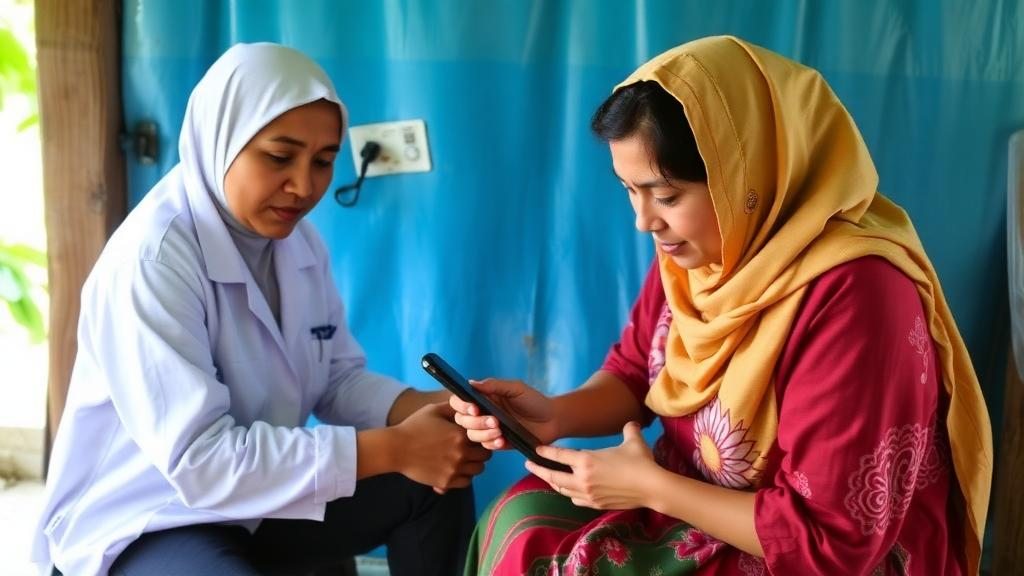
Indonesia is the largest archipelagic nation on Earth, a country of more than 17,000 islands where a village midwife in Maluku may be separated from the nearest hospital by hours of sea travel, and where a community health post in remote Sulawesi can struggle to maintain even a stable mobile signal. In settings like these, digital health technologies have long been promoted as a fix: mobile applications to support maternal care, telemedicine to reach isolated patients, and digital reporting systems to replace mountains of paper. But does deploying an app actually make a health system more resilient? A new scoping review published in Discover Social Science and Health offers one of the most systematic answers yet, and its conclusion is both encouraging and sobering.
The research team, led by Riswandy Wasir of Universitas Pembangunan Nasional Veteran Jakarta, set out to map the evidence on digital health interventions in rural and remote Indonesia and to interpret it through a health system resilience lens. Resilience, in this context, means more than simply keeping clinics open. It refers to the capacity of a health system to prepare for, respond to, and recover from shocks, whether pandemics, climate disasters, or chronic resource shortages, while adapting and learning in ways that reduce structural vulnerability over time. The distinction matters because a tool that helps a health worker keep working during a crisis is not necessarily one that transforms the system for the better in the long run.
To build their evidence base, the researchers searched PubMed, Scopus, and Web of Science for empirical studies published between January 2010 and March 2026, following the Arksey and O’Malley scoping review framework and reporting according to the PRISMA-ScR checklist. The initial search returned 9,842 records. After removing 2,134 duplicates and screening titles and abstracts, the team assessed 250 full-text reports and ultimately included 23 studies. Notably, no eligible study published before 2019 survived the screening process, and the vast majority appeared after 2020, reflecting the surge in digital health adoption driven by the COVID-19 pandemic. The protocol was registered in advance on the Open Science Framework, and two reviewers independently screened and extracted data to reduce bias.
The 23 studies spanned Java, Sumatra, Sulawesi, and eastern provinces such as Maluku, covering settings from village health posts known as Posyandu to primary care centres called Puskesmas and entire district health systems. The interventions fell into recognisable categories. The most common were mHealth applications used by community cadres, community health workers, and village midwives for screening, counselling, referral, follow-up, and maternal and child health monitoring. Digital reporting and health information systems came next, aimed at improving data capture, surveillance, and local monitoring. Telemedicine, teleconsultation, and patient-facing tools, including WhatsApp-based reminders for adolescent nutrition programmes and chatbot-enabled surveillance, appeared in a smaller subset of studies. Only a handful examined system-level innovations such as governance mechanisms or regulatory sandboxes.
When the team mapped these findings against five resilience dimensions, service continuity, reach and equity, information flow, frontline adaptation, and system integration, a clear pattern emerged. Digital health interventions in rural and remote Indonesia performed best on the first four. Mobile tools helped sustain follow-up, counselling, and monitoring when face-to-face access was disrupted, including during the pandemic. Digital reporting systems improved the timeliness of information flowing from villages to districts, supporting local decision-making. And frontline workers reported greater adaptive capacity, using digital platforms to adjust workflows and coordinate care under difficult conditions. In short, digital health functioned as an enabler of what the authors call operational resilience.
Transformative resilience, by contrast, remained largely out of reach. Evidence that digital interventions had achieved institutionalisation, interoperability, sustainable financing, governance alignment, or system-wide learning was thin, drawn mainly from a small number of implementation, governance, and economic evaluation studies rather than long-term system-wide assessments. The review highlights the well-documented problem of pilotitis, in which promising innovations remain trapped in small-scale experimentation because regulatory pathways, financing mechanisms, and integration plans are underdeveloped. Many of the included studies reported feasibility findings or programme-specific improvements, but few provided evidence on sustainability, routine embedding, or scale-up beyond the life of a project.
The barriers the review identified are as instructive as the successes. Poor internet access and unstable signals repeatedly undermined the routine use of mobile applications and digital reporting, particularly in geographically isolated areas, directly affecting the timeliness of reporting and continuity of data entry. Digital literacy among health workers and cadres was uneven, and multiple unintegrated platforms created duplicate reporting that added to, rather than reduced, administrative burden. Governance and financing challenges, including limited regulatory clarity and weak alignment between innovation initiatives and routine health system structures, constrained scale-up. Sociocultural factors such as trust, gender norms, and community acceptability also shaped uptake, reminding readers that technology adoption is never purely technical.
Yet the review also found consistent facilitators. Implementation succeeded most often when local actors, cadres, midwives, and community health workers, were actively engaged, bridging the gap between digital tools and end users. Tools that were simple, useful, and compatible with frontline capacities were used more consistently, especially when paired with formal training, mentoring, and peer support. Contextual adaptation mattered enormously: interventions were more likely to endure when they were tailored to local workflows, service demands, and connectivity constraints rather than rolled out as standardised solutions. Supportive policy environments and alignment with existing health priorities further legitimised digital initiatives within routine service structures.
These findings carry significant implications for Indonesia’s ambitious digital health transformation agenda, which includes national blueprints for interoperability and data integration. The review’s central message is that expanding coverage of apps and platforms is not the same as strengthening resilience. Priority should instead go to interoperable system architecture, institutional alignment, workforce development, sustainable financing beyond project cycles, and differentiated support for local implementation capacity across diverse subnational settings. The authors frame digital health not as an automatic source of resilience but as a conditional enabler whose value depends on governance, institutional embedding, and system capability. The review has limitations worth noting: the included studies were heterogeneous, much of the evidence came from short-term pilots, and the English-language database search may have missed locally published Bahasa Indonesia studies and grey literature. Still, as a map of where digital health stands in one of the world’s most challenging geographies, the review delivers a clear verdict. Technology can help rural health systems bend without breaking, but turning that flexibility into lasting transformation will require the unglamorous work of governance, integration, and sustained investment.
Subject of Research: Digital health interventions and health system resilience in rural and remote Indonesia
Article Title: Digital health interventions in rural and remote Indonesia: a scoping review through a health system resilience lens
Article References: Wasir, R., Thalib, W., Sulistiadi, W., Aulia Rahma, F., Desmawati, D., & Ariyanto, J. (2026). Digital health interventions in rural and remote Indonesia: a scoping review through a health system resilience lens. Discover Social Science and Health, 6(1), Article 103. https://doi.org/10.1007/s44155-026-00436-0
Image Credits: AI Generated
DOI: 10.1007/s44155-026-00436-0
Keywords: digital health, health system resilience, rural health, Indonesia, mHealth, telemedicine, scoping review, health information systems, community health workers, interoperability, COVID-19, health policy
Cite Scienmag News
Courtney Benton. (October 4, 2026). Digital Health in Rural Indonesia Keeps Services Running but Falls Short of Real System Change. Scienmag. https://scienmag.com/digital-health-in-rural-indonesia-keeps-services-running-but-falls-short-of-real-system-change/
Courtney Benton. "Digital Health in Rural Indonesia Keeps Services Running but Falls Short of Real System Change." Scienmag, 4 October 2026, https://scienmag.com/digital-health-in-rural-indonesia-keeps-services-running-but-falls-short-of-real-system-change/. Accessed 4 October 2026.
Courtney Benton. "Digital Health in Rural Indonesia Keeps Services Running but Falls Short of Real System Change." Scienmag. October 4, 2026. https://scienmag.com/digital-health-in-rural-indonesia-keeps-services-running-but-falls-short-of-real-system-change/


