


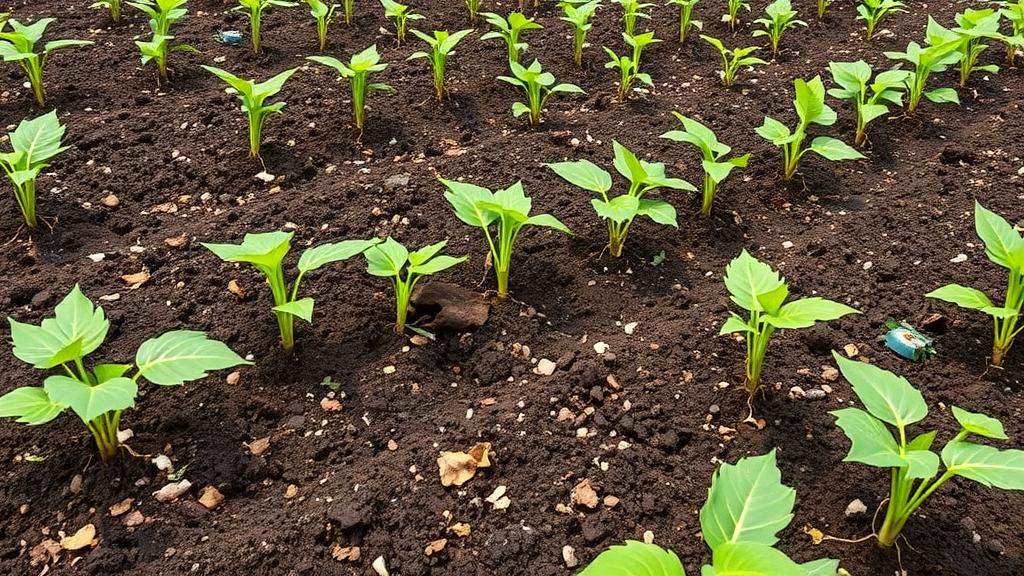
Phosphorus is one of agriculture’s most stubborn nutrients. Farmers spread it on fields as fertilizer, yet in many tropical soils the majority of it never reaches a crop. Instead, it is seized by clay minerals and calcium compounds and locked into forms that plant roots cannot touch. For the vast black cotton soils of Central India, known to soil scientists as Vertisols, this fixation problem is particularly severe. Now a long-term field experiment at the ICAR-Indian Institute of Soil Science in Bhopal has shown that the way farmers manage nutrients over many years can fundamentally change how these soils hold, release, and recycle phosphorus, with organic and conservation agriculture systems emerging as clear winners for phosphorus efficiency.
The study, published in the journal Discover Soil, examined surface soils from an ongoing long-term experiment established in 2015 under a soybean-wheat cropping system. The researchers compared five nutrient management treatments: an unfertilized control, soil test crop response-based fertilizer application (STCR), integrated nutrient management combining 75 percent recommended fertilizer with 25 percent farmyard manure, fully organic nutrient management, and conservation agriculture with recommended NPK plus 90 percent crop residue retention. The experimental soil was a classic Vertisol, a fine clayey, montmorillonitic Typic Haplustert containing 52 percent clay, slightly alkaline at pH 7.8, and initially very low in available phosphorus at just 5.74 kilograms per hectare by Olsen’s method.
What makes Vertisols so difficult for phosphorus management is their mineralogy and chemistry. These soils are dominated by smectitic clays that swell and shrink with moisture, and they carry appreciable calcium carbonate along with abundant exchangeable calcium. In alkaline, calcareous conditions, phosphate ions are adsorbed onto clay surfaces and precipitated as relatively insoluble calcium-phosphate minerals. The result is that only a small fraction of applied fertilizer phosphorus remains available for crop uptake during the growing season, making phosphorus deficiency a major constraint on productivity across tropical and subtropical agriculture.
To quantify how a decade of different management had altered this behavior, the team equilibrated soil samples with a series of potassium dihydrogen phosphate solutions ranging from 0 to 100 milligrams of phosphorus per kilogram, prepared in 0.01 molar calcium chloride at a 1:10 soil-to-solution ratio. After six days of equilibration, the amount of phosphorus retained by each soil was fitted to the Langmuir adsorption isotherm, a model that yields two key parameters: the sorption maximum, which describes how much phosphorus the soil can hold, and the bonding energy constant, which describes how tightly that phosphorus is gripped. The model performed superbly, with coefficients of determination of 0.99 across all treatments, confirming its suitability for characterizing phosphorus retention in these soils.
The differences between treatments were striking. The phosphorus adsorption maximum ranged from 394 to 527 micrograms per gram. The highest values appeared under the STCR treatment and the control, both at 527 micrograms per gram, with conservation agriculture close behind at 526. The lowest value by far was recorded under fully organic management at 394 micrograms per gram, followed by integrated nutrient management at 457. The bonding energy constant told an even sharper story, falling from 0.55 milliliters per microgram under STCR to just 0.10 under organic management. In other words, the organic soil not only held less phosphorus overall but held what remained far more loosely, leaving a larger share free to move into soil solution where roots can access it.
Derived quantities reinforced the pattern. The maximum phosphorus buffering capacity, which measures a soil’s ability to resist changes in solution phosphorus concentration, ranged from 278.13 liters per kilogram under STCR down to 40.57 under organic management. The standard phosphorus requirement, defined as the amount of phosphorus that must be sorbed to maintain a solution concentration of 0.2 milligrams per liter, the threshold generally considered adequate for most crops, followed the same trend: 57.39 milligrams per kilogram under STCR against only 7.33 under organic management. Practically, this means the organic soil needed roughly one-eighth as much phosphorus input to keep solution levels adequate, a dramatic improvement in potential fertilizer-use efficiency.
Sequential fractionation, following the classic Chang and Jackson scheme, revealed where the phosphorus actually resided. Calcium-bound phosphorus dominated every treatment, reflecting the inherent calcareous nature of Vertisols, but its share varied enormously. Under the control it accounted for 92.3 percent of the total phosphorus pool, whereas under organic farming it dropped to about 70.7 percent. Meanwhile, aluminum-bound phosphorus rose from roughly 3 to 4 percent under control and STCR to about 14.2 percent under organic management, and iron-bound phosphorus climbed from 2 to 4 percent to between 8.5 and 10 percent under organic and conservation systems. The combined pool of relatively labile fractions, including soluble, aluminum-bound, iron-bound, and available phosphorus, increased from about 7.7 percent in the control to 29.3 percent under organic farming, nearly a fourfold shift toward plant-accessible forms.
The mechanism behind this transformation lies in soil organic matter chemistry. As farmyard manure and crop residues decompose, they release low-molecular-weight organic acids and dissolved organic carbon that compete with phosphate ions for adsorption sites on clay and mineral surfaces. These compounds also chelate calcium and iron ions in solution, reducing the precipitation reactions that convert soluble phosphorus into insoluble calcium phosphates. Organic inputs simultaneously stimulate microbial communities and phosphatase enzymes that mineralize organic phosphorus into plant-available inorganic forms. The chemical data mirrored these processes: organic carbon reached 1.21 percent under organic management and 1.15 percent under conservation agriculture, compared with 0.64 percent in the control, while available phosphorus under organic treatment soared to 80.0 kilograms per hectare against 9.53 in the control. Soil pH also dipped slightly under organic and integrated management, from 8.09 in the control to around 7.87, consistent with organic acid release during decomposition.
The implications extend well beyond a single research farm. Because phosphorus is a finite, mined resource with rising costs and significant environmental risks when it accumulates excessively and runs off into waterways, any management system that reduces fixation losses carries both economic and ecological weight. The authors suggest that standard phosphorus requirement measurements could be used to tailor fertilizer recommendations to a soil’s actual buffering characteristics, avoiding over-application in lightly buffering soils and under-application in strongly fixing ones. Integrated nutrient management and conservation agriculture, by building organic carbon and moderating phosphorus retention, offer sustainable pathways for the Vertisol-based cereal and pulse systems that feed much of Central India.
The researchers caution that their findings come from a single long-term experiment at one Vertisol location, and that validation across diverse Vertisol regions, cropping systems, and climates would strengthen the conclusions. Even so, the message is compelling: a decade of patient organic inputs and residue retention measurably rewired the phosphorus chemistry of some of the world’s most phosphorus-hungry soils, converting locked-up reserves into forms that crops can actually use. For farmers wrestling with the twin burdens of fertilizer cost and declining soil fertility, the black soils of Bhopal suggest that the cheapest phosphorus may be the kind already in the ground, waiting to be released.
Subject of Research: Long-term effects of nutrient management on phosphorus sorption and fractionation in calcareous Vertisols
Article Title: Long-term nutrient management influences phosphorus sorption, buffering capacity, and fractionation in Vertisols of Central India
Article References: Davel, P., Gurav, P. P., Vinaykumar, L. N., Meena, B. P., Biswas, A. K., Shirale, A. O., Jain, R. C., Srivastava, S., Vishwakarma, A. K., Das, H., Shinogi, K. C., Yadav, D. K., & Shibin, M. (2026). Long-term nutrient management influences phosphorus sorption, buffering capacity, and fractionation in Vertisols of Central India. Discover Soil, 3(1), Article 174. https://doi.org/10.1007/s44378-026-00325-7
Image Credits: AI Generated
DOI: 10.1007/s44378-026-00325-7
Keywords: phosphorus sorption, Vertisols, Langmuir isotherm, phosphorus fractionation, organic farming, conservation agriculture, integrated nutrient management, soil fertility, buffering capacity, Central India, soil organic carbon, nutrient use efficiency
Cite Scienmag News
Alan Morgan. (October 4, 2026). Organic farming unlocks trapped phosphorus in India’s black cotton soils. Scienmag. https://scienmag.com/organic-farming-unlocks-trapped-phosphorus-in-indias-black-cotton-soils/
Alan Morgan. "Organic farming unlocks trapped phosphorus in India’s black cotton soils." Scienmag, 4 October 2026, https://scienmag.com/organic-farming-unlocks-trapped-phosphorus-in-indias-black-cotton-soils/. Accessed 4 October 2026.
Alan Morgan. "Organic farming unlocks trapped phosphorus in India’s black cotton soils." Scienmag. October 4, 2026. https://scienmag.com/organic-farming-unlocks-trapped-phosphorus-in-indias-black-cotton-soils/


