


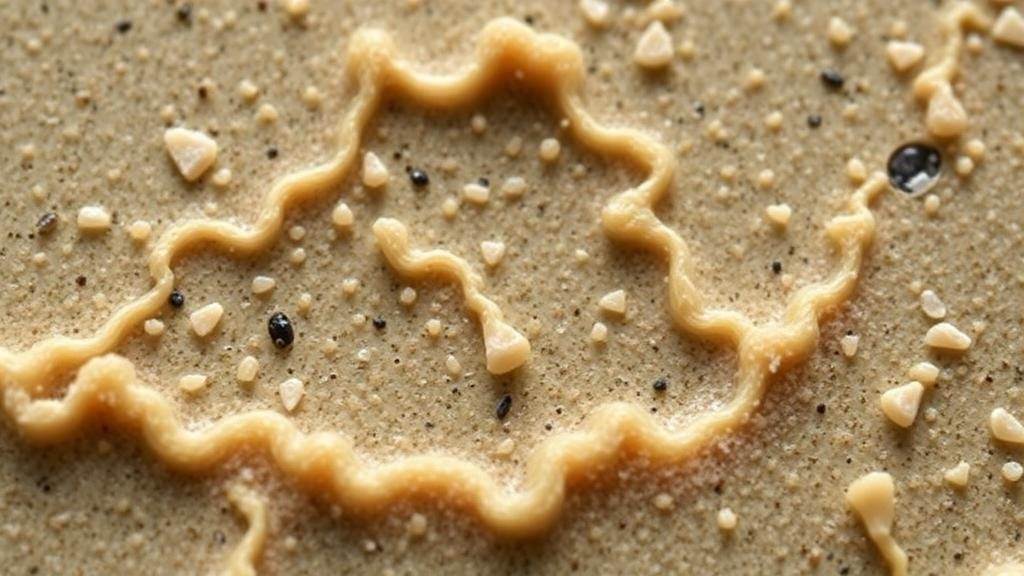
Along the northern edge of the Bay of Bengal, where the mighty Ganges-Brahmaputra-Meghna river system dumps more than a billion tons of sediment into the sea each year, the seafloor tells a story written in grains of sand and the shells of microscopic organisms. A new study of Bangladesh’s coastline has shown that the type of sediment on the seabed exerts a powerful, measurable, and geographically consistent control on the diversity of benthic foraminifera, the single-celled organisms whose calcareous and agglutinated tests accumulate in marine sediments and have served as environmental archives since the 1960s. The findings, published in Discover Geoscience, offer a new baseline for monitoring one of the world’s most dynamic and densely populated coastal zones.
The research team, led by scientists at the Department of Geology of the University of Dhaka, collected 34 sediment samples along a land-sea transect spanning three environmentally contrasting areas: Cox’s Bazar on the eastern coast, Kuakata in the central deltaic zone, and the Sundarbans mangrove forest in the west. Sampling took place during winter, within the intertidal zone at elevations of roughly 0.5 to 4 meters above mean sea level, with cores extracted to a depth of 30 centimeters using a hand auger at low tide. Each sample was dried at 60 degrees Celsius for 24 hours, and 100-gram aliquots were sieved through meshes ranging from 63 to 1000 micrometers at one-phi intervals, following the Wentworth grain-size scale. Mean grain size and sorting were calculated using the Folk and Ward method.
The three study areas could hardly be more different. Cox’s Bazar, home to one of the longest natural beaches on Earth at 145 kilometers, is dominated by fine and medium sand, with fine sand reaching up to 75.1 percent of a sample and averaging 48.2 percent, while mud fractions are scarce. Kuakata displays a mixed picture: sediments at the Tin Nodir Mohona river mouth average 62.4 percent coarse sand, whereas the nearby Jhau Bon and Lebu Bon sites are rich in fine and very fine sand. The Sundarbans, the world’s largest mangrove forest covering roughly 6017 square kilometers, is a low-energy setting where fine and very fine sand dominate, averaging 59.5 and 27.2 percent respectively. These textural contrasts reflect fundamentally different hydrodynamic regimes, from wave-dominated open coast to tide-swept estuary to sheltered, freshwater-influenced mangrove plain.
When the researchers examined the foraminifera preserved in these sediments, the diversity patterns mapped almost perfectly onto the sediment map. Cox’s Bazar yielded 36 species across 26 genera, the highest diversity of the three areas, with Fisher’s alpha index ranging from 9.95 to 17.06 and Shannon values between 2.71 and 3.23. Kuakata produced 32 species from 20 genera with intermediate indices, while the Sundarbans assemblage contained only 19 species from 14 genera, the lowest diversity, with Fisher’s alpha falling as low as 4.89. The single most diverse site was Inani beach in Cox’s Bazar, and the least diverse was Kotka in the Sundarbans, a contrast that the authors link directly to substrate texture and the ecological conditions it implies.
The composition of the assemblages was equally revealing. The genera Ammonia and Elphidium dominated throughout the entire coastline, demonstrating their remarkable ecological tolerance, but each region carried a distinctive signature of companion taxa. Cox’s Bazar was characterized by Rotalinoides, Ammonia, Elphidium, and Asterorotalia, with mean relative abundances of 17.9, 17.4, 12.8, and 9.3 percent respectively. Kuakata was overwhelmingly dominated by Elphidium and Cribroelphidium at 33.8 and 20.7 percent, alongside several Ammonia species. In the Sundarbans, Ammonia reached individual-sample abundances of up to 55.6 percent, accompanied by Rosalina, Haplophragmoides, Entzia, Haynesina, and Trochammina, a suite of stress-tolerant and salt-marsh agglutinated forms typical of fine-grained, organically enriched, freshwater-influenced environments.
To test whether these patterns were statistically robust rather than coincidental, the team deployed a battery of complementary analyses. Spearman’s rank correlation across the combined 34-sample dataset showed that 18 of the 30 analyzed genera had at least one statistically significant association with a sediment fraction. Medium sand emerged as the fraction with the strongest biological signal: twelve genera, including Amphistegina, Spiroloculina, Cibicides, Rotalinoides, Neorotalia, and Operculina, showed significant positive correlations with it, while Ammonia, Elphidium, Rosalina, and Haplophragmoides were significantly and negatively correlated, reflecting their preference for finer substrates. The genus Gyroidella stood out as the only taxon significantly and positively correlated with coarse sand while being negatively correlated with both fine and very fine sand, marking it as a specialist of high-energy, coarse-grained settings.
Canonical correspondence analysis reinforced these findings in striking visual terms. The first two ordination axes together accounted for 90.9 percent of the constrained species-environment variance, with Cox’s Bazar samples aligning strongly with medium sands and Sundarbans samples clustering consistently with finer grains. Species vectors in the biplot closely tracked the sediment gradients, and the analysis independently reproduced the genus-substrate affinities identified by the correlation analysis. Finally, a two-way PERMANOVA based on Bray-Curtis dissimilarity and 9999 permutations confirmed that both location and sediment category significantly structured the assemblages, with p-values of 0.0001 and 0.0031 respectively. Crucially, the interaction term was not significant, meaning that sediment grain size exerts the same directional effect on community composition regardless of which of the three coastal environments is considered.
Why should grain size matter so much to organisms barely visible to the naked eye? The authors point to an indirect but well-supported mechanism: fine-grained sediments have greater surface area and adsorption capacity and are typically associated with higher organic matter concentrations, which in turn can deplete oxygen in the uppermost sediment layer. Although organic matter and dissolved oxygen were not directly measured in this study, a limitation the authors openly acknowledge, the dominance of opportunistic and stress-tolerant taxa such as Ammonia, Elphidium, and agglutinated forms in the Sundarbans is consistent with assemblages known from organically enriched coastal settings worldwide. The reduced diversity there likely reflects these stressed conditions, where a few tolerant species outcompete the rest.
The assemblages also encode hydrodynamic history. At Inani beach in Cox’s Bazar, the researchers found transported planktonic foraminifera, including Globigerina bulloides and Hantkenina alabamensis, species that live in the open water column and could only arrive on the beach through active wave and tidal transport. Their presence signals a well-connected, open-marine setting characteristic of the inner to middle neritic zone, rather than evidence of local productivity. In Kuakata, the combination of Elphidium, Cribroelphidium, Ammonia, and various miliolids, together with the complete absence of planktonic species, points to estuarine to very inner neritic conditions. In the Sundarbans, salt-marsh agglutinated foraminifera such as Trochammina inflata, Miliammina, Haplophragmoides, and Entzia were confined to areas under strong freshwater influence, echoing ecological patterns reported from karstic coasts of the Adriatic.
Beyond its scientific interest, the study carries practical weight for a coastline facing mounting natural and anthropogenic pressures, from sea-level rise to pollution and sediment starvation. By establishing sediment texture as a tractable, measurable, and directly comparable control on foraminiferal diversity, the work provides a framework for using these microfossils as bioindicators in environmental assessment. The authors recommend that future investigations incorporate direct measurements of organic matter, dissolved oxygen, salinity, and sediment mineralogy to refine the picture. For now, the message from the northern Bay of Bengal is clear: the grains on the seafloor, and the energy that arranges them, set the rules by which life at the smallest scale thrives or struggles, and reading those grains through the lens of foraminifera offers a powerful window into the health of coastal ecosystems under change.
Subject of Research: Relationship between sediment grain size and benthic foraminiferal diversity across contrasting coastal environments of Bangladesh
Article Title: Spatial patterns of benthic foraminiferal diversity in relation to sediment type across contrasting coastal environments of Bangladesh
Article References: Al Kabir, M. S., Saha, S. K., Tushar, M. A. N., & Maria, R. S. (2026). Spatial patterns of benthic foraminiferal diversity in relation to sediment type across contrasting coastal environments of Bangladesh. Discover Geoscience, 4(1), Article 344. https://doi.org/10.1007/s44288-026-00712-1
Image Credits: AI Generated
DOI: 10.1007/s44288-026-00712-1
Keywords: benthic foraminifera, sediment grain size, Bay of Bengal, Bangladesh coast, Sundarbans, Cox's Bazar, Kuakata, PERMANOVA, canonical correspondence analysis, coastal biomonitoring, microfossils, Ganges-Brahmaputra-Meghna delta
Cite Scienmag News
Violet Maxwell. (October 4, 2026). Tiny Seafloor Fossils Reveal How Sediment Shapes Life on Bangladesh’s Coasts. Scienmag. https://scienmag.com/tiny-seafloor-fossils-reveal-how-sediment-shapes-life-on-bangladeshs-coasts/
Violet Maxwell. "Tiny Seafloor Fossils Reveal How Sediment Shapes Life on Bangladesh’s Coasts." Scienmag, 4 October 2026, https://scienmag.com/tiny-seafloor-fossils-reveal-how-sediment-shapes-life-on-bangladeshs-coasts/. Accessed 4 October 2026.
Violet Maxwell. "Tiny Seafloor Fossils Reveal How Sediment Shapes Life on Bangladesh’s Coasts." Scienmag. October 4, 2026. https://scienmag.com/tiny-seafloor-fossils-reveal-how-sediment-shapes-life-on-bangladeshs-coasts/


