


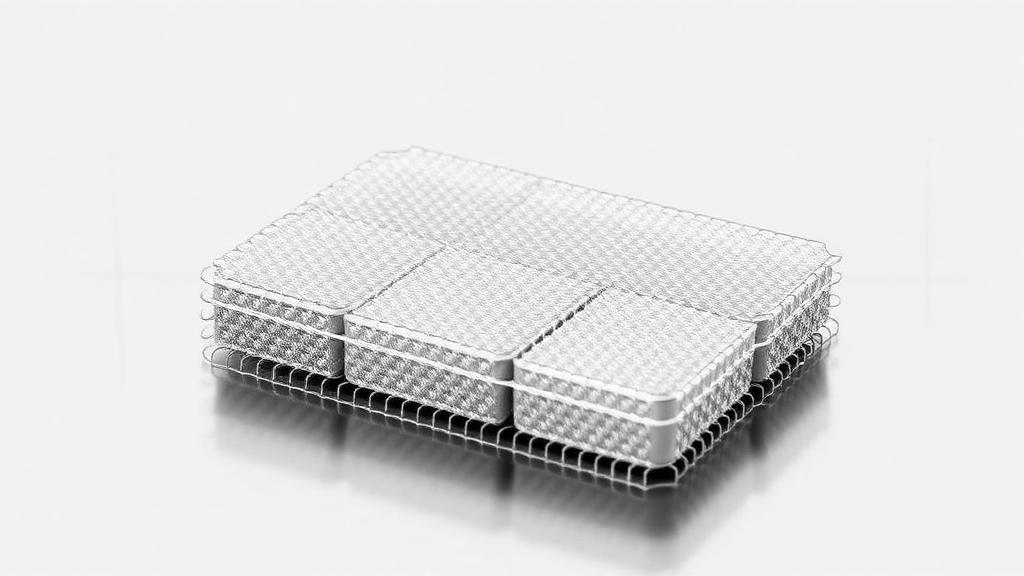
Silicon has long been the tantalizing prize of lithium-ion battery research. Theoretically, it can hold roughly ten times more lithium than the graphite that dominates today’s anodes, promising batteries that last dramatically longer on a single charge. Yet silicon has a fatal flaw that has kept it out of most commercial cells: when lithium floods into the material during charging, it swells by hundreds of percent, cracking particles, fracturing electrodes, and destroying the delicate interfaces that make a battery work. A team of researchers in Qinghai, China, now reports a practical route around this problem, combining a metal-processing technique borrowed from metallurgy with a carefully tuned dose of ordinary graphite.
The study, published in the journal Ionics by Zhanshou Yang, Fa-Feng Xu, and colleagues at the Qinghai Institute of Salt Lakes of the Chinese Academy of Sciences, centers on a process called dealloying. In dealloying, one element is selectively dissolved out of an alloy, leaving behind a sponge-like scaffold of the remaining element riddled with pores at the nanometer scale. The technique has a pedigree in materials science, having been used to create nanoporous gold and other architectures, and it has increasingly attracted attention as a scalable way to fabricate porous electrode materials for rechargeable batteries. Applied to silicon-bearing alloys, it produces porous silicon structures whose internal voids act as built-in expansion chambers.
That architectural trick addresses the core failure mode of silicon anodes. In a dense silicon particle, the volume change that accompanies lithiation generates enormous mechanical stress. Particles pulverize, fresh surfaces are repeatedly exposed to the electrolyte, and a thick, unstable solid electrolyte interphase layer grows and rebuilds with every cycle, consuming lithium and raising the cell’s internal resistance. A porous particle, by contrast, can expand into its own empty space. The pores absorb much of the strain, the particle’s outer dimensions stay comparatively stable, and the electrode’s conductive network and binder matrix survive far longer.
Porosity alone, however, does not solve every problem. Silicon is a semiconductor with modest intrinsic conductivity, and the tortuous pathways through a porous structure can slow both electrons and lithium ions. The Qinghai team therefore wrapped the porous silicon in a carbon coating, producing a composite they designate Si@C. The carbon shell serves a dual role: it provides an electron-conducting highway that connects the silicon to the current collector, and it acts as a mechanical and chemical skin that stabilizes the electrode structure and limits parasitic reactions with the electrolyte. Carbon coatings of this kind have become a standard strategy in silicon anode research, but their effectiveness depends heavily on the quality of the underlying silicon architecture and on how the composite is formulated.
The second half of the team’s strategy is arguably the more pragmatic one: blending the carbon-coated porous silicon with graphite. Graphite remains the workhorse anode of the lithium-ion industry, prized for its low cost, flat voltage profile, and remarkable structural stability over thousands of cycles. By mixing silicon with graphite, researchers can trade some of silicon’s enormous capacity for graphite’s reliability, while the graphite matrix helps buffer swelling and maintains electronic contact throughout the electrode. The ratio matters enormously. Too little silicon and the energy-density gain is marginal; too much and the electrode’s mechanical integrity collapses within a few hundred cycles.
Yang and colleagues systematically optimized this ratio, testing different proportions of porous silicon to graphite before settling on a mass ratio of 1:2. At that composition, the composite delivered the best combination of capacity, stability, and rate performance in their experiments. The finding underscores a broader lesson in battery engineering: the performance of a composite electrode is not simply the weighted average of its components, but emerges from how those components interact mechanically and electrochemically during cycling. The graphite appears to function not merely as a diluent but as an active structural partner for the swelling silicon.
The electrochemical results reported in the paper are striking. After 500 charge-discharge cycles, the optimized Si@C anode retained a reversible capacity of 688.5 milliampere-hours per gram, corresponding to a capacity retention of 63.6 percent. For context, conventional graphite anodes typically deliver around 350 to 370 milliampere-hours per gram, so even after substantial degradation the composite still stores nearly twice as much charge per unit mass. Equally important is the coulombic efficiency, which the team reports at 99.9 percent. This figure measures how many lithium ions that enter the anode during charging come back out during discharge, and values approaching 100 percent indicate that parasitic side reactions, which slowly poison a cell, have been largely suppressed.
The authors state that these results surpass previously reported data for comparable silicon-based anodes in both cycling stability and rate performance, the latter describing the electrode’s ability to deliver capacity at high charging speeds. Rate capability is often the quiet casualty of silicon anode designs, because the same structural features that buffer swelling can impede ion transport. The combination of porous silicon, a conductive carbon coating, and a graphite matrix appears to keep those transport pathways open even as the electrode ages, allowing the material to sustain fast charging without catastrophic capacity loss.
The work also carries a regional and industrial dimension. The Qinghai Institute of Salt Lakes specializes in the chemistry and utilization of China’s salt lake resources, and the study was supported by provincial programs including the Kunlun Talents-Top Talents project and an applied basic research grant from Qinghai Province. Silicon anode research worldwide is driven by the same calculus: electric vehicles demand longer driving ranges, and grid storage demands cheaper, denser cells. Every incremental improvement in silicon anode longevity translates into smaller, lighter, or longer-lived batteries, which is why the field has produced a torrent of strategies, from nanowires and core-shell structures to engineered binders and electrolyte additives, all aimed at taming silicon’s expansion.
What distinguishes the present approach is its relative simplicity. Dealloying is a wet-chemical or electrochemical process that can, in principle, be scaled to produce large quantities of porous material, and blending with graphite requires no exotic equipment. The authors suggest that the synergy between the pore-buffered silicon and the carbon coating, reinforced by the graphite framework, offers a design template for future high-performance silicon-based anodes. Challenges remain before such materials reach commercial cells, including the first-cycle losses that typically accompany silicon’s large surface area and the cost of processing, but the demonstration that a 1:2 silicon-to-graphite blend can survive 500 cycles with near-perfect coulombic efficiency marks a meaningful step. As the demand for energy-dense, long-lasting lithium-ion batteries continues to climb, strategies that combine clever materials architecture with industrial pragmatism are likely to define the next generation of anode chemistry.
Subject of Research: Dealloying-derived porous silicon-carbon composite anodes for high-stability lithium-ion batteries
Article Title: Dealloying-derived porous Si@C anode with optimized graphite integration for high-cycling-stability lithium-ion batteries
Article References: Yang, Z., Xu, F.-F., Niu, Z., Feng, H., Yang, K., & Zeng, J. (2026). Dealloying-derived porous Si@C anode with optimized graphite integration for high-cycling-stability lithium-ion batteries. Ionics. https://doi.org/10.1007/s11581-026-07515-x
Image Credits: AI Generated
DOI: 10.1007/s11581-026-07515-x
Keywords: lithium-ion batteries, silicon anode, dealloying, porous silicon, carbon coating, graphite, cycling stability, coulombic efficiency, energy density, anode materials, electrochemistry, battery technology
Cite Scienmag News
Faith Mcneil. (October 4, 2026). Dealloying Yields Porous Silicon-Carbon Anode That Endures 500 Battery Cycles. Scienmag. https://scienmag.com/dealloying-yields-porous-silicon-carbon-anode-that-endures-500-battery-cycles/
Faith Mcneil. "Dealloying Yields Porous Silicon-Carbon Anode That Endures 500 Battery Cycles." Scienmag, 4 October 2026, https://scienmag.com/dealloying-yields-porous-silicon-carbon-anode-that-endures-500-battery-cycles/. Accessed 4 October 2026.
Faith Mcneil. "Dealloying Yields Porous Silicon-Carbon Anode That Endures 500 Battery Cycles." Scienmag. October 4, 2026. https://scienmag.com/dealloying-yields-porous-silicon-carbon-anode-that-endures-500-battery-cycles/


