

A four-year, multi-institution research effort is set to tackle one of the most underappreciated vulnerabilities of the modern space economy: the risk that a violent burst of solar activity could disrupt the thousands of satellites now circling the Earth in low orbits. Edward Oughton, an Associate Professor of Geography and Geoinformation Science in George Mason University’s College of Science, will receive $499,837 from the U.S. National Science Foundation for a project titled “Collaborative Research: AI-enabled, Uncertainty-Aware Space Weather Risk Characterization and Mitigation for Satellite Operations.” Funding begins in October 2026 and runs through late September 2030, placing the work squarely within the period when operators of Low Earth Orbit and Very Low Earth Orbit constellations are racing to expand services while solar activity remains elevated.
The core problem the project addresses is a translation gap. Space weather forecasters can already issue probabilistic warnings about geomagnetic storms, but satellite operators, insurers, and downstream service providers have limited tools for converting those probabilities into concrete operational and financial consequences. Oughton’s team, working with collaborators at West Virginia University, The Ohio State University, and the Southwest Research Institute, intends to build an end-to-end framework that carries uncertainty from the Sun all the way to society. The goal is a systems-level capability in which a probabilistic forecast of storm occurrence, timing, intensity, and driver type can be propagated through atmospheric physics, orbital mechanics, and economic models to yield quantified estimates of risk and loss.
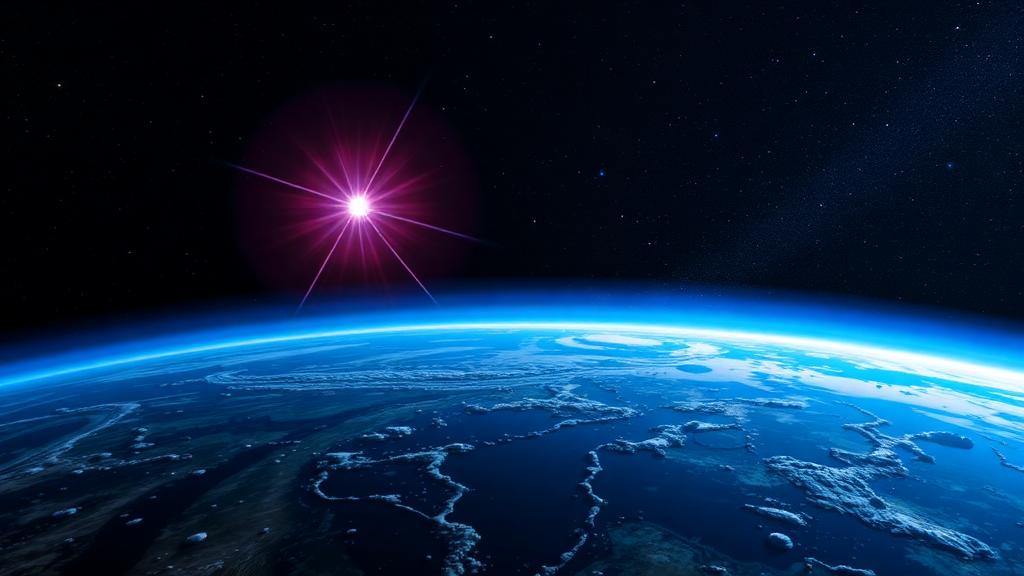
The physics at stake is well understood but notoriously difficult to quantify. When a coronal mass ejection or a high-speed solar wind stream strikes Earth’s magnetosphere, energy is deposited into the upper atmosphere, heating and expanding the thermosphere. Satellites in Low Earth Orbit, roughly 200 to 2,000 kilometers above the surface, suddenly encounter denser air, and atmospheric drag increases sharply. During extreme historical events, such as the February 2022 incident in which dozens of newly launched Starlink satellites were lost to a modest geomagnetic storm, operators have seen orbital decay accelerate far faster than nominal models predicted. For Very Low Earth Orbit systems, which fly even lower to improve latency and imaging resolution, the drag problem is amplified because the neutral atmosphere is the dominant environmental hazard.
Under the project, the West Virginia University team led by Piyush Mehta will generate calibrated forecasts of geomagnetic storm occurrence, timing, intensity, and driver type. The distinction between driver types matters because coronal mass ejections and co-rotating interaction regions produce different storm profiles, with different onset speeds and durations, and therefore different drag signatures. Rather than issuing a single deterministic forecast, the framework will treat storm forcing as a stochastic process, producing bounded estimates of how a satellite’s drag response will evolve. This uncertainty-aware approach acknowledges a fundamental limitation of space weather prediction: even the best models cannot specify exactly how much energy will reach the upper atmosphere or how the thermosphere will respond at a given altitude and latitude.
Those stochastic drag estimates then feed into the operational layer of the framework. Mrinal Kumar’s group at The Ohio State University will contribute artificial intelligence methods for propagating uncertainty into the quantities that operators actually manage: orbital migration, degraded operational modes, conjunction-management burden, and orbit-correction demand. Conjunction management, the process of assessing and avoiding close approaches between space objects, is already a growing workload for constellation operators, and a major storm can inflate both the collision-avoidance burden and the frequency of station-keeping maneuvers simultaneously. By modeling these effects together rather than in isolation, the project aims to capture the compounding stress that a single storm can place on ground teams, propulsion budgets, and satellite lifetimes.
The final link in the chain is socio-economic. Subhamoy Chatterjee at the Southwest Research Institute will work with Oughton to connect operational disruptions to satellite service degradation, embedded sectoral dependencies, economic losses, and operator mitigation decisions. This is where the framework departs most clearly from traditional space weather research. Communication outages, navigation errors, and Earth-observation gaps do not remain in orbit; they cascade into sectors such as aviation, maritime transport, agriculture, finance, and emergency response, all of which now depend on satellite infrastructure. By embedding these dependencies into the model, the researchers intend to produce estimates of economic consequence that decision-makers outside the space sector can act upon, whether they are insurers pricing risk, regulators drafting resilience requirements, or governments planning for critical-infrastructure protection.
The timing of the award is significant. The number of active satellites has grown dramatically over the past decade, driven by commercial broadband constellations and the falling cost of launch, and many of these spacecraft operate in the drag-sensitive regime where space weather matters most. At the same time, the Sun progresses through its natural activity cycle, and the current period of high activity has delivered repeated reminders that even moderate storms can perturb operations. A severe storm on the scale of historical extremes could, by many expert assessments, cause widespread and prolonged disruption. Yet quantitative, uncertainty-aware estimates of what such a storm would do to today’s mega-constellations, and to the economies that rely on them, remain scarce. The project’s framework is designed to fill precisely that gap.
Artificial intelligence plays a central role throughout. Machine learning models can assimilate vast streams of solar wind, magnetospheric, and thermospheric data and learn relationships that are difficult to capture in first-principles physics codes, which are computationally expensive and still imperfect. But AI predictions are only useful for high-stakes operational decisions if their uncertainty is quantified and calibrated, which is why the project emphasizes uncertainty-aware methods rather than black-box forecasting. The researchers aim to produce forecasts whose stated confidence levels can be trusted, so that an operator deciding whether to lower a satellite’s orbit, safe-mode a spacecraft, or postpone a launch can weigh the true probability of adverse outcomes rather than a falsely precise point estimate.
The funding structure reflects the collaborative nature of the research. Each institution receives its own NSF award, with Oughton’s $499,837 supporting the George Mason component of the work. The linked awards to Mehta at West Virginia University, Kumar at The Ohio State University, and Chatterjee at the Southwest Research Institute formalize a partnership that spans space physics, computer science, and risk economics. This interdisciplinary composition is arguably essential: no single field currently owns the full chain from solar eruptive event to societal loss, and the project’s explicit ambition is to stitch those links together into a single, coherent modeling pipeline.
If the project succeeds, its outputs could reshape how the space industry and its regulators think about space weather risk. Instead of qualitative warnings that a storm is coming, operators and policymakers would have a defensible, probabilistic picture of how a forecast storm would propagate through satellite orbits, operational workloads, service availability, and economic losses, along with a structured way to evaluate mitigation options before the storm arrives. As humanity’s dependence on orbital infrastructure deepens, tools that make the invisible hazard of space weather measurable, and its consequences insurable and governable, may prove to be among the most consequential investments in the resilience of the digital age.
Subject of Research: AI-enabled, uncertainty-aware characterization of space weather risks to Low Earth Orbit satellites and their socio-economic impacts
Article Title: Oughton to receive funding for project on space weather satellite risk characterization and socio-economic impacts
Article References: Oughton to receive funding for project on space weather satellite risk characterization and socio-economic impacts. (n.d.). Original publication
Image Credits: AI Generated
DOI: Not provided
Keywords: space weather, geomagnetic storms, satellites, Low Earth Orbit, artificial intelligence, uncertainty quantification, atmospheric drag, National Science Foundation, George Mason University, satellite operations, socio-economic impacts, conjunction management
Cite Scienmag News
Cameron Wolfe. (October 4, 2026). NSF Funds AI-Driven Space Weather Risk Project to Protect Satellite Fleets. Scienmag. https://scienmag.com/nsf-funds-ai-driven-space-weather-risk-project-to-protect-satellite-fleets/
Cameron Wolfe. "NSF Funds AI-Driven Space Weather Risk Project to Protect Satellite Fleets." Scienmag, 4 October 2026, https://scienmag.com/nsf-funds-ai-driven-space-weather-risk-project-to-protect-satellite-fleets/. Accessed 4 October 2026.
Cameron Wolfe. "NSF Funds AI-Driven Space Weather Risk Project to Protect Satellite Fleets." Scienmag. October 4, 2026. https://scienmag.com/nsf-funds-ai-driven-space-weather-risk-project-to-protect-satellite-fleets/


