


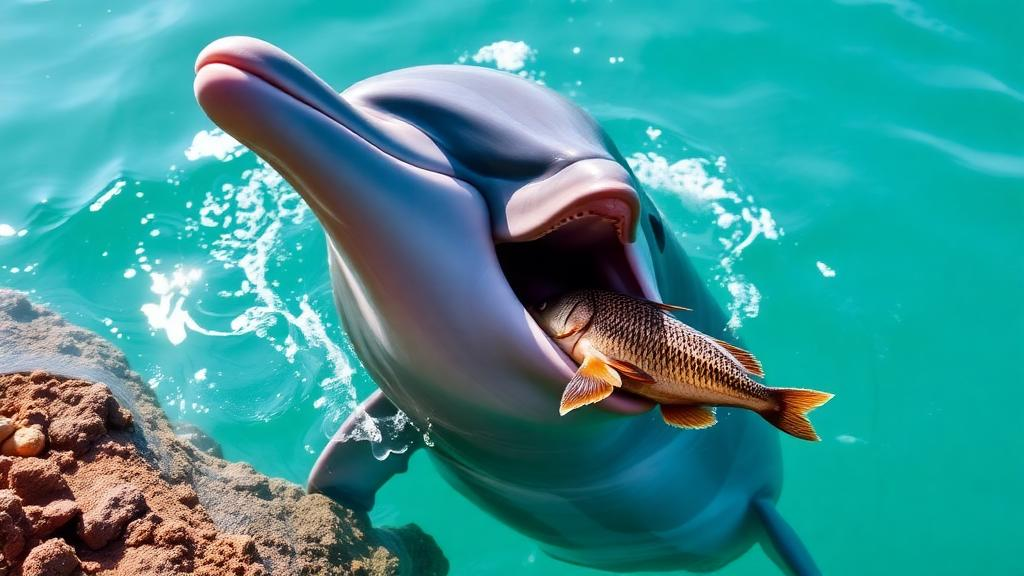
A single common bottlenose dolphin living in the shallow reefs off Lady Elliot Island, at the southern tip of the Great Barrier Reef, has given researchers a rare and remarkable glimpse of a feeding strategy that has never before been described in detail for any cetacean anywhere in the world. The dolphin, nicknamed Bubbles by the scientists who have watched him over successive field seasons, has been documented harassing schools of Bigeye Trevally until individual fish regurgitate the contents of their stomachs, after which he swoops in and consumes the freshly expelled meal. The behaviour, formally described as kleptoparasitism, or food theft from another animal, has been reported in a peer-reviewed study published in the journal Ecology and Evolution by researchers at the University of the Sunshine Coast.
Kleptoparasitism is a well-established phenomenon in ecology. It is familiar to anyone who has watched a frigatebird chase a gull until the gull drops its catch, or a hyena attempt to wrest a carcass from lions. In terrestrial and aerial systems, stealing food that another animal has already captured or collected is a recognised and often successful alternative to hunting directly. Yet despite decades of close observation of dolphins, whales and porpoises, kleptoparasitism has rarely been documented in aquatic species and has been particularly elusive among marine mammals. The new study, authored by Dr Asia Haines and PhD student Romney Edwards-Francis together with colleagues, therefore represents the first detailed description of this strategy in a cetacean, a finding that has surprised even the researchers themselves.
Between 2021 and 2025, the research team observed and videoed Bubbles engaging in his distinctive thieving routine on eleven separate occasions in the shallow reef habitats surrounding Lady Elliot Island. The consistency of the sequence was striking. In every single instance, the dolphin approached a school of Bigeye Trevally, selected one individual fish from the group, and chased it with focused persistence until the stressed fish regurgitated its food. Once the meal had been expelled, Bubbles feasted on the remains while the trevally swam away, presumably considerably relieved but considerably hungrier. The behaviour was recorded repeatedly across several years, ruling out the possibility of a one-off accident and establishing a clear, repeatable pattern.
The technical details of the interaction are what make the observations so compelling from a behavioural ecology perspective. Bigeye Trevally are schooling fish that feed by capturing smaller prey, and like many fishes they possess a stress response that can trigger regurgitation when they are pursued intensively. Bubbles appears to exploit precisely this physiological reaction. Rather than attempting to catch the fast-moving fish themselves, which would demand significant energy expenditure, the dolphin targets the fish’s vulnerability to pursuit-induced stress. The researchers hypothesise that he may even intensify the effect by using intense repeated clicking and low-pitched vocalisations, acoustic signals that could heighten the stress levels of the targeted fish and hasten the regurgitation. If confirmed, this would add an acoustic dimension to a foraging tactic already notable for its sophistication.
Perhaps most intriguing is the suggestion that Bubbles is not simply harassing fish at random, but is making informed choices about which individuals to pursue. Dr Haines noted that the dolphin repeated the behaviour over several years, which suggests he may have learnt to target the fish with the fullest bellies, thereby securing the most rewarding meals for his efforts. This implies a level of assessment and decision-making that goes well beyond opportunistic scavenging. Selecting a well-fed fish from within a school, chasing it until it surrenders its stomach contents, and then consuming the expelled food requires the dolphin to integrate information about prey condition, prey behaviour and the likely payoff of a pursuit, all in real time and underwater.
The energetic logic of the strategy is central to understanding why Bubbles might adopt it. Ms Edwards-Francis explained that the research team believes the dolphin’s thieving tendencies might help him avoid the energy cost of catching his own food, by letting other animals do the hard work for him. Common bottlenose dolphins typically forage in groups, coordinating their movements to herd and capture prey, yet Bubbles was always observed foraging alone. This solitary habit may be the key to the puzzle. It may be, the researchers suggest, that this specialised tactic requires less energy than directly pursuing fast-moving prey, particularly when foraging solo. A dolphin hunting alone cannot rely on the cooperative advantages that group foraging provides, and stealing a meal that a fish has already caught and digested partway may represent a far more efficient return on effort than a high-speed chase after agile, evasive prey.
The natural question that follows is whether Bubbles is simply one rogue individual who has stumbled upon a shortcut to an easy meal, or whether the behaviour is more widespread than anyone has realised. The researchers suspect the latter possibility deserves serious consideration. Ms Edwards-Francis observed that the dolphin’s behaviour demonstrates the species’ adaptability and flexibility when it comes to foraging, and the team further suspects that rare or novel foraging tactics such as kleptoparasitism are likely underreported in dolphins and other cetaceans. The challenge, she noted, is monitoring the animals underwater over longer time periods to capture their full range of behaviours. Combining emerging technologies such as drones with underwater surveys may provide a way to overcome this obstacle, allowing scientists to observe cetacean foraging with a frequency and detail that surface-based observation alone cannot achieve.
The findings form part of the UniSC-led Leaf to Reef project, a long-term ecological monitoring and research programme focused on Lady Elliot Island and its surrounding waters, conducted with support from the Great Barrier Reef Foundation’s Reef Islands Initiative. The project’s sustained presence at the island is precisely what made the repeated observations possible. Documenting eleven instances of a rare behaviour across four years requires patient, systematic fieldwork, and the shallow reef environment at Lady Elliot Island offers conditions in which underwater observation of dolphins and their prey is feasible over extended periods. Long-term monitoring programmes of this kind are increasingly recognised as essential for detecting behaviours that occur infrequently but may reveal important dimensions of a species’ ecological repertoire.
The study, published under the title describing repeated observations suggesting kleptoparasitism by a common bottlenose dolphin on the Great Barrier Reef, was based on an observational research method with animals as its subject, and the authors declared no conflicts of interest. Its implications extend beyond a single charismatic individual. If kleptoparasitism is genuinely underreported among cetaceans, then the behavioural flexibility of dolphins may be greater than current literature suggests, and the selective pressures shaping their foraging strategies may include pathways that scientists have largely overlooked. Bubbles, for now, remains a singular case, but he is a singular case that forces a reconsideration of what bottlenose dolphins are capable of when the conditions reward innovation.
As for dolphins’ enduring reputation as playful, friendly creatures of the sea, does Bubbles’ larcenous habit put it at risk? Dr Haines says no. The perception of dolphins as the good guys of the sea, she explained, has more to do with anthropomorphism, our tendency to assign human characteristics to them, and perhaps with the fact that dolphins appear to be smiling. The reality is that dolphins are predators and actively hunt their prey, whether that prey has been stolen from another species or not. Bubbles’ behaviour may look like theft through a human lens, but in ecological terms it is simply another expression of the predatory versatility that has made bottlenose dolphins one of the most successful and widely studied marine mammals in the world’s oceans.
Subject of Research: Kleptoparasitic foraging behaviour by a common bottlenose dolphin on the Great Barrier Reef
Article Title: Bubbles the food-stealing dolphin finds shortcut to easy meal
Article References: Bubbles the food-stealing dolphin finds shortcut to easy meal. (n.d.). Original publication
Image Credits: AI Generated
DOI: Not provided
Keywords: bottlenose dolphin, kleptoparasitism, Great Barrier Reef, Lady Elliot Island, foraging behaviour, cetaceans, Bigeye Trevally, animal behaviour, marine mammals, University of the Sunshine Coast, Ecology and Evolution, predation
Cite Scienmag News
Gavin Prescott. (October 4, 2026). Dolphin Caught Stealing Regurgitated Fish Meals in Reef First. Scienmag. https://scienmag.com/dolphin-caught-stealing-regurgitated-fish-meals-in-reef-first/
Gavin Prescott. "Dolphin Caught Stealing Regurgitated Fish Meals in Reef First." Scienmag, 4 October 2026, https://scienmag.com/dolphin-caught-stealing-regurgitated-fish-meals-in-reef-first/. Accessed 4 October 2026.
Gavin Prescott. "Dolphin Caught Stealing Regurgitated Fish Meals in Reef First." Scienmag. October 4, 2026. https://scienmag.com/dolphin-caught-stealing-regurgitated-fish-meals-in-reef-first/


