


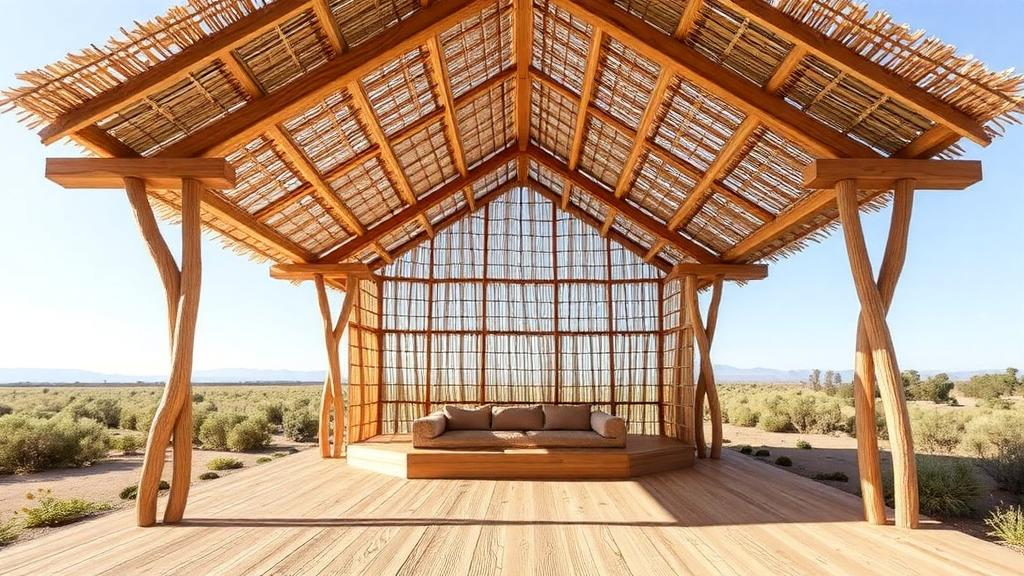
A pavilion built almost entirely from wood and flax fibres is challenging one of architecture’s oldest habits: deciding what a building should look like before asking what its materials can do. Researchers at the University of Stuttgart’s Institutes for Computational Design and Construction (ICD) and Building Structures and Structural Design (ITKE) have unveiled the ITECH Research Pavilion 2024, a full-scale canopy whose shape was not drawn by hand but computed from the mechanical behaviour of its constituent materials. The project, described in the journal Results in Engineering, marks the first time a partially bio-based epoxy resin has been used in a full-scale coreless filament-wound structure, and it demonstrates a design philosophy in which form emerges bottom-up from material properties rather than being imposed from above.
The motivation is environmental as much as architectural. The construction industry remains a major contributor to global resource consumption and carbon emissions, and while mass timber has made impressive inroads into mainstream building, relying on a single bio-based structural material raises concerns about supply chain resilience and ecological pressure on forests. Natural fibre composites offer a strategic diversification. Flax, hemp, jute and similar plants mature in three to six months, compared with the 35 to 70 years that construction-grade timber requires, and their cultivation can be regionalised to reduce transport emissions. Flax composites in particular have a long pedigree, with structural potential recognised since aerospace applications in the mid-twentieth century, and they achieve specific stiffness comparable to glass fibre reinforcement.
Yet a stubborn bottleneck has persisted. Conventional natural fibre polymer composites pair renewable fibres with petroleum-derived epoxy resins, meaning that more than half of the composite by mass remains fossil-based. The Stuttgart team addressed this by benchmarking three commercially available partially bio-based epoxy systems against a petroleum-based control, evaluating bio-content, viscosity, glass transition temperature, pot life and mechanical performance. Robotically wound loop specimens of every fibre-resin combination were compressed on a universal testing machine, a loading mode chosen because it is especially sensitive to impregnation quality and fibre-matrix interaction. Among the fibres, Safilin low-twist flax roving delivered the highest mean maximum force at 4.23 kilonewtons and the highest stiffness, while the Greenpoxy system, with 39 percent bio-content, came closest to the petroleum-based control, differing by only about 5 percent in both maximum force and stiffness.
With the material system settled, the team turned to the central question: how should a structure be shaped when the materials themselves are the design drivers? The researchers distinguish between material dependency and being genuinely materiality-driven. Classical form-finding methods, from Antoni Gaudí’s hanging models to Heinz Isler’s shell experiments and Frei Otto’s soap films, search for equilibrium between form and force, but they typically converge on a single solution. The Stuttgart approach, building on Achim Menges’ concept of material-informed morphospace, instead embeds fabrication constraints, assembly logics and material behaviours directly into a computational framework, allowing a broad solution space to be explored rather than a single optimum to be found.
The computational workflow unfolds in four steps. First, a continuous shell representing the canopy outline and support positions is analysed under distributed loading to extract a field of bending moments. Second, a fibre surface is generated by vertically offsetting the initial mesh in proportion to local moment magnitude, creating structural depth exactly where bending demands it, and principal stress directions are extracted to guide fibre pattern design. Third, timber struts are distributed along the principal stress paths, serving the dual function of resisting compression and acting as winding anchors for the robotically placed fibre bundles. Finally, an iterative optimisation adjusts each strut’s orientation so that its axis aligns with the resultant internal force vector, minimising parasitic bending moments in the same spirit as node-shifting methods and thrust network analysis used for funicular structures.
The optimisation paid measurable dividends. When the fibre network was represented in a detailed beam model, the maximum bending moment in the struts fell by 57 percent and the average bending moment by 37 percent compared with a benchmark of purely vertical struts, with a corresponding progressive increase in global structural stiffness. The algorithm respects practical constraints: strut bases must remain within their timber plate segments, the strut-to-plate angle must stay between 45 and 90 degrees to accommodate winding operations, and minimum clearances between adjacent struts must be maintained. Struts experiencing the highest bending moments are prioritised in each iteration, and the process converges within roughly ten cycles.
Physical prototyping proved just as instructive as computation. A full-scale column prototype, tested to destruction, collapsed prematurely at 610 kilograms when its transition layer, the fibre pattern bridging the plate-column junction, failed completely while the surrounding networks remained intact. The redesign redistributed fibre material over an extended vertical zone, simplified the inner plate truss, converted the outer truss into a closed ring, braced the strut ends and added a supplementary bracing layer. On the plate side, one-tenth-scale prototypes exposed a subtler problem: the diagonal bracing layer imposed concentrated tension during winding, deforming the timber struts and displacing the anchor points. The final layup balanced tension within individual winding layers by extending the bracing patterns to the plate edges and offsetting the winding pins.
The completed pavilion spans 7.5 metres between supports on a three-column layout with non-orthogonal spacing, deliberately departing from rectangular grids to demonstrate adaptability to irregular architectural conditions. Finite element analysis at two levels of resolution, a simplified global model and detailed component models with geometric nonlinearity, predicted maximum internal forces of 6.8 kilonewtons of compression in timber struts and 7.4 kilonewtons of tension in fibre bundles under ultimate limit state loading. A non-destructive load test, in which 300 kilograms of gravel were distributed over the most compliant slab, put the predictions to the test. A total station survey recorded a maximum central deflection of 9.7 millimetres against a predicted 9.2 millimetres, a difference of just 5.4 percent, with perimeter deflections of 1.8 to 2.0 millimetres matching the model almost exactly.
Perhaps the most striking result is comparative. The team quantified what fraction of the fibre composite volume works in tension, the loading regime where fibrous materials excel, across three generations of research pavilions. The compression-dominated dome of the livMatS Pavilion placed only 22.1 percent of its fibre volume in tension. The Hybrid Flax Pavilion’s fish-belly beams raised this to 52.6 percent. The new pavilion’s plate components, with discrete perpendicular struts carrying compression while the fibre network spans beneath, achieve 68.6 to 71.0 percent tensile utilisation, a fundamental morphological reorientation toward the material’s true strength. Because tension-loaded fibre architecture provides greater mechanical stability with less material, this shift directly reduces embodied carbon.
The researchers are candid about the limits of the achievement. Partially bio-based epoxies address regenerability of sourcing rather than the emissions of processing, and current formulations still involve manufacturing steps comparable to petroleum-based systems. Time-dependent creep effects, connection interface behaviour and precise stiffness calibration all warrant further study, particularly since the load test took place a year after construction. Still, the pavilion stands as proof that architectural form can be generated by the materials themselves, that flax and timber can share structural duty at building scale, and that the path to genuinely sustainable composites now runs through both better chemistry and a willingness to let the material speak first.
Subject of Research: Material-driven form-finding and structural evaluation of hybrid timber and natural fibre polymer composite structures
Article Title: Design form-finding and structural evaluation of timber-natural fibre polymer composite hybrid morphologies
Article References: Chen, T.-Y., Guo, Y., Lindstam, O., Chef, Q., & Knippers, J. (2026). Design form-finding and structural evaluation of timber-natural fibre polymer composite hybrid morphologies. Results in Engineering, 32, Article 113229. https://doi.org/10.1016/j.rineng.2026.113229
Image Credits: AI Generated
DOI: 10.1016/j.rineng.2026.113229
Keywords: timber, flax fibre, natural fibre composites, coreless filament winding, form-finding, bio-based epoxy, computational design, finite element analysis, sustainable construction, pavilion, structural optimisation, University of Stuttgart
Cite Scienmag News
Denise Maddox. (October 4, 2026). Flax and Timber Pavilion Shows How Materials Can Design Their Own Structures. Scienmag. https://scienmag.com/flax-and-timber-pavilion-shows-how-materials-can-design-their-own-structures/
Denise Maddox. "Flax and Timber Pavilion Shows How Materials Can Design Their Own Structures." Scienmag, 4 October 2026, https://scienmag.com/flax-and-timber-pavilion-shows-how-materials-can-design-their-own-structures/. Accessed 4 October 2026.
Denise Maddox. "Flax and Timber Pavilion Shows How Materials Can Design Their Own Structures." Scienmag. October 4, 2026. https://scienmag.com/flax-and-timber-pavilion-shows-how-materials-can-design-their-own-structures/


