


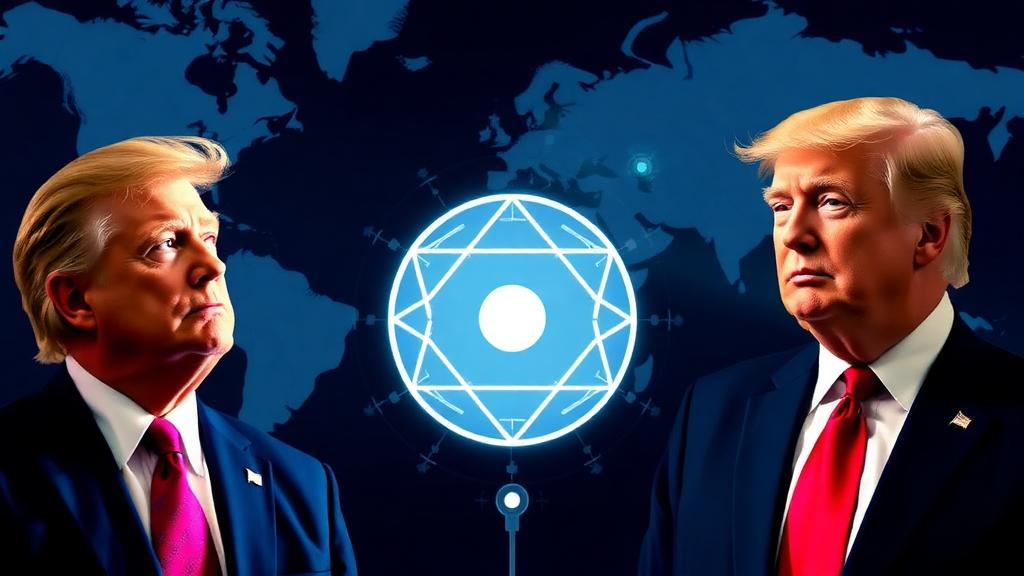
A new study argues that the second Trump administration has done more than withdraw the United States from international cooperation on artificial intelligence. According to Tom Pegram of University College London, writing in the journal Global Public Policy and Governance, Washington’s 2025 turn has triggered what political scientist Michael Zürn calls a reflexive legitimation conflict: a dispute not merely over what AI rules should say, but over who gets to decide what counts as rightful authority in the first place. In AI governance, a field that never consolidated into a proper regime in the first place, that dispute has become the defining battleground of global technology politics.
The conceptual starting point is that legitimacy in global governance has never rested on sovereign command. International institutions hold authority only insofar as their justificatory claims are recognised, contested or denied by audiences around the world. Zürn’s idea of reflexive legitimation conflict describes a situation in which disputes escalate beyond questions of performance or participation to the meta-criteria of legitimacy itself: not only what counts as an effective basis for legitimation, but who decides this and how the answers get institutionalised. Pegram shows that AI governance, fragmented and weakly institutionalised, is unusually exposed to this kind of conflict, because there is no settled regime whose performance can be evaluated. What is contested instead is the evaluative script of global rule itself.
The empirical pivot is the rupture between the Biden and Trump approaches to AI. In 2023, Biden’s Executive Order 14110 on safe and trustworthy AI built explicitly on emerging multilateral precedents, including the OECD AI Principles of 2019, UNESCO’s 2021 Recommendation on the Ethics of AI adopted by 193 member states, and the European Commission’s risk-based AI Act. The order committed the United States to allied engagement in multilateral bodies, international technical standards and global AI safety monitoring, and even adopted the OECD’s definition of AI. Washington subsequently joined the 2023 Bletchley Declaration, signed the Council of Europe Framework Convention on AI in 2024, and sponsored a UN General Assembly resolution calling for safe, secure and trustworthy AI systems for sustainable development.
That trajectory reversed abruptly. On his first day back in office, Trump revoked the Biden order, leaving the United States without federal regulatory guidance. Three days later he issued Executive Order 14179, declaring national policy to sustain and enhance America’s global AI dominance in the name of human flourishing, economic competitiveness and national security. At the Paris AI Action Summit in February 2025, Vice President J.D. Vance warned that excessive regulation could kill a transformative industry, rejected the European model as burdensome, and framed international cooperation chiefly as a defence against authoritarian powers capturing technological infrastructure. The administration declined to sign the summit’s declaration on inclusive and sustainable AI, and in July 2025 withdrew from UNESCO, the body anchoring global AI ethics norms.
Crucially, the study finds, the Trump administration did not abandon international forums altogether. Instead it recast engagement in plurilateral and mercantile terms. America’s AI Action Plan, published in July 2025, promotes plurilateral controls on the AI technology stack while avoiding multilateral treaty bodies, coordinates with allies to extend US export controls against adversaries, and pledges to leverage the US position in standard-setting bodies such as the ITU, OECD, G7 and G20 to counter Chinese influence and ensure AI governance reflects American values. In August 2025, Washington backed a second term for Doreen Bogdan-Martin as ITU Secretary-General, explicitly linking that contest to control over the more than 150 AI standards already set. Trump framed the stakes geopolitically, warning that foreign nations must not make rules and regulations that make it impossible for American firms to do business.
China’s response forms the other half of the analysis, and it is here that the study identifies a striking role reversal. Beijing’s 2017 New Generation Artificial Intelligence Development Plan had already pledged active participation in global AI governance, but Western observers long dismissed Chinese claims as authoritarian and censorial, describing ambitions ranging from the anodyne to the dystopian. Successive initiatives, including a 2022 position paper on ethical AI governance and the Global AI Governance Initiative launched by Xi Jinping at the Third Belt and Road Forum in October 2023, emphasised sovereignty, developing AI for good, greater voice for developing countries and a UN-centred governance body. Yet these claims struggled to gain traction, and China’s inclusion in the Bletchley Declaration was contested so vigorously that UK Prime Minister Rishi Sunak had to defend it publicly.
Trump’s return marked the inflection point. Confronted with tightened chip sanctions in January 2025, Beijing did not retreat into secrecy as many predicted. Instead, firms such as Alibaba and DeepSeek released advanced models as open source, with Premier Li Qiang declaring that China’s innovation is open and open source and that the country was willing to share indigenous technologies. The strategy served a dual purpose: it mitigated the effect of sanctions by globalising Chinese models, and it recast China’s legitimacy claims, transforming a state once portrayed as censorial into a putative provider of AI as a global public good. At the World AI Conference in Shanghai in July 2025, Li called global AI governance fragmented, warned against technological monopoly, and unveiled a Global AI Governance Action Plan proposing two UN-based mechanisms: an International Scientific Panel on AI and a Global Dialogue on AI Governance.
The juxtaposition of the two strategies reveals what Pegram calls rival scripts of legitimation, each mobilising distinct repertoires conditioned by material power and normative legacy. The American script invokes sovereign discretion, market dynamism and technological nationalism, delegitimising liberal norms of ethical oversight and multilateral coordination while instrumentalising international forums for competitive advantage. The Chinese script invokes sovereign equality, developmental inclusion and UN-centred ethics, aligning open-sourcing practices with discursive claims of ethical multilateralism. By August 2025, Western commentators were warning of America’s AI colonialism, while Trump officials confirmed the United States was explicitly rejecting China’s call for global governance, offering instead customised AI packages tied to American technology. Neither script has achieved uncontested recognition, but their antagonism demonstrates that legitimacy itself has become the object of the contest.
The study’s findings carry implications well beyond AI. Legitimation, it concludes, is processual and precarious, continually reconfigured through cycles of challenge and response, in which delegitimation by one actor creates openings for others to reformulate their claims. Repertoires of legitimation remain structurally conditioned: US claims drew credibility from material dominance and corporate alignment, while China’s gained traction precisely because Washington’s rejection of multilateral norms created space for alternative scripts. Crises act as catalytic junctures, and the advent of generative AI, reframed as systemic risk since ChatGPT’s release in November 2022, combined with Trump’s sovereigntist turn, has consolidated competing visions of global order rather than convergence on shared norms.
AI governance, the article suggests, may serve as a bellwether of a post-hegemonic or multiplex world order. What is at stake is not simply the regulation of a transformative technology but the capacity of global governance to sustain any authority at all in a system fractured by sovereignty claims, geopolitical rivalry and competing visions of justice. As the United States and China advance incompatible legitimacy scripts, one grounded in sovereign voluntarism and competitive dynamism, the other in UN-centred cooperation and developmental equity, the study warns that the field exhibits pluralised and antagonistic legitimation that resists consolidation, offering a preview of how authority itself may be contested across the international system in the decade ahead.
Subject of Research: The crisis of legitimacy in global AI governance under competing US and Chinese legitimation strategies
Article Title: Reflexive legitimation conflict: trumpism and the crisis of legitimacy in global AI governance
Article References: Reflexive legitimation conflict: trumpism and the crisis of legitimacy in global AI governance. (n.d.). https://doi.org/10.1007/s43508-025-00123-x
Image Credits: AI Generated
DOI: 10.1007/s43508-025-00123-x
Keywords: AI governance, legitimacy, Trumpism, global governance, China, United States, multilateralism, technological nationalism, UNESCO, open-source AI, sovereignty, post-hegemonic order
Cite Scienmag News
Courtney Benton. (October 4, 2026). How Trumpism Fractured the Rules of Global AI Governance. Scienmag. https://scienmag.com/how-trumpism-fractured-the-rules-of-global-ai-governance/
Courtney Benton. "How Trumpism Fractured the Rules of Global AI Governance." Scienmag, 4 October 2026, https://scienmag.com/how-trumpism-fractured-the-rules-of-global-ai-governance/. Accessed 4 October 2026.
Courtney Benton. "How Trumpism Fractured the Rules of Global AI Governance." Scienmag. October 4, 2026. https://scienmag.com/how-trumpism-fractured-the-rules-of-global-ai-governance/


