


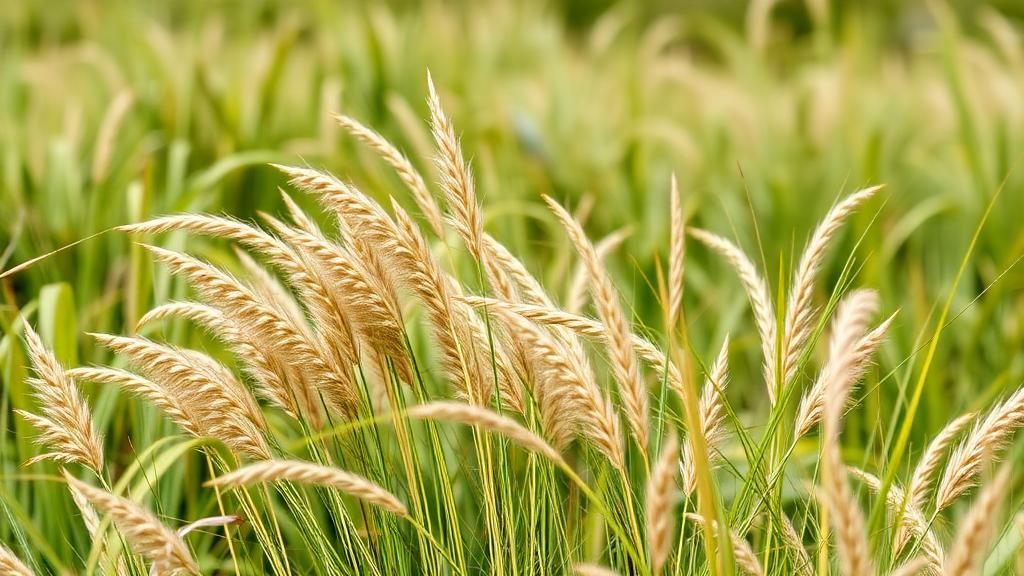
On the vast Eurasian steppe, a hardy perennial grass known as sheepgrass (Leymus chinensis) anchors entire ecosystems and sustains livestock across millions of hectares. Yet despite its enormous ecological and agricultural importance, sheepgrass has remained stubbornly resistant to the genomic revolution that has transformed breeding in crops like rice, wheat, and maize. The reason lies in its genome: sheepgrass is an allotetraploid, carrying four sets of chromosomes derived from two different ancestral species, and its genome is large, repetitive, and notoriously difficult to work with. Now, a team of researchers at the Chinese Academy of Sciences has unveiled a tool that could change everything—a high-density SNP panel containing more than 50,000 genetic markers, described in BMC Plant Biology, that promises to bring modern genomics and molecular breeding to this complex forage grass.
Single nucleotide polymorphisms, or SNPs, are the workhorses of modern plant genetics. These single-letter variations in the DNA sequence are scattered throughout the genome, and by tracking which variants an individual carries, scientists can map genes responsible for traits, measure genetic diversity, and select the best breeding lines with unprecedented precision. For polyploid species like sheepgrass, however, building a reliable SNP panel is far harder than in diploids. Each SNP exists in up to four copies, and markers from the two subgenomes can be easily confused, producing noisy data that undermines downstream analyses. The new panel, developed by Lei Tian, Shuyi Hu, Xiaoyun Han, Chuifan Kong, and colleagues under the leadership of corresponding authors Gongshe Liu and Shuangyan Chen, was specifically designed to overcome these challenges.
The foundation of the panel was whole-genome resequencing of 100 diverse sheepgrass accessions, a strategy that allowed the researchers to survey variation across the entire genome before selecting the most informative markers. From this rich dataset, they applied rigorous filtering criteria to identify 51,696 high-quality SNPs suitable for targeted enrichment genotyping. The selection process prioritized markers with even distribution across all chromosomes, ensuring that no genomic region was left in the dark. Functional annotation of the chosen SNPs revealed that 64.3 percent sit within genic regions—the parts of the genome that contain or are close to genes—while 35.7 percent fall in intergenic regions. This balance is a significant strength, because markers inside or near genes are more likely to be linked to the variants that actually influence agronomic traits.
Density varied across the genome in ways that reflect the panel’s design and the underlying biology of the species. SNP density ranged from 3.94 SNPs per megabase on chromosome 3Ns to 8.92 SNPs per megabase on chromosome 2Xm, spanning both of the ancestral subgenomes that make up the allotetraploid complement. The nomenclature itself tells a story of sheepgrass’s evolutionary origins: the Ns and Xm designations refer to the two distinct progenitor genomes that hybridized to form modern Leymus species. By capturing markers across both subgenomes, the panel gives researchers the resolution needed to disentangle the genetic architecture of traits in a species where homologous chromosomes from different ancestors can masquerade as one another in sequencing data.
Technical performance is where the panel truly proves its worth. In validation experiments, the platform achieved genotype concordance above 98 percent, meaning that repeated genotyping of the same samples produces nearly identical results—a critical requirement for any tool intended for large-scale breeding programs. Call rates and coverage rates both exceeded 98 percent, indicating that the targeted enrichment chemistry reliably captures the intended loci across hundreds of samples in a single experiment. Perhaps most remarkably, the panel also showed strong transferability to other Leymus species, extending its usefulness beyond sheepgrass itself and opening the door to comparative genomics across the genus, which includes several other important forage and rangeland grasses.
To demonstrate the panel’s power in practice, the team genotyped 648 sheepgrass samples drawn from natural populations, hybrids, and cultivated varieties. The resulting data revealed clear genetic differentiation among these groups, painting a detailed picture of how wild and domesticated sheepgrass relate to one another. Notably, the analysis detected gene flow between wild and cultivated groups in breeding varieties, a finding with direct implications for breeders who want to preserve the adaptive diversity of wild populations while incorporating desirable traits into improved cultivars. Population structure analyses of this kind are essential for conservation planning as well, since they help identify which populations harbor unique genetic variation that may be crucial for adapting the species to future climates.
The panel’s most striking demonstration came in the form of a genome-wide association study, or GWAS, conducted on 276 accessions for five agronomic traits of central importance to forage breeding. GWAS works by scanning the genome for SNPs whose variants correlate systematically with differences in a measurable trait, exploiting the fact that markers near a causal gene tend to be inherited together with it. Using a mixed linear model framework that accounts for population structure and relatedness—both of which are substantial in a species spanning wild steppes and improved cultivars—the researchers identified significant loci associated with total number of spikes, grain weight per spike, and germination rate. These traits directly govern seed yield and establishment success, two of the biggest bottlenecks in sheepgrass cultivation and restoration.
Behind the statistical associations lie candidate genes with plausible biological roles. Among the genes pinpointed near significant loci were XIAO, a probable inactive leucine-rich repeat receptor kinase; KCS17, a member of the 3-ketoacyl-CoA synthase family involved in cuticle and wax biosynthesis; and ACO1, an aminocyclopropane-1-carboxylate oxidase that participates in ethylene biosynthesis. Each of these gene families has well-documented connections to plant development and stress responses, making them credible targets for follow-up functional studies. Receptor kinases like XIAO are known to regulate developmental signaling, while ethylene-related genes such as ACO1 influence seed germination and dormancy—precisely the trait for which the association was detected. The identification of these candidates illustrates how a well-designed SNP panel can compress the journey from field measurement to gene-level hypothesis into a single, cost-effective experiment.
Why does this matter beyond the laboratory? Sheepgrass dominates the typical steppe of Inner Mongolia and neighboring regions, where it provides critical forage for grazing animals and stabilizes soils against degradation. Overgrazing, land conversion, and climate change have placed enormous pressure on these grasslands, and restoration efforts depend on a reliable supply of improved seed with high germination rates and strong establishment. Traditional breeding in sheepgrass has been slow, hampered by the species’ perennial life cycle, outcrossing nature, and polyploid genetics. A 50 K SNP panel changes the calculus entirely: breeders can now apply marker-assisted selection to track favorable alleles for yield and vigor, use genomic selection to predict the performance of seedlings before they ever reach the field, and monitor genetic diversity within breeding programs to avoid the erosion of adaptive variation.
The cost-effectiveness of targeted enrichment genotyping is a further advantage. Whole-genome resequencing of every individual in a breeding program remains prohibitively expensive for most forage crops, which typically attract far less research investment than staple cereals. A fixed SNP panel strikes a middle path, delivering high-density genotyping at a fraction of the cost while producing data that are directly comparable across experiments, laboratories, and years. This standardization is what transforms a research tool into an infrastructure asset—one that can support everything from seed certification and variety protection to long-term monitoring of how steppe populations respond to environmental change. For a species that has waited decades for genomic resources to catch up with its ecological importance, the arrival of a robust, reproducible, and transferable 50 K SNP panel marks a genuine turning point, one that could accelerate the breeding of better sheepgrass cultivars just as the world’s grasslands need them most.
Subject of Research: Development of a 50 K SNP target-enrichment genotyping panel for the allotetraploid forage grass Leymus chinensis
Article Title: A 50 K SNP target‑enrichment panel for allotetraploid Leymus chinensis: empowering genomics and breeding in a complex forage grass
Article References: Tian, L., Hu, S., Han, X., Kong, C., Cheng, L., Qi, D., Liu, G., & Chen, S. (2026). A 50 K SNP target‑enrichment panel for allotetraploid Leymus chinensis: empowering genomics and breeding in a complex forage grass. BMC Plant Biology. https://doi.org/10.1186/s12870-026-10065-z
Image Credits: AI Generated
DOI: 10.1186/s12870-026-10065-z
Keywords: Leymus chinensis, SNP panel, allotetraploid, genotyping, GWAS, molecular breeding, forage grass, polyploidy, genetic diversity, population structure, candidate genes, Eurasian steppe
Cite Scienmag News
Juliet Wilcox. (October 4, 2026). Scientists Build a 50,000-SNP Genetic Toolkit to Decode and Breed the Eurasian Steppe’s Vital Sheepgrass. Scienmag. https://scienmag.com/scientists-build-a-50000-snp-genetic-toolkit-to-decode-and-breed-the-eurasian-steppes-vital-sheepgrass/
Juliet Wilcox. "Scientists Build a 50,000-SNP Genetic Toolkit to Decode and Breed the Eurasian Steppe’s Vital Sheepgrass." Scienmag, 4 October 2026, https://scienmag.com/scientists-build-a-50000-snp-genetic-toolkit-to-decode-and-breed-the-eurasian-steppes-vital-sheepgrass/. Accessed 4 October 2026.
Juliet Wilcox. "Scientists Build a 50,000-SNP Genetic Toolkit to Decode and Breed the Eurasian Steppe’s Vital Sheepgrass." Scienmag. October 4, 2026. https://scienmag.com/scientists-build-a-50000-snp-genetic-toolkit-to-decode-and-breed-the-eurasian-steppes-vital-sheepgrass/


