


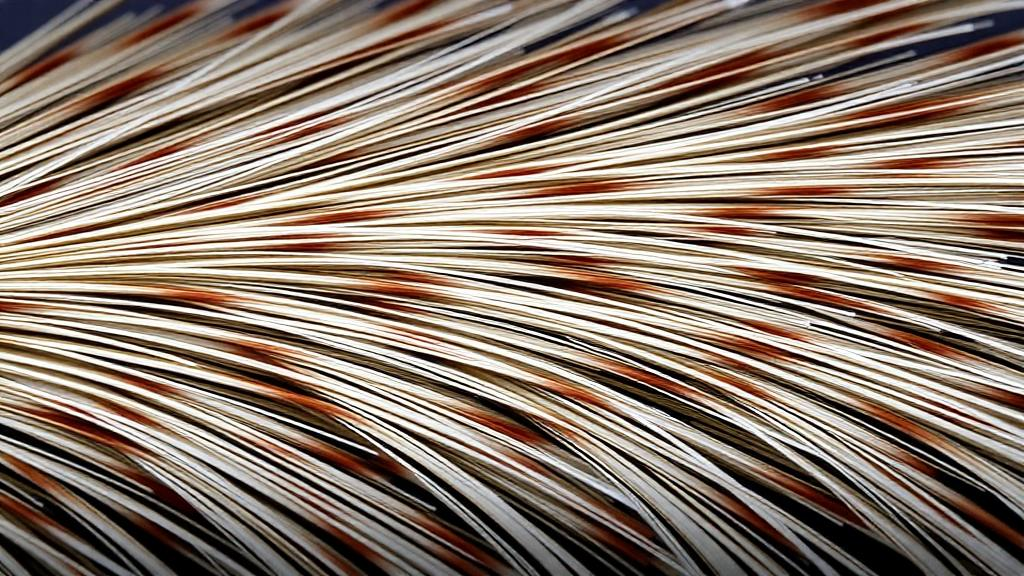
In the shadowy world of wildlife trafficking, some of the most devastating crimes leave behind the smallest evidence. Every year, an estimated 100,000 mongooses are killed in India to feed a trade that most consumers never suspect exists: the manufacture of fine paintbrushes. Roughly fifty animals must die to produce a single kilogram of usable guard hair, and the finished brushes are sold across India and smuggled to markets in the Middle East, the United States, and Europe, where buyers frequently have no idea of their illicit origins. Now, a new study published in Discover Conservation offers law enforcement a powerful new weapon in the fight against this underreported crime, one built not on DNA or high-tech genetics, but on the humble, intricate architecture of a single strand of hair.
The research, led by Monibhadra Roy of Doon University and the Zoological Survey of India, together with Shantanu Kundu of Pukyong National University and Manokaran Kamalakannan of the Zoological Survey of India, presents the first comprehensive tricho-taxonomic assessment of all six mongoose species found in India. Tricho-taxonomy, the science of identifying mammal species from the microscopic features of their hair, has long been a quiet workhorse of wildlife forensics. But until now, no study had systematically characterized the guard hairs of the complete Indian mongoose fauna, which includes the Small Indian Mongoose (Urva auropunctata), the Indian Grey Mongoose (Urva edwardsii), the Indian Brown Mongoose (Urva fusca), the Ruddy Mongoose (Urva smithii), the Crab-eating Mongoose (Urva urva), and the Stripe-necked Mongoose (Urva vitticolla). All six are protected under India’s Wildlife (Protection) Act of 1972, having been progressively elevated to Schedule I, the country’s highest level of legal protection, and all are listed in Appendix III of CITES.
The urgency of the work stems from a peculiar forensic problem. When mongoose hair is processed into paintbrushes, the basal portion of the hair, including the follicle, is typically removed during manufacturing. That follicle is where nuclear DNA resides, so confiscated brush samples are usually stripped of the genetic material that would make species identification straightforward. Mitochondrial DNA can sometimes persist in the hair shaft, but recovery is unreliable in processed brushes because of extensive chemical treatment and environmental exposure. Under such circumstances, tricho-taxonomy offers a practical, non-destructive, and rapid alternative: a way to read a species’ identity directly from the physical structure of the hair itself, even when the genetic trail has gone cold.
To build their diagnostic framework, the researchers turned to the National Zoological Collections at the Zoological Survey of India in Kolkata, an extensive repository of mongoose specimens gathered from across the country. For each of the six species, they sampled five individual specimens, extracting a minimum of twenty dorsal guard hairs per animal from the interscapular region between the shoulder blades, a standardized location chosen to account for variation along the body. The team then subjected each hair to a battery of physical and microscopic examinations, following the established protocols of Teerink and of Brunner and Coman, the foundational references in mammalian hair identification.
The physical analysis revealed striking differences in hair length and banding. The Stripe-necked Mongoose, the largest of the Indian species, also boasts the longest guard hairs, averaging 59.43 millimeters, followed by the Crab-eating Mongoose at 51.62 millimeters. At the other extreme, the Small Indian Mongoose, true to its name, produced the shortest hairs at just 16.37 millimeters. Banding patterns proved equally informative: the Indian Grey Mongoose and the Ruddy Mongoose each displayed the highest number of pigmentation bands, twelve in total, a trait that immediately sets them apart from their relatives. These bands, the alternating light and dark zones that give many mongoose coats their grizzled appearance, have long been recognized as crucial diagnostic characters, and the new study confirms and extends that understanding.
Under the microscope, the differences became even more pronounced. The researchers examined three key microstructures: the cuticle, the outermost layer of overlapping keratinized scales; the medulla, the central core of the hair shaft; and the cross-sectional shape of the shaft itself. All six species exhibited a transversal scale position with an irregular wave pattern, except the Stripe-necked Mongoose, which displayed a regular wave pattern with smooth margins, a subtle but reliable distinguishing feature. The medullary composition across all species consisted of multicellular rows with a wide or simple aeriform lattice structure, but the Ruddy Mongoose broke the pattern with a wider aeriform lattice and the highest mean medullary index, 1.47, compared with 0.67 in the Indian Grey Mongoose, despite both species sharing identical band counts. Cross-sectional morphology added yet another layer of discrimination: while most species showed biconcave light bands and oval dark bands, the Indian Brown Mongoose exhibited distinct concavo-convex shapes and the Ruddy Mongoose displayed oblong profiles.
To formalize these observations, the team employed Principal Component Analysis, a statistical technique that condenses many measured variables into a small number of axes capturing the greatest variation. Three separate analyses, focused on hair length, apical length, and basal length, revealed distinct clustering patterns among the Indian Grey, Indian Brown, Ruddy, and Crab-eating Mongooses, while the Small Indian Mongoose and Stripe-necked Mongoose showed greater dispersion across the axes. In the apical length analysis, the first two principal components together accounted for a full 100 percent of the variance, with PC1 alone explaining 78.28 percent. The result is a dichotomous identification key, a step-by-step decision tree that allows a trained examiner to assign an unknown guard hair to the correct mongoose species using a combination of band counts, medullary indices, and cross-sectional shapes.
The implications reach well beyond the courtroom. Hair analysis plays a growing role in ecological research, enabling scientists to identify prey species from predator scats and to monitor elusive or rare mammals through non-invasive methods such as hair traps. The diagnostic traits documented in this study can also help determine whether unidentified hairs originate from mongooses at all, a crucial first step in any forensic investigation. And the researchers point toward an even more automated future: a recently introduced framework called Tricho-Vision applies deep learning algorithms, including Convolutional Neural Networks and Vision Transformers, to classify microscopic hair images with high precision. Training such models reliably requires on the order of 100 to 200 well-labeled images per species, and the detailed morphological dataset generated by this study provides exactly the kind of foundation those systems need.
There are honest limits to what morphology alone can achieve. The authors acknowledge that the close similarities among the Indian Grey, Indian Brown, Ruddy, and Crab-eating Mongooses may sometimes exceed the resolving power of tricho-taxonomy, and they recommend integrating molecular tools such as Short Tandem Repeats or mitochondrial DNA markers for definitive species-level identification in ambiguous cases. Scale count measurements were excluded from the analysis altogether because of high observer variability. But the study’s core contribution stands: by incorporating the previously unstudied Indian Brown and Stripe-necked Mongooses, documenting novel differences in medullary and cross-sectional structure between light and dark band regions, and applying multivariate statistics to the full suite of traits, the team has produced the most comprehensive picture of Indian mongoose hair ever assembled. For enforcement agencies confronting a trade that funnels through Uttar Pradesh, Maharashtra, and Tamil Nadu and crosses the Indo-Nepal and Indo-Bangladesh borders via hubs in Delhi, Mumbai, and Kolkata, that picture could make the difference between a seized shipment and a missed one, and between thriving mongoose populations and another hundred thousand silent losses.
Subject of Research: Tricho-taxonomic identification of Indian mongoose species from guard hair morphology for wildlife forensics
Article Title: Tricho-taxonomic profiling of Indian mongoose guard hairs reveal potential applications in wildlife forensics and species conservation
Article References: Roy, M., Kundu, S., & Kamalakannan, M. (2025). Tricho-taxonomic profiling of Indian mongoose guard hairs reveal potential applications in wildlife forensics and species conservation. Discover Conservation, 2(1), Article 42. https://doi.org/10.1007/s44353-025-00060-0
Image Credits: AI Generated
DOI: 10.1007/s44353-025-00060-0
Keywords: mongoose, tricho-taxonomy, wildlife forensics, guard hair, illegal wildlife trade, paintbrush trade, India, Urva, medullary index, cuticular scales, Principal Component Analysis, species conservation
Cite Scienmag News
Margaret Porter. (October 4, 2026). Mongoose Hair Forensics: Microscopic Clues Could Help Crack India’s Illegal Paintbrush Trade. Scienmag. https://scienmag.com/mongoose-hair-forensics-microscopic-clues-could-help-crack-indias-illegal-paintbrush-trade/
Margaret Porter. "Mongoose Hair Forensics: Microscopic Clues Could Help Crack India’s Illegal Paintbrush Trade." Scienmag, 4 October 2026, https://scienmag.com/mongoose-hair-forensics-microscopic-clues-could-help-crack-indias-illegal-paintbrush-trade/. Accessed 4 October 2026.
Margaret Porter. "Mongoose Hair Forensics: Microscopic Clues Could Help Crack India’s Illegal Paintbrush Trade." Scienmag. October 4, 2026. https://scienmag.com/mongoose-hair-forensics-microscopic-clues-could-help-crack-indias-illegal-paintbrush-trade/


