


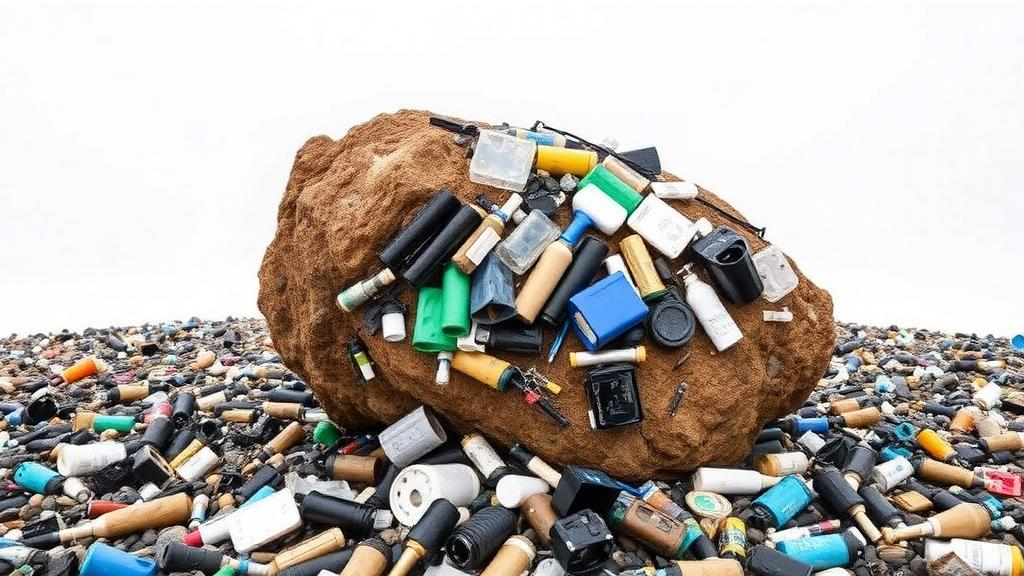
On a rocky stretch of Diveagar beach in the western Indian state of Maharashtra, researchers have uncovered something that blurs the line between geology and garbage: a rock with plastic woven permanently into its fabric. The team, led by Nirupama Saini and Punyasloke Bhadury of the Indian Institute of Science Education and Research Kolkata, together with independent researcher Shravani Mangeshkar, reports the first evidence of a plastic-rock composite known as a plastistone from the west coast of India, and quite possibly the first such report from the entire Indian subcontinent. The finding, published in the open-access journal Discover Oceans, adds a striking new entry to the growing catalogue of human-made materials that are becoming part of Earth’s geological record.
The story of plastic-rock formations began a decade ago, when geologist Patricia Corcoran and colleagues described plastiglomerate from Kamilo Beach in Hawaii, a material created when molten plastic from campfires fused with sand, rock fragments and organic debris. Since then, scientists have coined a small lexicon of terms for related phenomena: pyroplastics, melted and reshaped plastic lumps that mimic natural stones; plasticrusts, thin plastic crusts encrusting intertidal rocks; and plastitar, plastic-and-tar assemblages. Reports have followed from the Mediterranean, South America, the Turkish Black Sea coast and elsewhere. Yet the global picture of where, how and how often these materials form remains patchy, and until recently there was no documented evidence of any such formation from the coastal ocean of South Asia.
That gap mattered because India is the world’s second-largest plastic producer, generating roughly 3.4 million metric tons of plastic waste each year, nearly 40 percent of which is left uncollected or mismanaged. The country’s coastline stretches about 11,000 kilometres and is home to nearly half its population, with plastic making up around 70 percent of the litter load on Indian beaches. Maharashtra, the second-most populous state and one of India’s economic powerhouses, generated 536 thousand tonnes of plastic waste in 2022 alone, with 60 percent mismanaged. Its 720-kilometre Arabian Sea coast ranks second in marine fish landings, making fishing-related plastic a particularly prominent contributor. The stage, in other words, was set for plastic to start behaving like a geological agent.
In May 2024, the researchers walked roughly ten kilometres of the Diveagar shoreline in Raigad district, focusing on the low-tidal zone where debris accumulates. At two locations, they spotted something unusual: at one point, a white filamentous net material was embedded within the rock, and at another, a green net structure was similarly engulfed. Using a hammer and chisel, they extracted a representative specimen, photographed it in situ, wrapped it in aluminium foil and sealed it in labelled bags to prevent contamination. The recovered plastistone measured approximately 6.5 by 4 centimetres, with a green plastic filament about 365 micrometres thick trapped fully inside the rock matrix, its attachment points clearly visible under magnification.
Laboratory analysis began with bright-field and stereo-zoom microscopy, which revealed that bioclasts, fragments of once-living material, constitute a major component of the rock. Mollusc shells, barnacles and foraminifera of varying shapes and sizes were distributed throughout the matrix, alongside red and colourless microplastic filaments integrated into the rock fabric. The chemical identity of the plastics was then pinned down using Attenuated Total Reflectance-Fourier Transform Infrared (ATR-FTIR) spectroscopy and confirmed with Micro-Raman spectroscopy, with spectra matched against the open-source Open Specy reference library. The green filament produced an Amide I band near 1632 and an Amide II band near 1538 per centimetre, together with an N-H stretching band around 3300 per centimetre, the classic fingerprint of polyamide. The Raman spectrum, showing C-C skeletal stretching bands at 1132, 1081 and 1067 per centimetre, matched nylon 6 with a correlation coefficient of 0.81. The white filament from the first site told the same story: polyamide, the polymer of fishing nets.
A second, distinct section of the specimen offered a snapshot of the process in progress. This roughly 2.5 by 1.4 centimetre composite-cluster contained numerous plastic filaments in red, blue, black, white and colourless forms, compacted with sediment grains and biogenic material but not yet fully transformed into sedimentary rock. Spectroscopy identified a cocktail of polymers: polyethylene with strong CH2 stretching bands near 2913 and 2848 per centimetre, polypropylene with CH3 signatures near 2950 and 2870, PET with its distinctive ester carbonyl peak at 1715, and more polyamide. All spectra matched reference libraries at better than 70 percent. The filamentous morphology of nearly all the debris pointed to a single, sobering origin: discarded fishing gear, the so-called ghost nets that drift through the world’s oceans.
Crucially, the formation mechanism appears entirely natural. Unlike Hawaiian plastiglomerate, which forms when plastic waste is burned and the molten material cements surrounding debris, the Diveagar specimen showed no signs of melting or deformation, and it was found in the low-tide zone where campfires are implausible. Instead, the researchers propose a low-temperature diagenetic pathway: discarded nets and ropes drift on currents, mix with sandy particles and strand on the shore, where ultraviolet radiation, wave abrasion and the drying heat of sun-exposed rocks soften the plastic and increase its ability to bind sediments. In this state the plastic behaves as a weak, early-stage cement, trapping mineral grains and biogenic particles around it. Previous studies from Brazil and elsewhere have similarly implicated summer rock temperatures and UV heating in plastistone formation, and the authors note that global warming could accelerate the process.
The discovery fits a broader pattern of severe plastic contamination along the Mumbai-Maharashtra coast. Sediment surveys near Mumbai have recorded microplastic abundances of up to 15,300 items per kilogram dry weight, with fibres dominant, while surface waters have yielded mean concentrations of 372 items per litre. In the central Maharashtra zone encompassing Diveagar, pollution load index values of 1.28 for sediment and 1.52 for water indicate moderate risk, with average concentrations of 54 microplastics per kilogram of sediment and 27 per 100 litres of water, dominated by exactly the polymers found in the plastistone: polyethylene, polypropylene, polyester, PET and polyamide. Microplastics have also been documented in fish and shrimp from the northeastern Arabian Sea, showing that plastic debris is already woven into local food webs as well as local rocks.
The ecological implications of plastistones are only beginning to be understood, but early signals are concerning. Because these composites persist far longer than loose debris, they may act as long-term reservoirs of microplastics and chemical additives. Recent research suggests they alter microbial community structure in their surroundings, enriching certain microbes. Plastic-bearing rocks also absorb and retain more heat than natural stone, raising both daytime and nighttime temperatures in beach sediments, an effect shown to threaten the breeding habits of organisms such as crabs and sea turtles. The additives and contaminants packed into synthetic polymers add another layer of toxicological risk that remains largely unexplored.
For the researchers, the message is twofold. First, plastic litter has reached such abundance that it is increasingly available for incorporation into genuine rock-forming processes, mingling with shells and foraminifera in young coastal sediments, a hallmark of the Anthropocene epoch some have dubbed the Plasticene. Second, fishing gear deserves far more attention in waste management policy: it accounts for an estimated 10 percent of global marine plastic waste, with 640,000 tonnes lost to the ocean each year, and constitutes up to 70 percent of the plastic by weight in parts of the Great Pacific Garbage Patch. The team argues that plastistone occurrences should be incorporated into coastal ecological health monitoring protocols, and calls for interdisciplinary research to interpret the ecological consequences of these hybrid rocks. As plastics continue to fuse with the planet’s sedimentary systems, the coastline of Maharashtra now stands as evidence that the Anthropocene is not merely recorded in rocks. It is becoming one.
Subject of Research: Formation of plastistone, a plastic-rock composite, from discarded fishing gear on the Maharashtra coast of India
Article Title: First evidence of plastistone, a novel plastic rock composite, from the Maharashtra coast of India
Article References: Saini, N., Mangeshkar, S., & Bhadury, P. (2026). First evidence of plastistone, a novel plastic rock composite, from the Maharashtra coast of India. Discover Oceans, 3(1), Article 17. https://doi.org/10.1007/s44289-026-00131-7
Image Credits: AI Generated
DOI: 10.1007/s44289-026-00131-7
Keywords: plastistone, plastic-rock composite, marine plastic pollution, microplastics, fishing gear, ghost nets, Maharashtra coast, Anthropocene, ATR-FTIR spectroscopy, nylon, coastal geology, India
Cite Scienmag News
Violet Maxwell. (October 4, 2026). Scientists Find Plastic Fused Into Rock on India’s West Coast in a First. Scienmag. https://scienmag.com/scientists-find-plastic-fused-into-rock-on-indias-west-coast-in-a-first/
Violet Maxwell. "Scientists Find Plastic Fused Into Rock on India’s West Coast in a First." Scienmag, 4 October 2026, https://scienmag.com/scientists-find-plastic-fused-into-rock-on-indias-west-coast-in-a-first/. Accessed 4 October 2026.
Violet Maxwell. "Scientists Find Plastic Fused Into Rock on India’s West Coast in a First." Scienmag. October 4, 2026. https://scienmag.com/scientists-find-plastic-fused-into-rock-on-indias-west-coast-in-a-first/


