


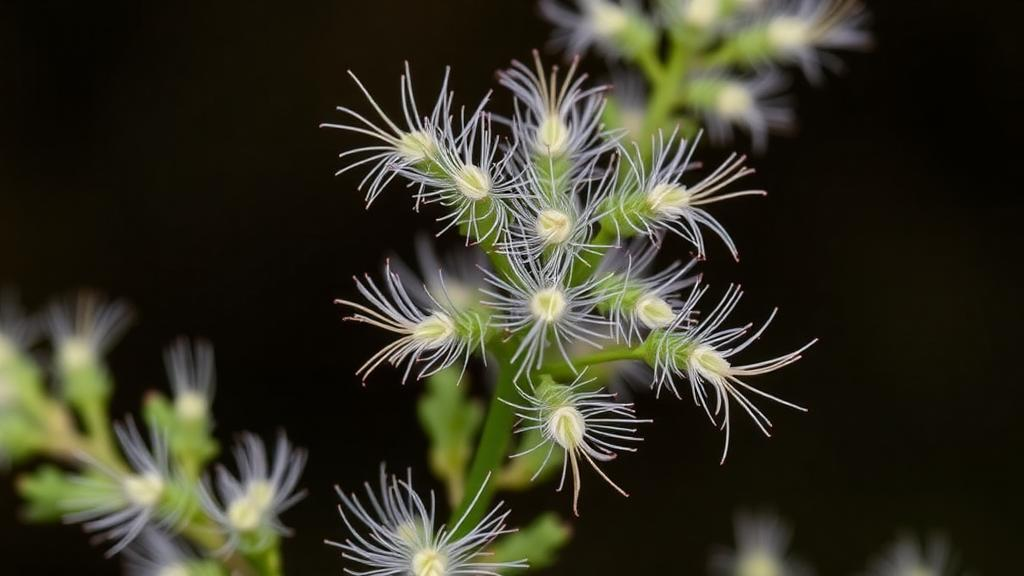
On the underside of every mugwort leaf lies a dense, silvery forest of microscopic hairs that has quietly shaped one of the world’s oldest medical traditions. These T-shaped non-glandular trichomes are the raw material of moxa floss, the fluffy substance burned in moxibustion therapy, and they largely determine both the yield and the therapeutic quality of one of China’s most commercially significant medicinal herbs. Now, a research team at Guangzhou University of Chinese Medicine has identified the transcription factors that build these hairs, revealing a gene family that expanded dramatically in mugwort and split its duties between two very different kinds of trichomes. The work, published in Advanced Biotechnology, offers the first functional glimpse into how a multicellular, non-glandular hair is genetically programmed in a crop plant.
Trichomes are epidermal appendages found across most flowering plants, as well as some gymnosperms and bryophytes, and they take an astonishing variety of forms, from cucumber fruit spines to cotton fibers. Botanists divide them into two broad classes. Glandular secretory trichomes manufacture and store volatile compounds, resins, and other metabolites, while non-glandular trichomes lack secretory activity but provide crucial physical defense, reducing water loss through transpiration, capturing moisture from fog, buffering against temperature extremes, and shielding leaf tissue from ultraviolet radiation and herbivores. Most of what science knows about non-glandular trichome development comes from unicellular systems such as Arabidopsis rosette leaves and cotton fibers, where each hair arises from a single epidermal cell. Multicellular non-glandular trichomes, by contrast, have lacked a workable model system, leaving a significant gap in plant developmental biology.
Artemisia argyi, a perennial herb in the Asteraceae family, turns out to be an unusually elegant model for closing that gap. Scanning electron microscopy performed by the team revealed a striking asymmetry: the upper leaf surface is dominated by slipper-shaped glandular trichomes measuring roughly 33.3 by 52.1 micrometers, while the lower surface is carpeted with elongated T-shaped trichomes whose branched arms exceed one millimeter in length and intertwine into a dense mat. The stalks of these T-shaped hairs are short, about 28.8 micrometers, but their asymmetrical arms give the structure its name and its function. This clean separation of trichome types between the two leaf surfaces gives researchers a natural experiment in epidermal patterning, and it explains why the species has become a defining subject for studying multicellular hair development.
The commercial stakes are considerable. Mugwort’s dried leaves are the primary medicinal material documented in the Chinese Pharmacopoeia for warming the meridians, stopping bleeding, dispelling cold, and relieving pain, and the sector exceeded 30 billion yuan in industrial output in 2023. Moxa floss, the fibrous product central to moxibustion, consists primarily of these leaf trichomes, and its efficacy is attributed not only to combustion heat but to bioactive volatile compounds released from trichome tissue. Because trichome abundance and morphology directly determine floss yield and quality, understanding the genes that control hair formation has immediate implications for breeding improved cultivars of a plant whose germplasm is distributed across China, Mongolia, and North Korea.
To find those genes, the researchers manually separated T-shaped trichomes from the remaining leaf tissue and sequenced the transcriptomes of both, generating 39.03 gigabases of clean reads mapped to a reference genome at rates between 74.30 and 97.15 percent. The comparison was dramatic: 8,901 genes were upregulated and 4,698 downregulated in the trichome fraction. Gene Ontology enrichment pointed toward membrane components, the plasma membrane, and defense responses, while KEGG analysis flagged pathways including MAPK signaling and isoflavonoid and flavonoid biosynthesis. Several transcription factor families long associated with trichome development, including R2R3-MYB, C2H2 zinc-finger, HD-ZIP IV, bHLH, ethylene-responsive, and WD40 repeat proteins, were markedly enriched in the hairs, confirming that the sequencing had captured a genuine developmental signature rather than random tissue noise.
The team then widened the lens, integrating public RNA-seq datasets from old leaves, young leaves, stems, and glandular trichomes with their own data in a Weighted Correlation Network Analysis covering 53,354 genes. Five co-expression modules emerged, and one, the cyan module, stood out for its enrichment in cutin biosynthetic genes and homologs of known Arabidopsis trichome regulators. Within that module’s network, members of a family the authors named AarMIXTAs behaved as hub genes, strongly connected to MYB, bHLH, WD40, HD-ZIP, and WRKY factors. Homology-based screening against well-characterized regulators from Arabidopsis and the related species Artemisia annua identified 119 mugwort genes tied to trichome development across 27 allelic groups, with evidence of tandem duplication for some genes such as ETC1, TT8, and EGL3, and allelic amplification for others including TTG1, RGA, and the MIXTAs themselves.
The evolutionary story proved to be the most striking finding. Drawing on 144 MIXTA and MIXTA-like protein sequences from NCBI and Phytozome databases, spanning 136 angiosperms, two gymnosperms, and six ANA-grade outgroups, the researchers built a maximum likelihood phylogeny that resolved into four major clades. The gymnosperm sequences occupied the most ancestral position, monocots clustered separately, and two dicot-only clades containing 33 and 77 proteins appeared to have descended from the earlier lineages. Within this framework, mugwort stood out: its genome harbors eight AarMIXTA genes, a substantial expansion compared with A. annua. These fell into two clades, one most closely related to lettuce and the other to A. annua, suggesting the duplication events occurred after the Asteraceae lineage diverged from other eudicots. Elevated synonymous substitution rates between the clades hinted at accelerated evolution, possibly driven by local recombination, relaxed selection, or positive selection following segmental or tandem duplication.
Crucially, the duplicated genes did not simply do the same job twice. Although the AarMIXTAs share conserved exon-intron structures and high sequence similarity with their A. annua homologs, their expression patterns diverged sharply. The clade comprising AarMIXTA1.1 through 1.4 was expressed at significantly higher levels in T-shaped trichomes, while AarMIXTA1.5 through 1.8 were more abundant in glandular trichomes. Since AanMIXTA1 in A. annua is a validated positive regulator of glandular trichome density and artemisinin biosynthesis, its mugwort relatives in the second clade likely inherited that role. The first clade, occupying a distinct phylogenetic position, appears to have been recruited for a different task: building the non-glandular, T-shaped hairs that define the species. This is a textbook case of neofunctionalization after gene duplication, likely facilitated by the polyploid history of A. argyi, which is an autotetraploid.
Functional validation sealed the argument. The team selected AarMIXTA1.2, whose expression rises progressively during leaf development and peaks specifically in T-shaped trichomes, and overexpressed it in Arabidopsis under the 35S promoter. The transgenic plants showed two clear phenotypic changes: increased total leaf number and a roughly twofold increase in trichome density, along with moderately longer trichome branches and stalks. Quantitative PCR revealed that core Arabidopsis trichome regulators, including AtGL2, AtTAR2, AtMYB23, AtTTG1, and AtHD1, were all significantly upregulated in the transgenic lines, and the native AtMIXTA gene was elevated as well, hinting at feedback or synergistic interactions. The results demonstrate that a single mugwort transcription factor can activate a conserved downstream cascade and reshape epidermal patterning even in a distantly related species.
The implications extend well beyond mugwort. For developmental biologists, the study establishes A. argyi as a model for multicellular non-glandular trichome development, a process long overshadowed by unicellular systems, and shows that the ancient MIXTA toolkit, first cloned from snapdragon in 1994 as a controller of petal cell shape, has been repeatedly redeployed across plant evolution to sculpt epidermal surfaces. For the mugwort industry, the AarMIXTA family offers molecular markers for breeding varieties with denser, higher-quality trichomes, potentially through targeted genetic screening and trait selection. The authors point to next steps including yeast two-hybrid screens for AarMIXTA1.2 interactors, epigenetic and chromatin accessibility studies, and functional testing in mugwort itself. They also raise an intriguing ecological question: whether the plant’s remarkable environmental adaptability across diverse Chinese habitats owes something to its trichome armor, connecting a millennia-old therapeutic tradition to the frontiers of modern plant genetics.
Subject of Research: Genetic regulation of T-shaped non-glandular trichome development in Artemisia argyi by MIXTA-like transcription factors
Article Title: Functional characterization of AarMIXTAs as essential regulators in T-shaped non-glandular trichome development of Artemisia argyi
Article References: Functional characterization of AarMIXTAs as essential regulators in T-shaped non-glandular trichome development of Artemisia argyi. (n.d.). https://doi.org/10.1007/s44307-025-00077-5
Image Credits: AI Generated
DOI: 10.1007/s44307-025-00077-5
Keywords: Artemisia argyi, trichome development, AarMIXTA, transcription factors, moxibustion, moxa floss, gene duplication, polyploidy, Arabidopsis, comparative transcriptomics, WGCNA, plant morphogenesis
Cite Scienmag News
Juliet Wilcox. (October 4, 2026). Scientists Uncover the Genetic Switch Behind Mugwort’s Silvery Armor of T-Shaped Hairs. Scienmag. https://scienmag.com/scientists-uncover-the-genetic-switch-behind-mugworts-silvery-armor-of-t-shaped-hairs/
Juliet Wilcox. "Scientists Uncover the Genetic Switch Behind Mugwort’s Silvery Armor of T-Shaped Hairs." Scienmag, 4 October 2026, https://scienmag.com/scientists-uncover-the-genetic-switch-behind-mugworts-silvery-armor-of-t-shaped-hairs/. Accessed 4 October 2026.
Juliet Wilcox. "Scientists Uncover the Genetic Switch Behind Mugwort’s Silvery Armor of T-Shaped Hairs." Scienmag. October 4, 2026. https://scienmag.com/scientists-uncover-the-genetic-switch-behind-mugworts-silvery-armor-of-t-shaped-hairs/


