


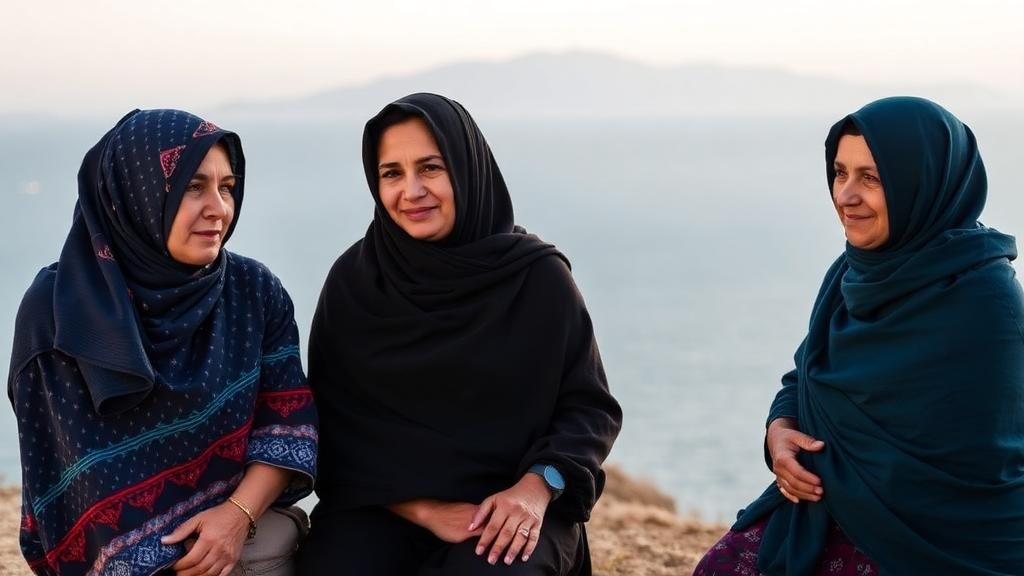
In the sprawling Mavrovouni camp on the Greek island of Lesbos, the largest refugee reception facility in Europe, a group of women decided that the usual way of studying their health was not good enough. Instead of answering questionnaires designed by outsiders, they helped design, carry out, and interpret a study of their own sexual and reproductive health needs. The result, published in the International Journal for Equity in Health, is one of the most detailed participatory accounts to date of what refugee women actually want from health systems, and it reaches a conclusion that challenges the way humanitarian medicine is usually practiced: their needs extend far beyond clinics, into housing, food, safety, legal status, and dignity.
The study, led by Jamilah Sherally of the Athena Institute at VU Amsterdam together with colleagues from Leiden University Medical Centre, KIT Royal Tropical Institute, Radboud University, and the University of Amsterdam, was built on an unusual foundation. Nine refugee women living in the camp were trained and employed as co-researchers. They helped develop the research questions, recruited participants, collected data, and took part in collective analysis of the findings. Between August and October 2023, the team conducted six focus group discussions and 27 peer-to-peer interviews, in which women from the community spoke with one another rather than with external investigators. In total, 67 women from nine nationalities took part, with seven women contributing to both methods.
The participatory design was not merely a matter of convenience. Research with displaced populations has long been criticized for extracting information without returning any control over how it is framed or used. By using approaches drawn from Participatory Ethnographic and Evaluative Research, the team employed creative techniques such as body mapping, in which participants draw their experiences onto an outline of a human body; storytelling; photovoice; guided visualization; and a world café format of rotating small-group conversations. These methods are designed to allow women to express experiences that may be traumatic, taboo, or difficult to articulate in a conventional interview, and to position them as agents of change rather than passive subjects of research.
The title of the paper itself captures a recurring grievance. One participant’s words, quoted in the study, describe clinical encounters in which examinations were performed without explanation: women submitted to pelvic examinations without being told what was being looked for or why. That single complaint crystallizes a broader finding. What the women described as missing from their healthcare was not only access to services but respect, information, and autonomy. They wanted timely and equitable care, but they also wanted to understand their own bodies, to make informed decisions, and to be treated as competent adults rather than as bodies to be processed.
Using a socio-ecological model combined with an intersectional lens, the researchers organized the findings across multiple levels, from individual wellbeing to camp conditions to the structures of European migration governance. At the individual level, women emphasized mental health and health literacy as core components of sexual and reproductive health. Many described the psychological toll of prolonged uncertainty, and the way that anxiety, depression, and trauma shaped their capacity to care for themselves, their pregnancies, and their children. Information emerged as a recurring demand: women wanted to understand contraception, pregnancy, menstruation, infections, and their legal rights, in languages they could actually read and hear.
At the level of daily life, the study found that sexual and reproductive health was inseparable from material living conditions. The quality of accommodation, access to sanitation, and the adequacy of nutrition all shaped health outcomes in ways that no clinic could compensate for. Women described how inadequate food supplies affected pregnancies and breastfeeding, how shared and unsafe sanitation facilities compromised privacy and hygiene, and how the physical environment of the camp made it difficult to maintain basic reproductive health. Relational and religious support networks, the researchers found, served as important coping resources, but they operated within conditions that no amount of community solidarity could fully offset.
Safety emerged as a central and multidimensional concept. For the women in the study, safety meant far more than the absence of violence. It encompassed physical protection from assault and harassment, legal stability regarding their asylum status, food security, and access to reliable information. Protection from gender-based violence was a persistent concern, particularly for women traveling alone or heading single-parent households. The researchers note that needs were shaped by intersecting identities: legal status, single motherhood, and gender combined to produce distinct patterns of vulnerability and resilience among the women interviewed.
Perhaps the most striking analytical contribution of the study is its account of justice. The women articulated a demand for fairness that extended across the entire system they inhabited: asylum procedures conducted without arbitrary delay, non-discriminatory treatment within the camp, equitable access to healthcare, protection from gender-based violence, and an end to pushbacks, the forcible return of migrants across borders without any opportunity to apply for asylum, a practice that contravenes the principle of non-refoulement under the 1951 Refugee Convention. The authors frame this as reproductive justice in the fullest sense: reproductive autonomy, dignified conditions during pregnancy, safety for newborns, and even birthright citizenship for children born in displacement.
This framing matters because it reframes what health interventions should aim at. If the health needs of refugee women are produced by securitized migration governance, border violence, and precarious camp conditions, then distributing more contraceptives or adding antenatal appointments, while valuable, cannot address the root causes of poor outcomes. The authors argue that improving sexual and reproductive health in such settings requires tackling structural constraints on self-determination, information, food security, safety, legal stability, and dignified healthcare, and that this demands interdisciplinary and justice-oriented approaches rather than purely clinical ones. The study contributes to ongoing debates in reproductive and gender justice by demonstrating, in the authors’ words, how justice is lived rather than externally defined.
The methodological lessons may prove as influential as the substantive findings. The research received ethical approval from the Hellenic National Public Health Organization and was funded by the Dutch Research Council, and its design shows that rigorous qualitative research can be conducted with, rather than merely on, displaced communities, even in one of the most heavily controlled migration environments in Europe. The nine co-researchers are listed as authors, an acknowledgment that the knowledge produced belongs to the community that generated it. For policymakers and humanitarian organizations, the message is uncomfortable but clear: refugee women on Lesbos do not need to be studied again so much as listened to, and what they are asking for is not charity but the conditions under which health, autonomy, and justice become possible.
Subject of Research: Sexual and reproductive health needs of refugee women in the Mavrovouni camp on Lesbos, Greece
Article Title: “They looked at our vaginas but didn’t tell us why”: a participatory study on sexual and reproductive health needs of refugee women on Lesbos, Greece
Article References: Sherally, J., Grossek, G. M., Alshamari, Z., Bari, L. B., Beshir, E., Hosseini, Z., Jafari, H., Jafari, M., Mohamed, K., Mohammadyasin, S., Mobaki, K., van den Akker, T., Le Mat, M. L. J., & van den Muijsenbergh, M. (2026). “They looked at our vaginas but didn’t tell us why”: a participatory study on sexual and reproductive health needs of refugee women on Lesbos, Greece. International Journal for Equity in Health. https://doi.org/10.1186/s12939-026-03024-5
Image Credits: AI Generated
DOI: 10.1186/s12939-026-03024-5
Keywords: sexual and reproductive health, refugee women, participatory action research, Lesbos, Mavrovouni camp, reproductive justice, intersectionality, gender-based violence, migration governance, health literacy, Greece, qualitative research
Cite Scienmag News
Courtney Benton. (October 4, 2026). Refugee Women on Lesbos Redefine Sexual and Reproductive Health as a Matter of Justice. Scienmag. https://scienmag.com/refugee-women-on-lesbos-redefine-sexual-and-reproductive-health-as-a-matter-of-justice/
Courtney Benton. "Refugee Women on Lesbos Redefine Sexual and Reproductive Health as a Matter of Justice." Scienmag, 4 October 2026, https://scienmag.com/refugee-women-on-lesbos-redefine-sexual-and-reproductive-health-as-a-matter-of-justice/. Accessed 4 October 2026.
Courtney Benton. "Refugee Women on Lesbos Redefine Sexual and Reproductive Health as a Matter of Justice." Scienmag. October 4, 2026. https://scienmag.com/refugee-women-on-lesbos-redefine-sexual-and-reproductive-health-as-a-matter-of-justice/


