


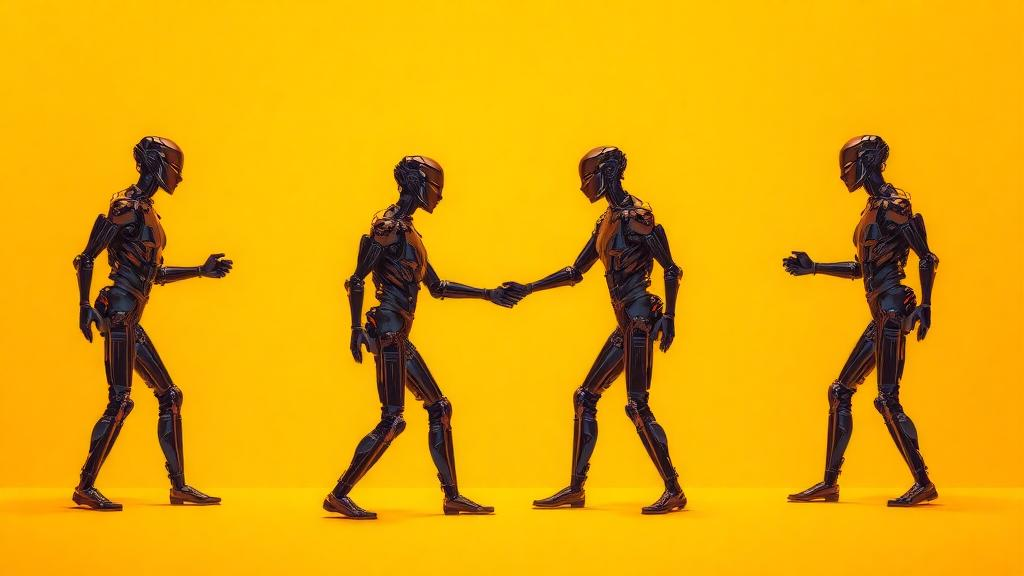
Generative artificial intelligence has reignited one of the oldest arguments in cultural life: can a machine make art? A new open-access paper in the journal AI & Society argues that the question itself is aimed at the wrong target. Amit Raphael Zoran of the Hebrew University of Jerusalem contends that debates over authorship, originality, and output quality fixate on artifacts, while the deeper historical function of art has always been transformation, of makers, of audiences, and of cultures. His central claim, which he calls the decoupling thesis, is that generative AI has quietly severed a bond that held for most of human history: the bond between producing sophisticated artistic forms and the long developmental journey a maker must undergo to produce them.
Zoran begins by distinguishing two intertwined dimensions of art. The first is artistic form: the images, texts, compositions, and objects through which meaning is stabilized and transmitted. The second he terms artistic becoming: the developmental and transformative processes through which new possibilities of perception, interpretation, and experience emerge. Renaissance perspective reorganized how people perceived space. Cubism unsettled assumptions about objects and viewpoints. Conceptual art shifted attention from objects to systems of meaning. In each case, the lasting effect was not the artifact itself but a reorganization of how reality could be perceived and understood. The distinction has a clear ancestor in John Dewey’s contrast between the art product and art as experience, and Zoran does not claim novelty for the distinction itself. What is new, he argues, is the historical and technological claim that follows from it.
For most of history, the two dimensions were contingently coupled. Producing a sophisticated form required years of skill acquisition, negotiation with resistant materials, and the disciplining of the senses, a process that transformed the maker. Generative AI, Zoran argues, partially undoes this coupling at the level of production. Images, texts, and designs of a sophistication that once demanded a decade of training can now emerge without the specific developmental trajectory through which comparable forms traditionally arose. Crucially, the thesis is narrower than it may first appear. Prompting, curation, and iteration remain genuine relational activities, and the training corpora behind generative models condense vast quantities of past human labor. What loosens is not every pathway, but the coupling between a particular form and the particular trajectory that once conditioned it.
The paper situates this shift within a longer history of hybridization. From the algorithmic experiments of Georg Nees, Frieder Nake, Vera Molnar, and Harold Cohen’s AARON, through interactive installations and relational aesthetics, computational systems gradually became participants in creative processes rather than mere instruments. Yet a stable division of labor persisted: machines contributed precision, repetition, and combinatorial complexity, while humans retained interpretation, ambiguity, and cultural meaning. Hybrid craft, digital fabrication, computational textiles, and interactive fabrication systems all extended this complementarity rather than dissolving it, deliberately preserving gesture, improvisation, and material engagement. Even contemporary practices such as Sougwen Chung’s robotic drawing collaborations, Refik Anadol’s data-driven installations, and Holly Herndon’s Spawn project reconnect symbolic production with embodiment and curation.
What makes generative AI different, according to Zoran, is its material. Earlier media worked on marble, pigment, clay, sound, or light, and on the trained hand that shaped them. Generative systems work on the accumulated symbolic and cognitive record of humanity itself, the images, texts, and concepts people have gathered and preserved across history. Culture, once the product of human becoming, has become the substrate on which these systems operate. More precisely, as the paper notes, generative models are trained not on human cognition as such but on the recorded symbolic traces of human activity, from which they learn statistical regularities, and what they internalize is never a neutral whole but an unevenly weighted, culturally skewed slice of the record. Symbolic production itself becomes shared, and the familiar oppositions between execution and imagination grow unstable.
The consequences of decoupling are not uniform. Zoran distinguishes three levels of artistic becoming: the becoming of the maker, the becoming of the recipient, and cultural becoming. The decoupling operates first at the level of the maker, whose years of formation are no longer a load-bearing condition for producing sophisticated forms. Whether an AI-generated work can still transform a viewer is a different question, and the paper is careful not to answer it prematurely. A generated image can plainly reorganize how someone perceives. What becomes uncertain is subtler: whether the capacity of forms to occasion transformation was historically nourished by the maker’s becoming invested in them, and what happens to that capacity when the first level is bypassed at scale. Becoming, Zoran stresses, cannot circulate at all; it can only be undergone. Forms transmit occasions for transformation, not the transformation itself.
Detachment, however, does not mean disappearance. Creative activity relocates toward prompting, curation, orchestration, selection, and sustained iterative dialogue with generative systems. These are genuine developmental practices, but their structure differs from the trajectories they displace: they operate largely on the symbolic plane, on representations rather than materials, and many can be entered without long apprenticeship. The paper draws a structural parallel to Walter Benjamin, who described how mechanical reproduction loosened the artwork from the singular aura of its origin. Generative AI produces a related disclosure, but at the level of production itself. The argument is explicitly not nostalgic: photography did not eliminate painting, recording did not eliminate live performance, and generative tools need not eliminate creative practice, only redefine it.
Perhaps the paper’s most provocative move is its normative conclusion. When sophisticated forms become abundant and their production no longer depends on specialized training, the decisive question is no longer how to produce, but what is worth making at all. Zoran’s answer is that the creative practices most worth pursuing under conditions of symbolic abundance are those that route generative fluency back into embodied, situated experience, into material resistance, bodily encounter, place, living processes, and other people. Work that circulates entirely within the symbolic plane, recombining representations for the sake of further representation, may be skillful and may find markets, but on this account it multiplies forms without deepening anyone’s relation to anything. The criterion is directional rather than a purity test of media: conceptual art qualifies fully insofar as it reorganized viewers’ relations to institutions and habits they actually inhabited.
Three interventions from the author’s own practice illustrate the redirection, offered as demonstrations of practicability rather than evidence of effect. In one, a live lecture gradually reveals itself to be partially prerecorded, with multiple versions of the speaker interacting, letting audiences feel firsthand how easily confidence in digital presence can be manipulated. In another, participants taste an essence reconstructed from an old oak through connections among historical alchemy, botany, chemistry, and ethnobotany, combinations difficult to assemble without computational assistance. In a third, a tree becomes the center of a multisensory environment where its recorded sounds are transformed by generative AI into music performed acoustically by a human musician, while projections reveal hidden structures. In each case the technology recedes, its virtuosity spent on weaving sound, image, smell, taste, and performance into a single embodied experience.
The paper also sketches provisional commitments for practitioners, institutions, and system builders. Practitioners are urged to treat the effort generative systems save as a budget and reinvest it in experiential engagement. Schools, museums, and funders are asked to value duration, process, and documented engagement alongside finished forms, precisely because finished forms no longer certify them. System builders are encouraged to design against convergence, preserve friction where it serves exploration, make provenance legible, and evaluate systems not by output quality alone but by observable conditions: the breadth of territory a system leads users to explore, the ratio of exploration to retrieval, and whether defaults regress toward the statistically familiar. Becoming itself resists measurement, Zoran concedes, and that limitation follows from his own thesis. But the environments in which transformation might occur can be assessed. As symbolic production becomes abundant, art’s significance may lie less in generating artifacts than in keeping open the conditions under which individuals and cultures encounter reality differently, and become otherwise.
Subject of Research: The decoupling of artistic form from artistic becoming under generative AI
Article Title: More than we can make: generative AI, artistic forms, and artistic becoming
Article References: More than we can make: generative AI, artistic forms, and artistic becoming. (n.d.). https://doi.org/10.1007/s00146-026-03379-x
Image Credits: AI Generated
DOI: 10.1007/s00146-026-03379-x
Keywords: generative AI, artistic becoming, creativity, aesthetics, computational creativity, human-AI collaboration, craft theory, digital fabrication, philosophy of art, cultural transformation, hybrid craft, AI & Society
Cite Scienmag News
Denise Maddox. (October 4, 2026). When Machines Make the Forms: AI Loosens Art’s Oldest Coupling. Scienmag. https://scienmag.com/when-machines-make-the-forms-ai-loosens-arts-oldest-coupling/
Denise Maddox. "When Machines Make the Forms: AI Loosens Art’s Oldest Coupling." Scienmag, 4 October 2026, https://scienmag.com/when-machines-make-the-forms-ai-loosens-arts-oldest-coupling/. Accessed 4 October 2026.
Denise Maddox. "When Machines Make the Forms: AI Loosens Art’s Oldest Coupling." Scienmag. October 4, 2026. https://scienmag.com/when-machines-make-the-forms-ai-loosens-arts-oldest-coupling/


