


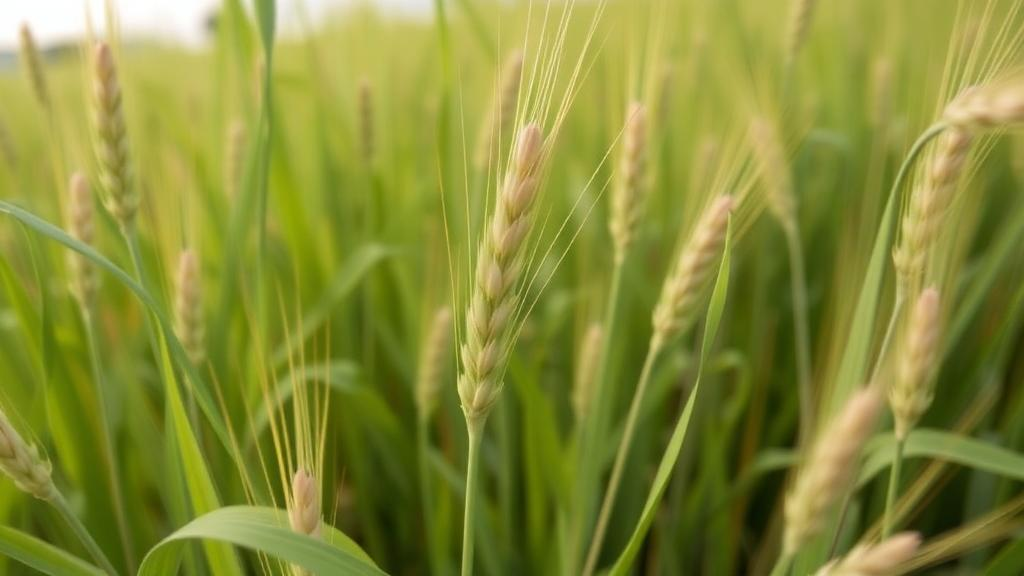
Bread wheat feeds billions, but its genome is a patchwork stitched together from wild grasses over millennia of hybridization. One of the most important contributors is Aegilops tauschii, the wild goatgrass that donated the entire D genome to modern wheat. Despite decades of intense study, this species has kept one stubborn secret: its own internal classification. Botanists have long split Ae. tauschii into two subspecies based on spike shape, yet the genetic data never quite lined up with the morphological categories, leaving a mismatch that has puzzled wheat researchers for generations. A new study published in BMC Genomics by Laibin Zhao, Ming Hao, Dengcai Liu and colleagues now claims to have cracked the puzzle, using a combination of precise morphological scoring and chromosome painting to redraw the subspecies boundaries of wheat’s wild ancestor.
The traditional taxonomy rested on a simple visual distinction. The subspecies tauschii carries cylindrical spikes, in which the spikelets sit evenly along the head, while the subspecies strangulata displays moniliform spikes, so called because the spikelets bulge like beads on a necklace. The trouble arose with a third group of accessions whose spikes looked intermediate, showing only mildly moniliform spikelets. These intermediate plants refused to fit either category, and their evolutionary origin remained almost entirely unexplained. Worse, when researchers compared the morphological assignments with molecular phylogenies, the two classifications frequently disagreed, a mismatching that the authors describe as a long-standing puzzle for the species.
To bring objectivity to a debate that had relied on eyeballing spike shapes, the team adopted a quantitative measure known as the spikelet index, a ratio-based score derived from spike morphology that captures the degree of moniliformity along the spike. Rather than sorting plants into subjective bins, the index allowed every accession to be placed on a continuous scale. The researchers applied this criterion to a large and diverse collection of 399 Ae. tauschii accessions, spanning the natural range of the species. The result was striking: 238 accessions had clearly cylindrical spikes, 56 had moniliform spikes, and 105 fell into the intermediate category with mildly moniliform spikelets, meaning that more than a quarter of the collection could not be assigned to either classical subspecies by appearance alone.
Before diving into the genetics, the team also ran a classical inheritance experiment. They made 25 reciprocal crosses between plants of ssp. tauschii with cylindrical spikes and plants of ssp. strangulata with moniliform spikes, then examined the spike morphology of every F1 hybrid produced. In every single cross, regardless of which parent served as the male or the female, the offspring displayed intermediate spikes. This result carried two important messages. First, the intermediate phenotype is not a rare anomaly but the expected outcome of combining the two subspecies, suggesting a genetic architecture in which the moniliform form is not simply dominant. Second, the uniformity across reciprocal crosses indicated that cytoplasmic effects play little or no role in shaping spike form, pointing instead to nuclear genetic factors.
With the morphology quantified, the researchers turned to fluorescence in situ hybridization, or FISH karyotyping, a cytogenetic technique that uses fluorescently labeled DNA probes to paint specific sequences onto chromosomes. They employed two probes, oligo-pTa-535 and (CTT)10, which bind to distinct repetitive sequence families distributed in characteristic patterns across the seven chromosomes of the D genome. Because these signal patterns are inherited and stable, they act as chromosome-level barcodes, allowing researchers to compare karyotypes across hundreds of accessions and to spot any structural rearrangements that might have occurred during the species’ evolution.
The FISH analysis delivered a remarkably clean answer. The 399 accessions fell into just two clusters, designated FISH-C1 and FISH-C2, based on their chromosomal signal patterns. Even more satisfying, these two cytogenetic clusters matched perfectly with the two clusters produced by the spikelet index, SI-C1 with low index values and SI-C2 with high index values, and those in turn corresponded to the two major phylogenetic lineages, L1 and L2, previously assembled from molecular data. For the first time, the botanical, cytogenetic and molecular classifications of Ae. tauschii aligned into a single coherent framework. The team also identified two FISH markers, 2D-CTT-4 and 2D-535, that can be used to accurately distinguish the two clusters, providing a practical diagnostic tool for future work.
Within this tidy picture, the study also uncovered signs of genomic turbulence. Twelve accessions carried obvious chromosomal rearrangements, visible as altered FISH signal patterns, and most of these rearranged plants originated from Iran. The supplementary data document specific translocations, such as exchanges between chromosome arms 2DS and 3DS and between 2DL and 3DL in one accession. Such structural variants are more than curiosities; they can suppress recombination, shuffle gene content and generate novel variation, and their concentration in a particular geographic region hints at localized evolutionary dynamics within the species’ range.
The most consequential finding, however, concerns the placement of the intermediate accessions. By combining the spikelet index with the FISH and phylogenetic data, the authors concluded that the intermediate-spike plants belong within ssp. strangulata rather than constituting a separate entity. This single taxonomic decision reconciles the previously conflicting categorizations: ssp. tauschii is now aligned with the cytogenetic and molecular lineage designated SI-C1/FISH-C1/L1, while ssp. strangulata corresponds to SI-C2/FISH-C2/L2. The intermediate forms are no longer taxonomic orphans but simply one end of the variation within strangulata, and the mismatch that plagued earlier classifications dissolves once they are assigned correctly.
The reclassification also illuminates the deep history of bread wheat itself. When the team compared the FISH patterns of Ae. tauschii with those of 219 common wheat cultivars, the wheat D genome matched the FISH-C2 pattern, the signature of ssp. strangulata. In particular, the intermediate-spike accessions from the southwestern and southern Caspian region showed FISH patterns most closely resembling those of common wheat. This points to that corner of the species’ range, around the southern shores of the Caspian Sea, as a key source of the D genome that entered wheat during its domestication-era hybridization. In other words, the very accessions that once defied classification turn out to be the closest living cytogenetic relatives of the D genome that billions of people eat every day.
The implications ripple outward in several directions. For wheat breeders, a clean two-lineage framework makes it easier to mine Ae. tauschii for useful diversity, since the D genome of wheat captures only a fraction of the variation present in its wild donor, and the L1 lineage in particular represents a reservoir of alleles absent from modern cultivars. The FISH markers 2D-CTT-4 and 2D-535 offer a fast, chromosome-level way to assign new accessions to the correct lineage before investing in genotyping or crossing. For evolutionary biologists, the study demonstrates how a quantitative morphological index, a classical crossing program and modern cytogenetics can be woven together to resolve a classification problem that neither approach could solve alone. And for the broader story of crop domestication, it sharpens the geographic focus of one of the most important hybridization events in human history, anchoring the origin of the wheat D genome to intermediate-spike strangulata populations of the southwestern and southern Caspian region. What began as a puzzle about bead-shaped spikelets ends as a clearer map of wheat’s wild heritage, one that should guide the conservation and use of this remarkable species for years to come.
Subject of Research: Subspecies classification and cytogenetic variation in Aegilops tauschii, the D-genome donor of bread wheat
Article Title: Systematic morphological and genetic comparisons defining the two subspecies of Aegilops tauschii
Article References: Zhao, L., Zuo, Z., Fu, M., Xie, D., Xian, Y., Dudnikov, A. J., Ning, S., Zhang, L., Fan, C., Hu, X., Hu, T., Ru, Z., Liu, D., & Hao, M. (2026). Systematic morphological and genetic comparisons defining the two subspecies of Aegilops tauschii. BMC Genomics. https://doi.org/10.1186/s12864-026-13343-0
Image Credits: AI Generated
DOI: 10.1186/s12864-026-13343-0
Keywords: Aegilops tauschii, bread wheat, D genome, subspecies, FISH karyotyping, spikelet index, ssp. strangulata, ssp. tauschii, chromosomal rearrangements, Caspian region, wheat domestication, BMC Genomics
Cite Scienmag News
Alan Morgan. (October 3, 2026). Goatgrass Study Resolves a Century-Old Puzzle in Wheat’s Wild Ancestor. Scienmag. https://scienmag.com/goatgrass-study-resolves-a-century-old-puzzle-in-wheats-wild-ancestor/
Alan Morgan. "Goatgrass Study Resolves a Century-Old Puzzle in Wheat’s Wild Ancestor." Scienmag, 3 October 2026, https://scienmag.com/goatgrass-study-resolves-a-century-old-puzzle-in-wheats-wild-ancestor/. Accessed 3 October 2026.
Alan Morgan. "Goatgrass Study Resolves a Century-Old Puzzle in Wheat’s Wild Ancestor." Scienmag. October 3, 2026. https://scienmag.com/goatgrass-study-resolves-a-century-old-puzzle-in-wheats-wild-ancestor/


