


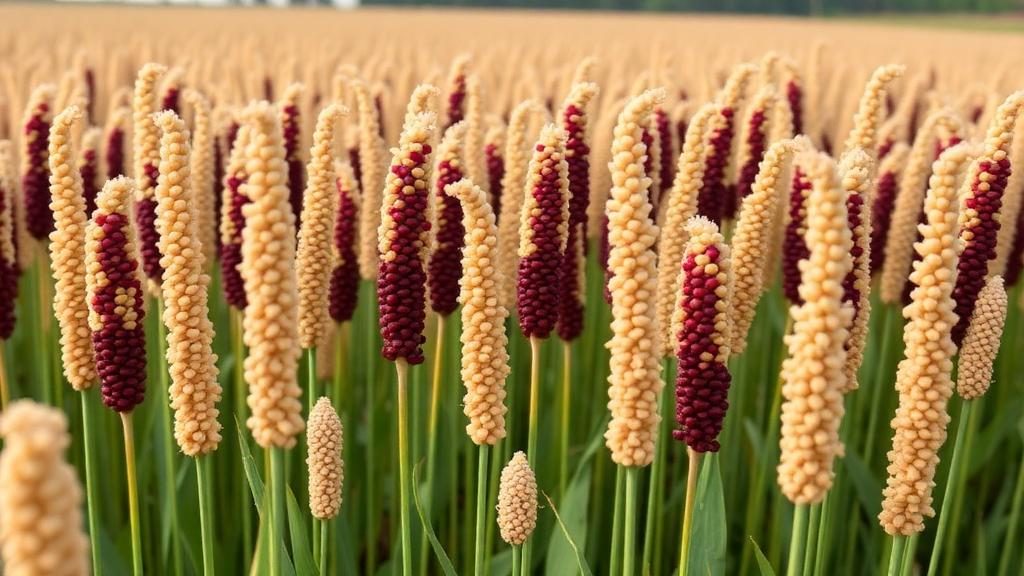
Finger millet, a humble grain that has sustained millions of people across South Asia and East Africa for millennia, is finally getting the high-tech breeding attention that scientists say it deserves. A new study published in the Indian Journal of Genetics and Plant Breeding has used sophisticated statistical modeling to identify finger millet breeding lines that deliver consistently high yields no matter where or when they are grown. The research, led by Chetana and T. E. Nagaraja of the University of Agricultural Sciences in Bangalore, together with colleagues at ICAR institutes, offers a roadmap for developing climate-resilient varieties of one of the world’s most nutritious yet underappreciated cereal crops.
The team’s central challenge was a familiar one in plant breeding: a genotype that thrives in one field may flop in another. This phenomenon, known as genotype by environment interaction, or GEI, arises because a plant’s genetic potential and the environment in which it grows do not act independently. Rainfall patterns, soil type, temperature, and season all shape how genes express themselves, and the resulting interplay can scramble the apparent rankings of breeding lines. A variety that looks like a champion in one trial may turn out to be a disappointment when farmers plant it elsewhere. Disentangling genuine genetic merit from environmental noise is therefore one of the most important tasks in modern crop improvement.
To tackle this problem, the researchers worked with two large populations of recombinant inbred lines, or RILs, which are genetically distinct lines created by crossing two parent varieties and then self-pollinating successive generations until each line is nearly genetically uniform. The first population, designated Population A, comprised 237 lines derived from a cross between GPU 28, a well-known and economically important Indian finger millet variety, and GE 1746. The second, Population B, comprised 201 lines from a cross between GPU 28 and GE 6635. GPU 28 has a documented track record of economic impact in Indian agriculture, making it a valuable donor parent for breeding programs seeking to combine its favorable traits with those of other germplasm lines.
The field evaluation was ambitious in scale and design. The two populations were tested across three environments over two cropping seasons in 2023, the Kharif or monsoon season and the Summer season, using an alpha lattice design with two replications. Alpha lattice designs are a form of incomplete block design that allows breeders to control field variability more effectively than simple randomized designs, improving the precision of yield estimates when large numbers of lines must be compared. This kind of multi-environment, multi-season testing is the gold standard for detecting how much of the observed yield variation comes from genetics, how much from environment, and how much from the interaction between the two.
The statistical backbone of the study came from two complementary analytical frameworks. The first, the Additive Main effect and Multiplicative Interaction model, universally known as AMMI, combines the classical analysis of variance with principal component analysis of the interaction term. In practical terms, AMMI first strips out the average effects of each genotype and each environment, then examines the residual interaction pattern to reveal which specific genotypes perform unusually well or poorly in which specific environments. The model can be visualized and interpreted through biplots, graphical representations that plot genotypes and environments in a shared space defined by the principal components of the interaction.
The second framework, the GGE biplot, takes a different but equally powerful approach. Rather than analyzing the interaction separately, the GGE biplot focuses on the genotype main effect plus the genotype by environment interaction effect, the two components that matter most when breeders want to know which line to recommend where. The GGE biplot has become a favorite tool among breeders because it can accomplish several tasks at once: it groups testing locations into so-called mega-environments that share the same best-performing genotypes, it identifies which locations are most discriminating and representative for testing purposes, and it reveals genotypes that combine high mean yield with high stability across sites.
The results of the AMMI analysis were unambiguous. All three sources of variation, the genotype main effects, the environment main effects, and the genotype by environment interaction, had statistically significant effects on grain yield. This triple significance confirms that both the choice of breeding line and the choice of growing environment matter, and that their interaction is large enough to influence which genotypes should be recommended to farmers. It also validates the multi-environment approach itself, because a significant interaction means that single-location trials would give misleading conclusions about overall performance.
The GGE biplot analysis then translated these statistical findings into actionable breeding information. By visualizing the yield data across environments, the researchers were able to delineate mega-environments, groups of locations where the same genotypes consistently came out on top, and to distinguish discriminating environments that effectively separate strong genotypes from weak ones. Most importantly, the analysis pinpointed specific lines that combined superior mean performance with stability across testing locations. In Population A, the standout genotypes were G229, G191, and G297, while in Population B the top performers were G130, G298, and G171. These lines represent the best of both worlds: they yield well on average and they do so reliably, without dramatic swings in performance from one environment to another.
Why does this matter beyond the breeding plot? Finger millet, known locally as ragi in India, is a nutritional powerhouse. Its grain is rich in calcium, iron, dietary fiber, and phenolic compounds with documented health-promoting properties, and recent reviews have highlighted its potential to contribute to food and nutritional security in a warming world. Millets generally require less water and fewer inputs than major cereals like rice and wheat, making them attractive candidates for climate-smart agriculture. Yet finger millet has historically received far less breeding investment than the big three cereals, which means that gains in yield and stability, even modest ones, can translate into meaningful improvements for smallholder farmers who depend on the crop.
The study also carries methodological significance for the broader plant breeding community. The authors note that their findings demonstrate the utility of AMMI and GGE models in selecting finger millet genotypes with broad adaptation and provide a statistical basis for genotype recommendation in targeted environments. In other words, the same analytical pipeline can be applied to other crops and other regions, helping breeders everywhere make more defensible decisions about which lines to advance and which testing sites to prioritize. The work builds on a rich statistical literature stretching back to the 1960s, when stability parameters were first formalized, and on decades of AMMI and GGE applications in crops ranging from rice and chickpea to wheat and soybean.
For the finger millet research community, the identification of stable, high-yielding RILs from two large mapping populations opens several doors. Because these lines are genetically characterized descendants of known parents, they can serve not only as candidate varieties but also as material for genetic mapping studies aimed at locating the genes underlying yield stability itself. The populations were originally developed partly to study grain iron content, another trait of nutritional importance, suggesting that the same lines could eventually support breeding for both productivity and nutritional quality. As climate variability intensifies and global interest in millets continues to grow, studies like this one show how classical field breeding, when paired with modern statistical tools, can quietly deliver the resilient crop varieties that food security will demand.
Subject of Research: Genotype by environment interaction and yield stability analysis in finger millet recombinant inbred line populations
Article Title: Ameliorating the Stability and Yield Potential in Finger Millet (Eleusine Coracana (L) Gaertn) Through Genotype × Environment Interaction Studies
Article References: Chetana, Nagaraja, T. E., Meenakshi, J., Vinutha, D. N., Manjunatha, M., Kavya, S., Bhat, S., Tilak, I. S., & Madhusudhana, R. (2026). Ameliorating the Stability and Yield Potential in Finger Millet (Eleusine Coracana (L) Gaertn) Through Genotype × Environment Interaction Studies. Indian Journal of Genetics and Plant Breeding, 86(1), 17-28. https://doi.org/10.1007/s44489-026-00004-5
Image Credits: AI Generated
DOI: 10.1007/s44489-026-00004-5
Keywords: finger millet, genotype by environment interaction, AMMI analysis, GGE biplot, recombinant inbred lines, yield stability, plant breeding, mega-environments, grain yield, climate resilience, multi-environment trials, Eleusine coracana
Cite Scienmag News
Alan Morgan. (October 3, 2026). Finger Millet’s Future: New Study Pinpoints High-Yielding, Stable Genotypes Across Environments. Scienmag. https://scienmag.com/finger-millets-future-new-study-pinpoints-high-yielding-stable-genotypes-across-environments/
Alan Morgan. "Finger Millet’s Future: New Study Pinpoints High-Yielding, Stable Genotypes Across Environments." Scienmag, 3 October 2026, https://scienmag.com/finger-millets-future-new-study-pinpoints-high-yielding-stable-genotypes-across-environments/. Accessed 3 October 2026.
Alan Morgan. "Finger Millet’s Future: New Study Pinpoints High-Yielding, Stable Genotypes Across Environments." Scienmag. October 3, 2026. https://scienmag.com/finger-millets-future-new-study-pinpoints-high-yielding-stable-genotypes-across-environments/


