


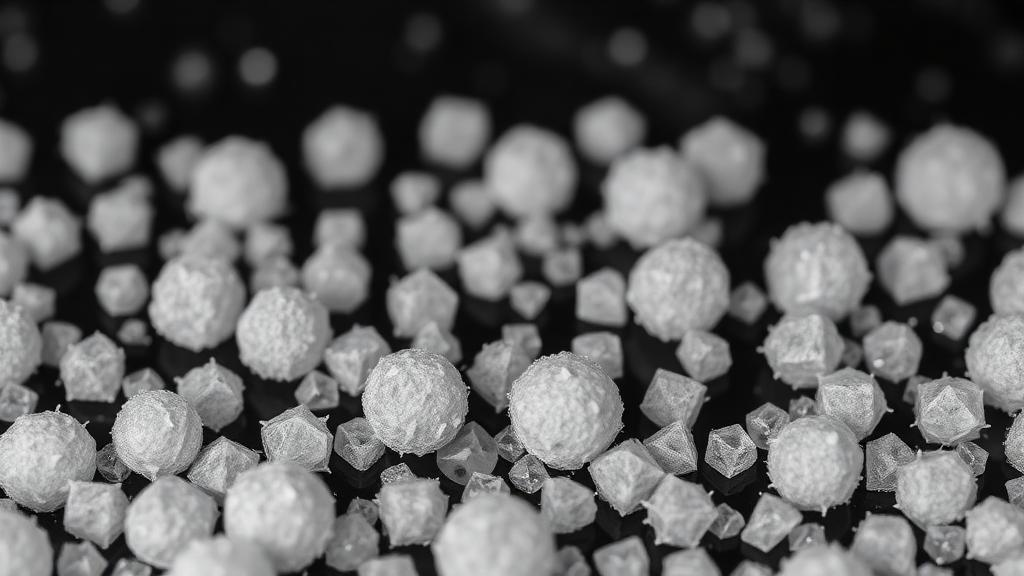
Scandium is one of the rarest and most strategically valuable elements on Earth, prized for its ability to transform ordinary aluminum alloys into lightweight, high-strength materials for aerospace components, solid oxide fuel cells, and high-intensity lighting. Yet despite its technological importance, scandium rarely forms its own ore deposits and instead appears in trace amounts scattered across red mud, lateritic nickel ores, and other industrial by-products. Extracting it from dilute, often acidic aqueous streams remains a costly chemical challenge. A new study published in Polymer Bulletin by researchers at Northeastern University in Shenyang, China, reports a biopolymer-based adsorbent that could make this recovery simpler, cheaper, and greener: microspheres of chitosan modified with polyethylene glycol and crosslinked with glutaraldehyde, engineered specifically to capture scandium ions from solution.
Chitosan, derived from chitin in crustacean shells, is one of the most abundant natural biopolymers and carries a dense array of amino and hydroxyl groups along its backbone. These nitrogen- and oxygen-containing functional groups are natural coordination sites for trivalent metal cations, which makes chitosan an attractive scaffold for metal recovery. The catch is that raw chitosan dissolves in acidic media, precisely the environment in which scandium leachates are typically found. The research team, led by Xiaoqi Liu and corresponding author Ting’an Zhang, addressed this weakness by crosslinking the polymer with glutaraldehyde, which locks the chains into an insoluble network while preserving most of the binding sites needed to grab Sc(III) ions from water.
The innovation at the heart of the study, however, lies in a second modification step. Before crosslinking, the researchers incorporated polyethylene glycol with a molecular weight of 200, known as PEG-200, into the chitosan matrix. PEG acts as a pore-forming agent: as the microspheres form, the small polymer molecules occupy space within the gel and later leave behind an open, accessible pore network. This porosity matters enormously in adsorption, because metal ions can only bind to functional groups they can physically reach. By combining PEG-assisted pore formation with glutaraldehyde crosslinking, the team achieved a balance that is difficult to strike: the crosslinks provide acid stability and mechanical integrity, while the PEG template ensures that a large fraction of the binding sites remains accessible to scandium ions in solution.
To verify that the modified material, designated MCS, had actually been fabricated as intended, the researchers subjected it to a battery of characterization techniques. Fourier-transform infrared spectroscopy confirmed the presence of the crosslinking bonds and the N- and O-containing functional groups. Thermogravimetric analysis probed the thermal behavior of the polymer network, while X-ray diffraction revealed changes in crystallinity induced by the modifications. Brunauer-Emmett-Teller measurements quantified the surface area and pore structure, and scanning electron microscopy provided direct images of the microsphere morphology, showing the improved porous architecture relative to the unmodified, glutaraldehyde-crosslinked control material, called GCS. X-ray fluorescence analysis rounded out the picture of the elemental composition. Together, these results confirmed the successful synthesis and the beneficial effect of the PEG-200 pore-forming strategy.
With the material in hand, the team systematically optimized the adsorption conditions. They found that solution pH played a decisive role, with a working pH of 5 delivering the best performance. At lower pH values, protons compete with Sc(III) ions for the amino and hydroxyl sites and can protonate the polymer, suppressing uptake; at pH 5, the balance of electrostatic attraction and coordination chemistry favors binding. The optimal dosage was 50 milligrams of adsorbent, equilibrium was reached within 100 minutes of contact time, and the experiments were carried out at 30 degrees Celsius. These parameters were then fixed for the detailed kinetic, isotherm, and thermodynamic investigations that followed.
The kinetic analysis revealed that Sc(III) adsorption onto MCS follows a pseudo-second-order model, which implies that the rate-limiting step is the chemical interaction between the scandium ions and the binding sites rather than simple diffusion. In practical terms, this means the microspheres are not merely soaking up metal like a sponge but engaging in genuine chemical bonding with the target ions. The equilibrium data, meanwhile, were best described by the Langmuir isotherm, indicating that adsorption proceeds as a monolayer on a finite number of equivalent sites. From the Langmuir fit, the researchers calculated a maximum monolayer adsorption capacity of 55.28 milligrams of scandium per gram of adsorbent at 30 degrees Celsius, a figure that outperformed the non-PEG-modified control and compares favorably with many other adsorbents reported for Sc(III) recovery.
Thermodynamic analysis added further insight into the nature of the process, and the authors concluded that the adsorption mechanism rests on three synergistic interactions. Coordination interactions between Sc(III) and the lone pairs of nitrogen and oxygen atoms in chitosan provide the primary chemical driving force. Electrostatic attraction contributes to the initial approach and attachment of the cations to the polymer surface, and hydrogen bonding involving the hydroxyl-rich matrix helps stabilize the bound species. This multi-mode mechanism is a key reason why the material performs robustly: even if one interaction weakens under changing conditions, the others continue to hold the metal ions in place.
The broader context makes this work particularly timely. Global demand for scandium has been rising with the growth of aerospace manufacturing and clean energy technologies, yet supply chains remain fragile and dominated by a handful of producers. Conventional recovery routes rely on solvent extraction, which requires large volumes of organic solvents and multiple stages of processing, or on specialized ion-exchange resins that can be expensive to synthesize. Adsorption onto biopolymer microspheres offers an alternative that is mechanically simple, potentially regenerable, and built from a renewable raw material. The Chinese team’s approach of using a cheap, low-molecular-weight PEG as a sacrificial pore template is especially appealing because it adds essentially no exotic chemistry to the process while measurably improving performance.
The study also situates itself within a growing body of literature on chitosan-based adsorbents for critical metals. Previous work has shown chitosan composites capturing chromium, copper, lead, and rare earth elements, and other researchers have explored biochar, mesoporous silicon, covalent organic frameworks, and functionalized silica resins for scandium specifically. What distinguishes the new material is the deliberate combination of acid resistance and pore accessibility in a single, easily prepared microsphere. The authors note that the synergistic pairing of PEG-200-assisted pore formation with glutaraldehyde crosslinking is what allows MCS to function in acidic aqueous media, the very condition that defeats many natural polymer adsorbents.
Looking ahead, the findings suggest a practical pathway toward integrating biopolymer adsorbents into hydrometallurgical flowsheets for scandium recovery from red mud leachates and other acidic industrial streams. Questions of selectivity against competing ions, long-term cycling stability, and scale-up of microsphere production will need further study, but the reported capacity, kinetics, and mechanistic understanding provide a solid foundation. As nations race to secure supplies of critical minerals, solutions that marry abundant biological feedstocks with clever polymer engineering may prove to be among the most sustainable tools in the arsenal. This work, supported by the National Natural Science Foundation of China and provincial and university research funds, demonstrates that sometimes the key to unlocking a scarce metal lies in a material as humble as shrimp shell chemistry, refined with a touch of everyday polyethylene glycol.
Subject of Research: PEG-modified crosslinked chitosan microspheres for the adsorptive recovery of scandium(III) ions from aqueous solutions
Article Title: Preparation of modified chitosan microspheres for the removal of Sc(III)
Article References: Liu, X., Zhang, R., Chen, T., Xiang, L., Wang, J., Lv, G., Liu, Y., & Zhang, T. (2026). Preparation of modified chitosan microspheres for the removal of Sc(III). Polymer Bulletin, 83(11), Article 626. https://doi.org/10.1007/s00289-026-06638-5
Image Credits: AI Generated
DOI: 10.1007/s00289-026-06638-5
Keywords: scandium, chitosan, adsorption, PEG-200, glutaraldehyde crosslinking, microspheres, critical metals, rare earth recovery, biopolymer, hydrometallurgy, Langmuir isotherm, water treatment
Cite Scienmag News
Bethany Barker. (October 3, 2026). PEG-Modified Chitosan Microspheres Show Promise for Scandium Recovery from Acidic Waters. Scienmag. https://scienmag.com/peg-modified-chitosan-microspheres-show-promise-for-scandium-recovery-from-acidic-waters/
Bethany Barker. "PEG-Modified Chitosan Microspheres Show Promise for Scandium Recovery from Acidic Waters." Scienmag, 3 October 2026, https://scienmag.com/peg-modified-chitosan-microspheres-show-promise-for-scandium-recovery-from-acidic-waters/. Accessed 3 October 2026.
Bethany Barker. "PEG-Modified Chitosan Microspheres Show Promise for Scandium Recovery from Acidic Waters." Scienmag. October 3, 2026. https://scienmag.com/peg-modified-chitosan-microspheres-show-promise-for-scandium-recovery-from-acidic-waters/


