


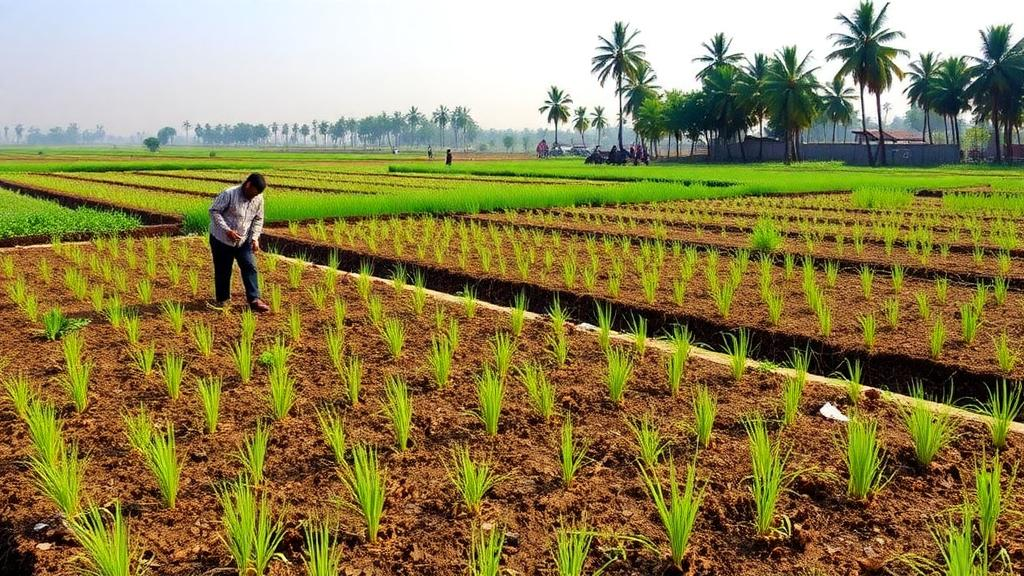
Indian agriculture stands at a crossroads. The country must produce more food for a growing population while its soils degrade, its aquifers fall, and its climate grows less predictable. A new open-access review in Discover Sustainability, led by Chetankumar Prakash Sawant of ICAR-Central Institute of Agricultural Engineering in Bhopal together with colleagues from Symbiosis International (Deemed University), takes stock of one of the most heavily promoted answers to this dilemma: conservation agriculture. Using a structured literature review methodology inspired by the Preferred Reporting Items for Systematic Reviews and Meta-Analyses (PRISMA) framework, the authors synthesize evidence on how conservation agriculture performs across India’s remarkably diverse agro-ecosystems, and their conclusion is refreshingly nuanced rather than promotional. The practice works, but not everywhere, not always, and not for the same reasons.
Conservation agriculture rests on three interlocking principles: minimum mechanical disturbance of the soil, permanent organic cover on the soil surface, and diversification of crops in space and time. In its more advanced forms, the approach also includes controlled traffic farming and permanent raised beds, which confine machinery wheels to fixed lanes and reshape the root zone. The logic is that intact soil architecture, protected by residue and fed by rotating crops, rebuilds the biological and physical machinery that decades of intensive tillage have dismantled. In India, where rice-wheat rotations dominate the Indo-Gangetic Plains and smallholder systems dominate elsewhere, the translation of these principles into practice is anything but uniform. The review emphasizes that performance varies widely with agro-ecological conditions, cropping systems, residue availability, mechanization levels, and socio-economic constraints.
The strongest evidence, according to the synthesis, concerns soil physical health. Across studies, conservation agriculture generally improves aggregate stability, the measure of how well soil particles bind into water-resistant crumbs that resist erosion and hold pore space. It also tends to increase soil organic carbon, the backbone of soil fertility, and to enhance infiltration, allowing rain and irrigation water to enter the profile rather than run off. Better infiltration feeds directly into improved moisture retention and water-use efficiency, a critical advantage in a country where irrigation already strains groundwater reserves. These are not trivial gains. Soil structure governs nearly everything else: root penetration, microbial habitat, nutrient cycling, and the capacity of a field to buffer both drought and deluge. The review treats these outcomes as well established, distinguishing them from responses that remain context dependent.
That distinction matters because several headline claims about conservation agriculture do not hold uniformly in Indian conditions. Carbon sequestration, for instance, the idea that no-till soils will lock away atmospheric carbon and help offset climate change, shows highly variable results depending on soil type, climate, residue management, and how long the practice has been in place. Nutrient stratification is another context-dependent outcome: without tillage to mix the profile, nutrients and organic matter accumulate near the surface, which can benefit shallow-rooted crops but leave deeper layers depleted. Greenhouse gas emissions present perhaps the most complicated picture. While conservation agriculture can reduce emissions associated with fuel and field operations, the review highlights a trade-off in rice systems, where flooded, residue-covered soils can increase methane production, a potent greenhouse gas. Yield responses, too, vary with soil type, climate, residue handling, cropping system, and duration of adoption, rather than following a single predictable trajectory.
On the production side, the review finds that conservation agriculture enhances yield stability and water use in irrigated cereal systems, particularly over the long term. Stability, rather than spectacular single-season yields, is arguably the more valuable metric for farmers facing increasingly erratic monsoons. A system that maintains output through a failed rainfall event or a heat spike protects both food supply and farm household income. The review also examines weed and pest ecology, an area where the news is mixed. Reduced tillage changes the germination environment for weeds, and permanent residue cover can suppress some species while favoring others, sometimes shifting pressure toward herbicide dependence. These ecological trade-offs are part of why the authors insist that conservation agriculture cannot be evaluated as a simple package but must be treated as a system whose components interact.
Perhaps the most socially charged finding concerns residue. The same crop residues that conservation agriculture wants left on the soil surface are also a critical fodder resource in a country with a vast livestock population. The review identifies residue-livestock competition as a key adoption barrier: a farmer who removes straw to feed animals is, from the soil’s perspective, undermining the permanent cover principle. This is not a marginal conflict. In mixed crop-livestock systems that dominate much of rural India, the decision about residue is an economic decision about animals, milk, and household livelihood, and no amount of agronomic persuasion will override it without alternatives such as improved fodder crops or residue substitutes. The review’s willingness to foreground this tension sets it apart from more celebratory accounts of the practice.
Machinery is the second major barrier. Minimum tillage and residue handling demand specialized equipment, including seed drills capable of planting through heavy residue, and permanent raised bed systems require their own implements. Access to appropriate machinery is uneven across regions, and smallholders often cannot afford it individually. The review also points to knowledge and extension gaps: conservation agriculture is a management-intensive system in which timing, residue handling, and weed control must be relearned, and extension systems built around tillage-based advice are poorly equipped to teach it. Regional disparities compound these problems, meaning that the same national policy can produce very different outcomes in Punjab’s mechanized rice-wheat belt and in rainfed smallholder regions of the Deccan.
The authors’ central argument is that mechanization and institutions drive outcomes beyond biophysics. In other words, whether conservation agriculture succeeds is not determined solely by soil science but by whether farmers can obtain the right machines, the right information, and the right incentives at the right time. This reframing has significant policy implications. Subsidies for zero-till drills, support for custom hiring centers that rent equipment to smallholders, and investment in extension capacity may matter as much as any agronomic refinement. The review calls for climate-smart mechanization as a research priority, alongside long-term system performance studies, integrated nutrient and water management, and policy support tailored to regional realities.
For scaling, the review’s prescription is region-specific, system-based adaptive design. There is no universal conservation agriculture template for a country spanning Himalayan altitudes, arid western plains, humid deltas, and semi-arid plateaus. In irrigated cereal systems, where water savings and yield stability are well documented, scaling can proceed with confidence. In rice systems, methane dynamics demand careful water and residue management. In fodder-scarce regions, residue retention must be negotiated with livestock economics. Adaptive design means co-developing systems with farmers, testing component combinations locally, and accepting that some principles may need modification rather than dogmatic enforcement.
The broader significance of this review lies in its honesty. Conservation agriculture has been promoted worldwide with near-evangelical fervor, and Indian programs have followed suit. This synthesis does not abandon the approach; it confirms genuine and valuable gains in soil structure, organic carbon, infiltration, water-use efficiency, and long-term yield stability. But it also insists that carbon sequestration claims, emission outcomes, and yield responses are contingent, that methane in rice is a real problem, that weeds can shift rather than disappear, and that residue conflicts and machinery gaps are structural, not incidental. For a country whose food security depends on getting the next decades of intensification right, that kind of evidence-based sobriety may be the most useful harvest of all. The review, published open access on 3 October 2026 in Discover Sustainability, offers researchers, extension agencies, and policymakers a clear map of what is known, what remains uncertain, and where the next decade of work must focus if sustainable intensification in India is to become more than an aspiration.
Subject of Research: Conservation agriculture and sustainable intensification of Indian agro-ecosystems
Article Title: Conservation agriculture for sustainable intensification in India integrating soil processes, water resources, crop performance, climate impacts, and adoption
Article References: Sawant, C. P., Gupta, A., Gautam, R., Khadatkar, A., Magar, A. P., Kumar, V., Chaudhary, V. P., & Kolekar, S. (2026). Conservation agriculture for sustainable intensification in India integrating soil processes, water resources, crop performance, climate impacts, and adoption. Discover Sustainability. https://doi.org/10.1007/s43621-026-04878-z
Image Credits: AI Generated
DOI: 10.1007/s43621-026-04878-z
Keywords: conservation agriculture, India, soil health, soil organic carbon, water-use efficiency, sustainable intensification, greenhouse gas emissions, rice-wheat system, crop residue, farm mechanization, climate resilience, adoption barriers
Cite Scienmag News
Alan Morgan. (October 3, 2026). Can Conservation Agriculture Rescue India’s Stressed Farmland? A sweeping review weighs the evidence. Scienmag. https://scienmag.com/can-conservation-agriculture-rescue-indias-stressed-farmland-a-sweeping-review-weighs-the-evidence/
Alan Morgan. "Can Conservation Agriculture Rescue India’s Stressed Farmland? A sweeping review weighs the evidence." Scienmag, 3 October 2026, https://scienmag.com/can-conservation-agriculture-rescue-indias-stressed-farmland-a-sweeping-review-weighs-the-evidence/. Accessed 3 October 2026.
Alan Morgan. "Can Conservation Agriculture Rescue India’s Stressed Farmland? A sweeping review weighs the evidence." Scienmag. October 3, 2026. https://scienmag.com/can-conservation-agriculture-rescue-indias-stressed-farmland-a-sweeping-review-weighs-the-evidence/


