


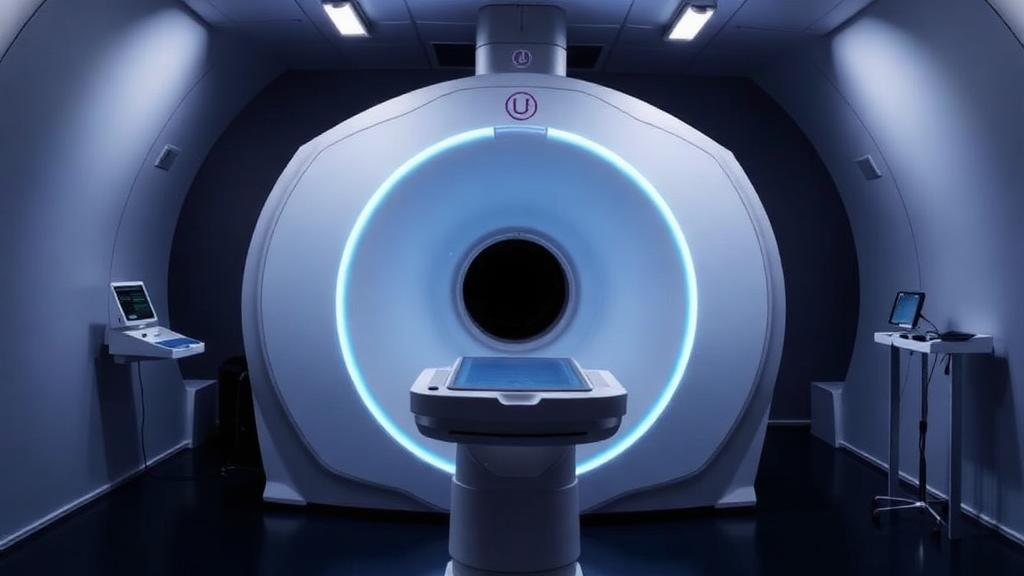
Radiotherapy teams around the world rely on cone beam computed tomography (CBCT) to position patients before each treatment session, but the same images have long been considered too imprecise for the next frontier of cancer care: adaptive radiotherapy, in which treatment plans are recalculated to track changes in a patient’s anatomy over the course of therapy. A new study from Oulu University Hospital in Finland has now put one of the most heavily marketed CBCT upgrades to a rigorous test, and the verdict is nuanced. The HyperSight imaging system, installed on Varian TrueBeam linear accelerators, delivered measurable but modest improvements in image quality, with the clearest gains appearing in the accuracy of Hounsfield unit values, the numbers that underpin radiation dose calculations. The findings, published in the Annals of Biomedical Engineering, suggest the technology could support offline adaptive workflows, but they stop short of declaring a decisive clinical breakthrough.
The research team, led by Jesse Lohela and colleagues at the University of Oulu, compared two TrueBeam machines fitted with HyperSight against two standard TrueBeam systems, using the widely recognized Catphan 504 imaging phantom. HyperSight brings a substantial hardware refresh to the imaging chain: a larger 43 by 43 centimeter detector panel replacing the standard 40 by 30 centimeter unit, a cesium iodide scintillator instead of gadolinium oxysulfide, a stronger anti-scatter grid with a ratio of 15:1 rather than 10:1, and a faster gantry rotation speed of 1.5 revolutions per minute compared with 1.0. Together these changes extend the usable field of view to as much as 70 centimeters, up from 46.5 centimeters, and enable updated iterative reconstruction algorithms with Acuros-based scatter correction and an optional metal artifact reduction mode.
The physics behind why CBCT image quality lags behind diagnostic CT is central to the study. The wide cone-shaped X-ray beam used in linac-mounted imaging generates far more scatter radiation than the narrow fan beam of a CT scanner, degrading contrast and distorting Hounsfield unit values. Slow acquisition times also make CBCT vulnerable to motion artifacts from breathing and heartbeat. Because dose calculations in radiotherapy depend on converting Hounsfield units into electron density, international guidelines from EFOMP, ESTRO, and the IAEA recommend that deviations stay within plus or minus 50 HU of baseline values for dose planning purposes. Deviations of about 20 HU in soft tissue and 50 HU in lung and bone generally keep dose calculation errors below one percent, which is why HU accuracy sits at the heart of the evaluation.
The phantom measurements, performed at 100 kV and 125 kV with all available clinical protocols and reconstruction algorithms, revealed a clear density-dependent pattern. For lower-density materials such as air, polymethylpentene, and polyethylene, the standard CBCT actually performed slightly better, while for denser inserts including acrylic, Delrin, and Teflon, HyperSight tracked the CT reference values more closely. The standard system exceeded the 50 HU tolerance for the densest materials in some protocol combinations, whereas HyperSight deviations generally remained within limits. The researchers attribute the improved linearity to the new cesium iodide scintillator, which converts X-rays to signal more efficiently and responds more consistently across a wide density range, a property that matters enormously when electron density maps feed directly into dose calculations.
Uniformity, which measures how consistently pixel values behave across a homogeneous region, also favored the upgraded system, particularly at 100 kV where the standard TrueBeam failed to meet the manufacturer’s plus or minus 30 HU tolerance in some acquisitions. Contrast-to-noise ratio showed a trend toward improvement with HyperSight, with statistically significant differences appearing only in a few specific combinations of tube voltage and reconstruction algorithm. Spatial resolution, quantified through the modulation transfer function, produced mixed results: the larger field of view of HyperSight slightly increases voxel size, which can shave away fine detail, but at the higher energy setting the upgraded system compensated and even outperformed the standard configuration at some contrast levels.
Noise characteristics told a similar story of subtle rather than transformative change. With the older filtered back-projection reconstruction, HyperSight actually showed higher average noise power, though this difference was driven largely by one specific machine, hinting at unit-to-unit variability. With iterative reconstruction algorithms, the noise spectra of the two systems became nearly indistinguishable, suggesting that modern software can suppress machine-dependent noise signatures. Low-contrast visibility, the ability to detect faint differences in tissue attenuation, showed no meaningful difference between the two techniques at either energy, and both systems passed the relevant tolerance criteria in almost all cases.
To test whether the phantom findings translate to the clinic, the team enlisted eight radiographers, the professionals who use CBCT images daily for patient positioning, in a blinded evaluation of scans from 15 patients imaged before and after the HyperSight installation. The evaluators did not know which system produced which image, and volumes were cropped to match fields of view to preserve blinding. The overall result hovered at grade C, meaning no clear preference in image quality or registration accuracy. Yet when the cases were broken down by anatomical region, the radiographers preferred HyperSight in every category except the body region, which included esophageal and femoral cases. The researchers note that status quo bias, the human tendency to favor familiar technology, may have tempered enthusiasm for the new system.
The statistical architecture of the study deserves attention because it illustrates how imaging claims should be scrutinized. The team used pairwise linear mixed models to compare matched acquisitions while accounting for machine-specific and longitudinal variability, and separately applied McNemar’s tests to determine whether differences crossed clinically meaningful tolerance thresholds. Strikingly, the mixed models revealed several differences with large effect sizes, but the McNemar tests confirmed a significant difference in tolerance compliance for only one parameter, Hounsfield unit accuracy, at one measurement point. In other words, the two systems perform similarly within the framework of international guidelines, and the authors argue that the growing importance of adaptive radiotherapy demands more robust and widely accepted image quality tolerance criteria than currently exist.
The study is not without limitations, and the authors are candid about them. Only two machines per group were evaluated at a single center, measurements were limited to three imaging sessions, and the number of paired image slices in each statistical comparison was small, in some cases as few as six. The metal artifact reduction algorithm was not assessed because it is unavailable on the standard system, and the faster acquisition speed of HyperSight, which halves scan time and should reduce motion artifacts, was not directly investigated. The blinded subjective evaluation also required cropping images, which masked one of HyperSight’s headline advantages, its much larger field of view, potentially underestimating its clinical benefit.
What emerges is a portrait of an incremental rather than revolutionary upgrade. HyperSight on C-arm linear accelerators met international and manufacturer tolerance criteria more consistently than the standard system, with the most reliable gains in the Hounsfield unit accuracy that matters most for dose calculation and offline adaptive radiotherapy. Because offline adaptation uses existing clinical tools rather than the full online team of physicists, radiographers, and oncologists, even modest improvements in image fidelity could make adaptive workflows more scalable for clinics worldwide. The Finnish team concludes that patient-based studies across multiple centers are now needed to determine whether the phantom-bench advantages translate into better treatment plans and, ultimately, better outcomes for people with cancer.
Subject of Research: Image quality evaluation of HyperSight cone beam CT on Varian TrueBeam linear accelerators for adaptive radiotherapy
Article Title: Evaluating Image Quality of Cone Beam Computed Tomography Using HyperSight® on the Varian TrueBeam
Article References: Lohela, J., Rytky, S. J. O., Karhula, S. S., & Nikkinen, J. (2026). Evaluating Image Quality of Cone Beam Computed Tomography Using HyperSight® on the Varian TrueBeam. Annals of Biomedical Engineering. https://doi.org/10.1007/s10439-026-04372-7
Image Credits: AI Generated
DOI: 10.1007/s10439-026-04372-7
Keywords: CBCT, HyperSight, TrueBeam, image quality, adaptive radiotherapy, Hounsfield units, radiotherapy, medical imaging, linear accelerator, phantom study, image-guided radiotherapy, dose calculation
Cite Scienmag News
Nathaniel Bowman. (October 3, 2026). HyperSight CBCT Upgrade Delivers Modest Image Quality Gains on Standard Radiotherapy Linacs. Scienmag. https://scienmag.com/hypersight-cbct-upgrade-delivers-modest-image-quality-gains-on-standard-radiotherapy-linacs/
Nathaniel Bowman. "HyperSight CBCT Upgrade Delivers Modest Image Quality Gains on Standard Radiotherapy Linacs." Scienmag, 3 October 2026, https://scienmag.com/hypersight-cbct-upgrade-delivers-modest-image-quality-gains-on-standard-radiotherapy-linacs/. Accessed 3 October 2026.
Nathaniel Bowman. "HyperSight CBCT Upgrade Delivers Modest Image Quality Gains on Standard Radiotherapy Linacs." Scienmag. October 3, 2026. https://scienmag.com/hypersight-cbct-upgrade-delivers-modest-image-quality-gains-on-standard-radiotherapy-linacs/


