


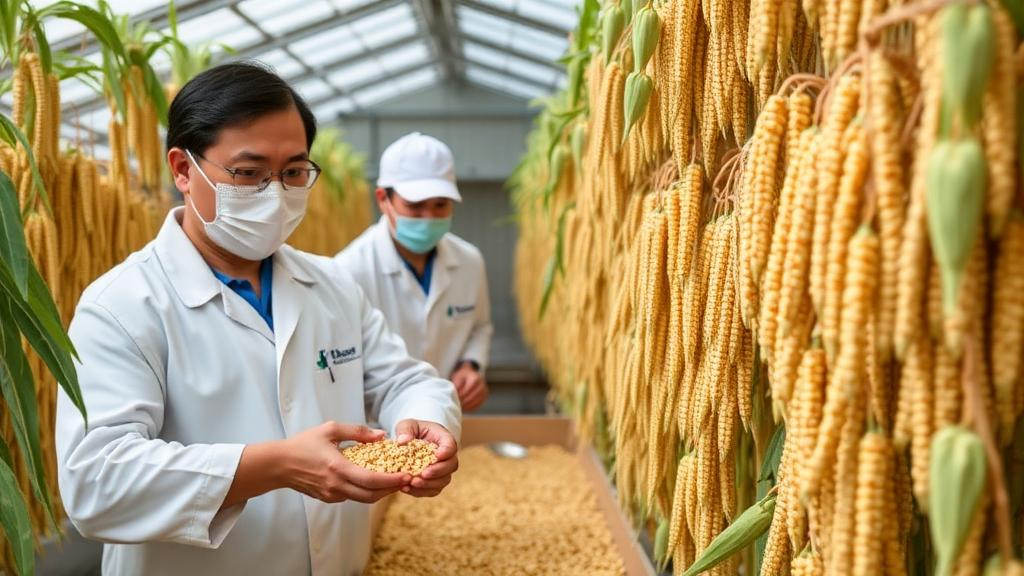
Sesame has a problem that most consumers never see. The tiny seeds that end up on burger buns and in cold-pressed oils come from a plant that, quite literally, wants to throw its harvest away. When sesame capsules mature, they split open along their sutures and fling their seeds onto the ground, an ancient dispersal strategy that modern agriculture has never fully tamed. For farmers, this means that every delayed harvest, every hot drying day, and every rough handling can translate into seeds lost before they ever reach the market. Now, researchers working at the Garoua Multipurpose Research Station in northern Cameroon have put numbers on that risk, testing seven sesame varieties under three different drying regimes to find out which ones hold on to their seeds and which ones let go too easily.
The study, published in BMC Agriculture, was led by Danielle Christelle Tinak Ekom and colleagues from Cameroon’s Institute of Agricultural Research for Development (IRAD). Their motivation is straightforward: pod shattering can slash sesame yields by as much as half, and Cameroon, which ranks 17th in global sesame production and 11th in Africa, has seen its yields decline due in part to this single trait. The team grew seven genotypes, three introduced from Niger (‘SN 203’, ‘SN 403’ and ‘SN 01–06’) and four local varieties (‘Ngong’, ‘Djalingo 1’, ‘Djalingo 2’ and ‘Djalingo 3’), in a Fisher block design with three replications per genotype at the Sanguéré-Paul research site, which sits at 222 meters above sea level in a Sudanian-Sahelian climate with alternating dry and rainy seasons.
Once the plants reached physiological maturity, the researchers harvested capsules and subjected them to three drying treatments designed to mimic real-world conditions. In the oven-dry method, sixty mature pods per genotype were placed in Petri dishes and incubated at 30 °C for three days, then stepped up to 40 °C, 50 °C and finally 60 °C for one day each, with open pods counted at every stage. In the ambient method, whole plants were dried upright at room temperature for ten days, with pod opening recorded every two days. In the field method, plants were left standing in the ground for forty days, observed every eight days. This tiered approach allowed the team to separate the effect of temperature from the effect of drying duration, two variables that farmers rarely control independently.
The results revealed dramatic differences between varieties. Under oven drying, ‘SN 403’ proved the most resilient, losing only 50 percent of its pods to shattering across the full temperature range, while ‘SN 203’ fared worst at 92.5 percent. Temperature itself emerged as a decisive factor: at 30 °C, average shattering across all varieties was just 38.1 percent, but at 60 °C it climbed to 93.1 percent. At the gentlest temperature, ‘SN 403’ shattered a mere 6.67 percent of its pods and ‘Ngong’ only 13.33 percent, while ‘Djalingo 2’ lost 63.33 percent. By the time the oven reached 50 °C and 60 °C, statistical differences between varieties had vanished, because every genotype had effectively become a super-shatterer, retaining less than 10 percent of its seeds.
The ambient drying experiment told a similar story along a different axis: time. On the second day of drying, all seven varieties still qualified as direct-combine, meaning they retained 70 to 90 percent of their seeds. But as days accumulated, the losses mounted relentlessly. Average shattering rose from 6.2 percent on day two to 85.7 percent by day ten. ‘SN 01–06’ was the worst performer at the end of the period, with 96.14 percent of pods open, followed by ‘SN 203’ at 90 percent, while ‘Djalingo 2’ held out longest, still losing 72.75 percent of its pods by day ten. The pattern is consistent with what is known about pod dehiscence in related crops: as moisture leaves the pod wall, tension builds at the sutures until the capsule fails mechanically.
Field drying, the most realistic test of all, stretched the timeline to forty days and produced the same inexorable trend. By day eight, shattering was negligible at 4.1 percent across the board, and all varieties remained direct-combine. By day forty, average shattering had reached 91.8 percent, and every variety except ‘Djalingo 1’ and ‘Djalingo 2’ had crossed into the super-shattering category. ‘Djalingo 2’ again stood out as the most field-tolerant genotype, with only 33.9 percent shattering across the whole period, while ‘Djalingo 3’ and ‘SN 01–06’ were the most vulnerable. The practical message for farmers is uncomfortable but clear: the longer ripe sesame stands in the field, the more of the crop ends up in the soil.
To quantify resistance more precisely, the team adopted Langham’s shatter-resistance framework, measuring the Unattached Seed Weight released when dried capsules were inverted and rotated, the Retained Seed Weight extracted afterwards, and the Potential Seed Weight obtained by full threshing. From these they calculated Upright Shatter Resistance (USR) and Inverted Shatter Resistance (ISR), the proportions of seeds held when a dry capsule is vertical or upside down. On this stricter quantification, none of the seven varieties achieved non-shattering status; all were classified as shattering types. Interestingly, variety alone did not significantly affect USR or ISR, suggesting that while genotypes differ in how quickly they shatter during drying, the intrinsic mechanical strength of their fully dried capsules may be more uniform than the field observations implied.
The correlation analysis added a layer of nuance for breeders. USR and ISR were strongly and positively correlated (r = 0.645, p < 0.01), meaning that a capsule strong enough to hold seeds upright is also likely to hold them when inverted, so selecting for one trait should improve the other. Empty capsule weight correlated positively with both capsule length (r = 0.679) and seed weight per capsule (r = 0.639), pointing toward heavier, sturdier pods as a breeding target. Seed weight per capsule rose with capsule length (r = 0.699) but fell with plant height (r = -0.436), hinting at a resource-allocation trade-off in which taller plants produce lighter-seeded capsules. ‘Djalingo 3’, the tallest variety at 211.7 centimeters, also carried the longest capsules and the heaviest seed load per capsule, yet it still shattered readily, confirming that no single morphological trait determines shattering on its own.
Why does heat accelerate the burst? The authors point to moisture dynamics. Elevated temperatures drive water out of the pod wall faster, degrading cellular structure and increasing tension at the dehiscence zone. Comparable work on soybean has shown the same temperature sensitivity, with shattering climbing steadily as drying temperatures rise from 40 to 60 °C, and studies of soybean pod dehiscence under ambient conditions confirm that dehiscence frequency increases as pod moisture falls over successive days. Sesame is not a legume, but its capsules behave in mechanically similar ways, and the underlying physics of drying, shrinking tissues and splitting seams, appears to be shared. Genetic background matters too: prior research has identified quantitative trait loci linked to shatter-resistant capsules in sesame, and traits such as pod wall thickness and the presence of an abscission layer are known to be heritable, giving breeders concrete targets.
The study’s conclusions carry immediate practical weight for Cameroon, where sesame is still harvested almost entirely by hand and farmers have historically favored easily detached seeds. For traditional systems, the findings suggest that timely harvest and gentle drying at around 30 °C could preserve a substantially larger share of the crop, while for the mechanized systems that Cameroon’s sesame sector aspires to, varieties like ‘SN 403’ and ‘Djalingo 2’ represent the best available starting points for developing direct-combine cultivars. The authors recommend that breeders prioritize low-shattering genotypes, that farmers adopt controlled drying practices, and that molecular markers linked to shattering resistance be deployed to accelerate selection. None of the tested varieties is yet a true non-shattering line, but by mapping exactly how temperature, time and genotype interact to open a sesame capsule, the study turns a centuries-old nuisance into a measurable, and therefore breedable, target.
Subject of Research: Genotypic variability in pod shattering resistance among sesame varieties under different drying conditions
Article Title: Assessing pod shattering resistance in sesame (Sesamum indicum L.): identification and evaluation of genotypic variability
Article References: Assessing pod shattering resistance in sesame (Sesamum indicum L.): identification and evaluation of genotypic variability. (n.d.). https://doi.org/10.1186/s44399-025-00008-8
Image Credits: AI Generated
DOI: 10.1186/s44399-025-00008-8
Keywords: sesame, pod shattering, seed retention, drying methods, genotypic variability, Cameroon, crop breeding, post-harvest losses, oilseed crops, agronomy, yield stability, Sesamum indicum
Cite Scienmag News
Alan Morgan. (October 3, 2026). Scientists Race to Stop Sesame Pods From Bursting Before Harvest. Scienmag. https://scienmag.com/scientists-race-to-stop-sesame-pods-from-bursting-before-harvest/
Alan Morgan. "Scientists Race to Stop Sesame Pods From Bursting Before Harvest." Scienmag, 3 October 2026, https://scienmag.com/scientists-race-to-stop-sesame-pods-from-bursting-before-harvest/. Accessed 4 October 2026.
Alan Morgan. "Scientists Race to Stop Sesame Pods From Bursting Before Harvest." Scienmag. October 3, 2026. https://scienmag.com/scientists-race-to-stop-sesame-pods-from-bursting-before-harvest/


