


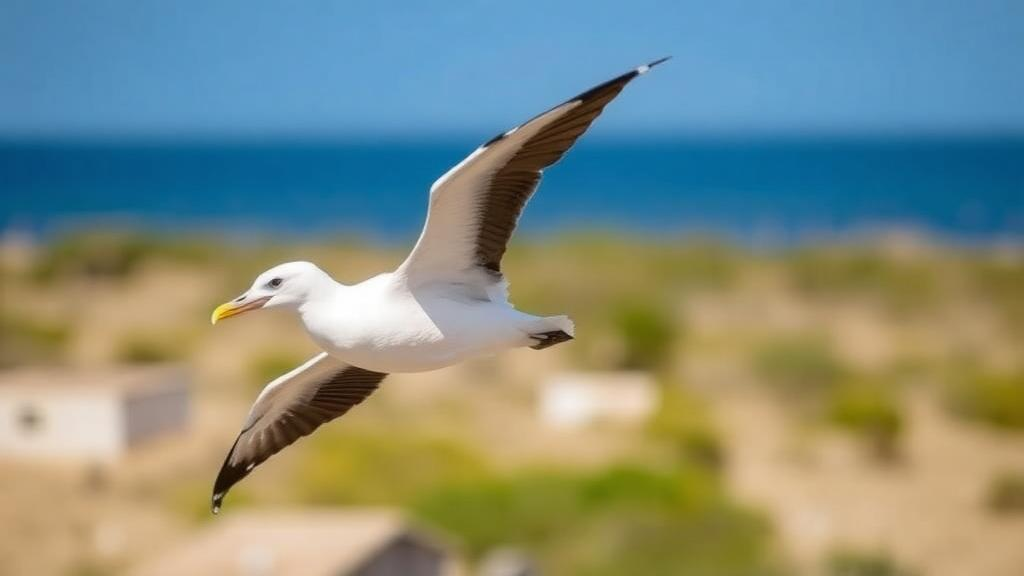
On Clarion Island, a remote volcanic outpost in Mexico’s Revillagigedo Archipelago, a small colony of Laysan Albatrosses has been trying to raise chicks for decades and has almost nothing to show for it. A new study published in Ecology and Evolution documents eight consecutive years of total breeding failure at the colony, combining GPS tracking, stable isotope analysis and hundreds of hours of direct observation to explain why. Between 2016 and 2023, researchers monitored every nest they could find on the island and recorded not a single fledgling. The findings reveal a striking mismatch between the geography of a breeding site and the energetic demands of one of the ocean’s most far-ranging birds, compounded by native predators that strike with remarkable precision at the most vulnerable moment in a chick’s life.
The Laysan Albatross, Phoebastria immutabilis, is a philopatric seabird of the North Pacific that traditionally breeds on the Hawaiian archipelago. In the 1980s, the species expanded its breeding range roughly 4,000 kilometers eastward into the eastern Pacific, establishing colonies on Guadalupe Island in 1983, Clarion Island in 1987, San Benedicto Island in 1990 and Rocas Alijos in 2003. Scientists suspect this expansion was driven by density-dependent dispersal from crowded Hawaiian colonies and by shifts in the eastern Pacific marine ecosystem, though the exact mechanisms remain unclear. What is clear is that the fates of these new colonies have diverged dramatically. On Guadalupe Island, the colony grew from a single pair in 1983 to 1,511 pairs by 2020, making it the largest Laysan Albatross colony in the eastern Pacific. Clarion Island, by contrast, has hovered between roughly 30 and 50 nests for decades with no sustained growth.
The key difference, the new research suggests, lies in where each colony can find its food. Using lightweight GPS loggers attached to the tail feathers of breeding adults, the team recovered 29 complete foraging trajectories from Clarion Island. During incubation, the albatrosses flew extraordinary distances: an average maximum distance of 3,630 kilometers from the colony, covering an average total of 9,925 kilometers per trip over roughly 14.5 days at sea. The most extreme traveler spent 18 days away, reached 5,552 kilometers from the colony and logged 14,304 kilometers of total flight. Kernel density analysis showed that these incubation-period foraging grounds sit squarely within the California Current System, with a dense concentration of use off the California coast between San Francisco and Los Angeles, about 2,000 kilometers north of the breeding colony.
That destination is the same productive region exploited by albatrosses breeding on Guadalupe Island, but Clarion’s birds must travel two to four times farther to reach it. During the chick-brooding period the pattern flips: Clarion’s albatrosses make short trips, averaging 291 kilometers from the colony and 862 kilometers total over about 47 hours, targeting waters roughly 200 kilometers south-southeast of the island. But the incubation journeys are the bottleneck. Albatrosses share incubation duties in long shifts, and although either parent can theoretically sit on the egg for up to 58 days without relief, most abandon the egg well before that limit. Adults can lose up to 22 percent of their body mass during incubation and must maintain at least 1,600 to 1,900 grams to survive. Birds in poor condition leave the egg unattended before their partner returns, and on Clarion Island that happens often.
The consequences are lethal and immediate. Across the monitored years, parental abandonment followed by consumption of unattended eggs by Common Ravens accounted for 44 to 66 percent of all breeding failures. During incubation, every single failure traced back to this sequence: an adult leaves, a raven arrives. The stable isotope analysis added a nutritional dimension to the story. The researchers measured carbon and nitrogen isotope ratios in the blood of tracked adults and found that eggs were significantly more likely to hatch when the parents’ red blood cells were less enriched in carbon-13. Using Firth penalized logistic regression to handle the small sample of 12 breeding attempts, the team found a negative association between δ13C and hatching success, with an odds ratio of 0.09, and the δ13C-only model carried the strongest support among eight candidates. The specific prey could not be identified from isotopes alone, but the signal indicates that dietary quality during incubation shapes whether an egg hatches at all, echoing patterns documented in black-browed and gray-headed albatrosses in the Southern Ocean.
Even when eggs did hatch, the chicks faced an enemy that seemed to be waiting. The Clarion Island whip snake, Masticophis anthonyi, a native and protected endemic predator, turned out to be the dominant cause of chick mortality, responsible for 26 to 41 percent of failures in the two intensively studied seasons. Focal observations at nine nests recorded 190 snake attacks on nestlings. On their very first day of life, chicks endured an average of 9.8 attacks per day, with individual nests experiencing as many as 18. A generalized linear mixed model showed that attack rates depended on weather and chick age: snakes, which rely on external heat for their physiology, were far more active on sunny days than on cloudy or rainy ones, and attacks declined as chicks grew older. Without intervention, every monitored chick was killed by a snake on the day it hatched or the day after.
The timing of the snake attacks offers a clue to how the predators find their prey. Hatching floods the nest with new organic material, including embryonic fluids, blood and excreta, and the accumulating feces steadily enrich the nest’s odor profile. Snakes hunt primarily with chemosensory cues, so the sudden olfactory beacon created at hatching plausibly explains the concentrated assault during a chick’s first days. In response, the research team implemented an intervention protocol: when a snake moved directly toward a nest and attempted to slither beneath an incubating adult or came within 10 centimeters of a chick, it was captured with a herpetological hook, measured, weighed and released at least 200 meters away. Ant predation and probable starvation accounted for smaller fractions of mortality, each under 10 percent, but the overall outcome was unchanged: zero fledglings, year after year.
Perhaps the most sobering finding is what the failure means for the colony’s future. Band-recovery records show that at least two breeding adults on Clarion were banded as chicks elsewhere, one on Whale-Skate Island and one on Guadalupe Island, and the apparent absence of local recruitment suggests the colony persists almost entirely on immigration. Newly founded seabird colonies typically depend on immigrants early on, then shift toward natal recruitment as they grow. Clarion’s decades-long reliance on newcomers is unusual, and without chicks of its own the colony cannot replace adults lost to natural or human-caused mortality. The birds’ own biology works against them: Laysan Albatrosses are famously faithful to their breeding sites and mates, returning year after year even after repeated failure, a pattern seen on Whale-Skate Island where birds nested until the island was completely flooded. That fidelity, normally an asset, can become an evolutionary trap when conditions at the chosen site are persistently hostile.
The study’s authors argue that the main causes of failure on Clarion are natural rather than anthropogenic, which complicates the conservation calculus. Controlling predators is not straightforward because both Common Ravens and the whip snake are native, and the snake is endemic and legally protected. Instead, the researchers suggest that conservation actions could include translocating eggs or newly hatched chicks from Clarion to established colonies with more favorable conditions, such as Guadalupe Island, rather than committing to indefinite intensive management of a site where reproduction appears structurally impossible. Such interventions would require careful feasibility and benefit assessments before implementation. What the eight-year record makes unmistakable is that colony size alone does not equal colony health. Clarion Island’s albatrosses look like a functioning colony, but they are, in effect, a population propped up by arrivals from elsewhere, drawn to a beautiful island where the food is too far, the ravens too patient and the snakes too quick for a single chick to survive.
Subject of Research: Breeding failure of Laysan Albatrosses on Clarion Island caused by foraging constraints and native predation
Article Title: Breeding on a Tropical Island Proves More Difficult Than Expected: The Ongoing Breeding Failure of Laysan Albatross on Clarion Island
Article References: Breeding on a Tropical Island Proves More Difficult Than Expected: The Ongoing Breeding Failure of Laysan Albatross on Clarion Island. (n.d.). https://doi.org/10.1002/ece3.74346
Image Credits: AI Generated
DOI: 10.1002/ece3.74346
Keywords: Laysan Albatross, Clarion Island, Revillagigedo Archipelago, breeding failure, foraging ecology, GPS tracking, stable isotope analysis, whip snake predation, Common Raven, seabird conservation, colony dynamics, California Current
Cite Scienmag News
Drew Townsend. (October 3, 2026). Snakes, Ravens and Long Flights: Why Albatrosses Keep Failing to Breed on a Remote Mexican Island. Scienmag. https://scienmag.com/snakes-ravens-and-long-flights-why-albatrosses-keep-failing-to-breed-on-a-remote-mexican-island/
Drew Townsend. "Snakes, Ravens and Long Flights: Why Albatrosses Keep Failing to Breed on a Remote Mexican Island." Scienmag, 3 October 2026, https://scienmag.com/snakes-ravens-and-long-flights-why-albatrosses-keep-failing-to-breed-on-a-remote-mexican-island/. Accessed 3 October 2026.
Drew Townsend. "Snakes, Ravens and Long Flights: Why Albatrosses Keep Failing to Breed on a Remote Mexican Island." Scienmag. October 3, 2026. https://scienmag.com/snakes-ravens-and-long-flights-why-albatrosses-keep-failing-to-breed-on-a-remote-mexican-island/


