


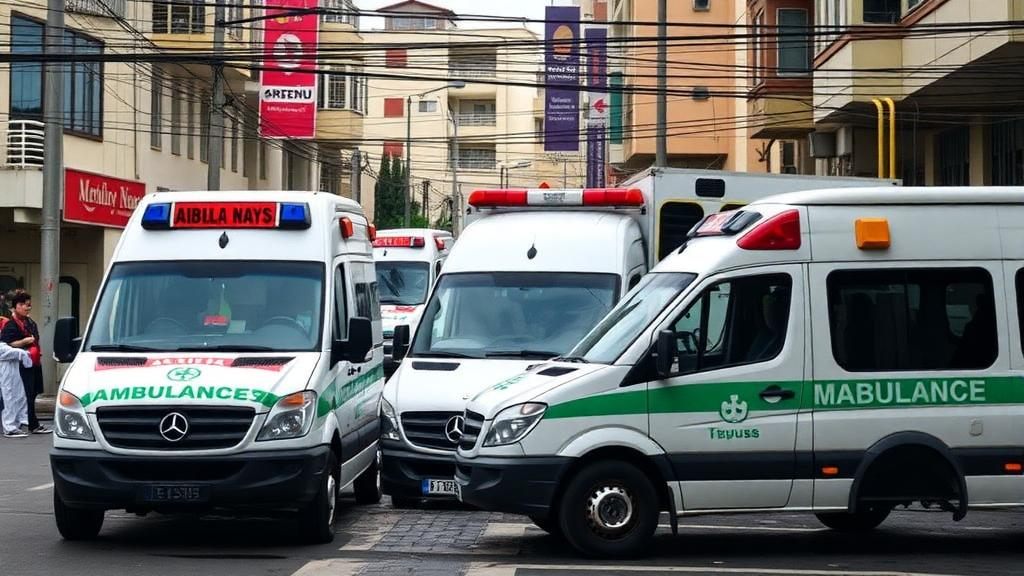
When a traffic accident victim collapses on the streets of Lima, the ambulance that arrives might be a government emergency vehicle, a hospital-based unit, a volunteer fire brigade truck, a police car, a municipal patrol, or a private ambulance that only the injured person’s family can afford to summon. Which of these responders appears, how quickly they arrive, and how well they are trained to treat life-threatening injuries depends on a patchwork of independent organizations that rarely coordinate with one another. A new qualitative study published in Global Surgical Education, the journal of the Association for Surgical Education, has mapped this fragmented landscape in unprecedented detail, drawing on forty-nine in-depth interviews with the physicians, nurses, technicians, and administrators who keep Lima’s prehospital trauma system running. The findings paint a sobering picture of a rapidly urbanizing middle-income capital where emergency care quality is unpredictable, training standards vary wildly between agencies, and many patients have concluded that calling an ambulance is not worth the wait.
The research team, led by Jaclyn A. VanDerWal and Allison D. Dentice of the Medical College of Wisconsin’s Division of Trauma, Critical Care and Acute Care Surgery, together with Peruvian collaborators at Universidad Peruana Cayetano Heredia and four Lima trauma hospitals, conducted a multi-method needs assessment across the city’s emergency care infrastructure. Rather than measuring outcomes with statistics alone, the investigators used semi-structured qualitative interviews, a methodology that allows participants to describe their experiences, frustrations, and workarounds in their own words. The interviews were analyzed using thematic analysis, a rigorous coding process in which researchers identify recurring patterns across transcripts and refine them into overarching themes. This approach is particularly valuable in health systems research because the people operating a system often understand its failure points more precisely than any external audit can capture.
What emerged from the analysis was a taxonomy of six distinct prehospital entities, each with its own capabilities, educational requirements, and geographic coverage. The first is SAMU, the public emergency medical service, which operates as the government’s formal ambulance system. The second is EsSalud, the social security health network that serves formally employed workers, meaning coverage depends on a patient’s employment status. The third, and in many ways the most consequential, is the volunteer fire service, the Cuerpo General de Bomberos Voluntarios del Perú. Volunteer firefighters are the most geographically widespread responders in Lima, yet the study found they operate without formal medical training requirements, meaning the personnel most likely to reach an injured patient may have little or no structured education in trauma care.
The fourth and fifth actors are the national police and the municipal security units known as Serenazgo. According to the study, these security forces frequently function as impromptu ambulances, transporting injured patients to hospitals in vehicles that were never designed for medical transport and staffed by personnel without formal emergency medical training. The sixth category comprises private ambulance companies, which offer a higher standard of care but remain accessible only to those who can pay for the service. The practical consequence of this fragmentation is stark: many trauma patients in Lima rely on private transportation, hailing taxis or borrowing cars, to reach emergency departments, because the formal system is perceived as slow, unreliable, or simply unavailable.
The thematic analysis of the forty-nine interviews surfaced four recurring problems that cut across all six entities. The first is fragmented organizational structure: with no unified dispatch or command authority, responsibility for a given emergency can fall through the cracks between agencies, and responders from different organizations may arrive at the same scene without a clear chain of command. The second is inconsistent educational requirements, where the level of trauma training a responder receives depends less on the medical needs of the patient than on which agency happens to be dispatched. The third is limited resource availability, encompassing shortages of equipment, vehicles, and trained personnel. The fourth is poor inter-agency coordination, which undermines even the well-resourced actors because information about patients, road conditions, and hospital capacity does not flow smoothly between organizations.
These structural weaknesses have measurable clinical consequences. Prior research cited by the authors demonstrates that prehospital trauma systems reduce mortality in low- and middle-income countries, and that the treatment a patient receives before reaching a trauma center significantly affects survival from life-threatening injuries. Studies from Peru and elsewhere have documented associations between prehospital care time and hospital mortality in traffic accident victims, and systematic reviews have mapped the so-called Three Delays framework, the delays in seeking, reaching, and receiving care, onto injury outcomes in resource-limited settings. In Lima, where road traffic injuries are a leading burden on the trauma system, the interval between injury and definitive surgical care is precisely the window in which airway management, hemorrhage control, and rapid transport save lives. A system in which the first responder may be an untrained security officer in a police vehicle forfeits much of that window.
The study’s authors frame the findings as the foundation for targeted intervention. Because the needs assessment was designed explicitly to inform the implementation of innovations, the identified themes translate directly into priorities: standardized trauma training curricula that can be adapted across agencies, professional recognition frameworks that formalize the role of volunteer and security personnel who already function as de facto first responders, and coordination mechanisms that link the six entities into a coherent network. International evidence suggests such interventions are feasible and cost-effective. Trauma training programs modeled on low-cost alternatives to Advanced Trauma Life Support have been successfully implemented in Haiti, Ecuador, Kenya, and across East, Central, and Southern Africa, and studies of Prehospital Trauma Life Support training have shown measurable improvements in on-scene time intervals. Similar community-based programs in Bolivia, a neighboring country with comparable resource constraints, have demonstrated that empowering local trauma responders can transform care in underserved regions.
The Lima study also contributes a methodological lesson for global surgery research. By centering the perspectives of the system’s principal actors, the hospital and prehospital personnel who confront the system’s gaps daily, the researchers captured operational realities that administrative data cannot reveal, such as which agencies actually respond to which emergencies and how personnel improvise when equipment or training falls short. The work builds on the team’s earlier qualitative needs assessment of Lima’s prehospital trauma system published in Surgery in 2025, extending it with a focused examination of the educational standards and organizational dynamics of each responding entity. The interviews were conducted with ethical approval from the Medical College of Wisconsin and three Lima hospitals, and informed consent was obtained from all participants, underscoring the collaborative and locally grounded nature of the research.
For the millions of residents of Lima, and for urban populations across middle-income countries facing similar rapid urbanization, the study’s message is both a warning and a roadmap. The warning is that a prehospital system composed of many independent actors with inconsistent training, variable response times, unpredictable care quality, and minimal coordination effectively functions as no system at all, pushing patients toward dangerous self-transport decisions. The roadmap is the demonstration that rigorous qualitative assessment can identify exactly where targeted training interventions and professional education frameworks would yield the greatest benefit. As the authors conclude, the urgent need is not merely for more ambulances but for a coherent professional structure, shared standards, formal recognition, and inter-agency coordination, that turns Lima’s six parallel emergency networks into a single, reliable safety net for the injured.
Subject of Research: Prehospital trauma care education and emergency medical services organization in Lima, Peru
Article Title: Urban trauma education in a middle-income country: a qualitative review of Lima, Peru’s prehospital emergency system principal actors
Article References: VanDerWal, J. A., Dentice, A. D., Zavala-Wong, G., Chavarria, M., Agrawal, A., Blaser, M., Morales, C. E., Leal, B. R., LaGrone, L. N., Arredondo-Manrique, G., Betalleluz Pallardel, J. R., Aragon-Graneros, G., Rodríguez-Castro, M., Borda-Luque, G., Castro-Dolorier, A., Allagual, A., Huamán-Egoávil, E., & Iverson, K. R. (2026). Urban trauma education in a middle-income country: a qualitative review of Lima, Peru’s prehospital emergency system principal actors. Global Surgical Education – Journal of the Association for Surgical Education, 5(1), Article 139. https://doi.org/10.1007/s44186-026-00541-3
Image Credits: AI Generated
DOI: 10.1007/s44186-026-00541-3
Keywords: prehospital care, trauma education, emergency medical services, Peru, global health, qualitative research, middle-income countries, trauma systems, medical training, urban emergency care, inter-agency coordination, Lima
Cite Scienmag News
Courtney Benton. (October 3, 2026). Six Ambulance Systems, One City: Inside Lima’s Fragmented Prehospital Trauma Care Network. Scienmag. https://scienmag.com/six-ambulance-systems-one-city-inside-limas-fragmented-prehospital-trauma-care-network/
Courtney Benton. "Six Ambulance Systems, One City: Inside Lima’s Fragmented Prehospital Trauma Care Network." Scienmag, 3 October 2026, https://scienmag.com/six-ambulance-systems-one-city-inside-limas-fragmented-prehospital-trauma-care-network/. Accessed 3 October 2026.
Courtney Benton. "Six Ambulance Systems, One City: Inside Lima’s Fragmented Prehospital Trauma Care Network." Scienmag. October 3, 2026. https://scienmag.com/six-ambulance-systems-one-city-inside-limas-fragmented-prehospital-trauma-care-network/


