


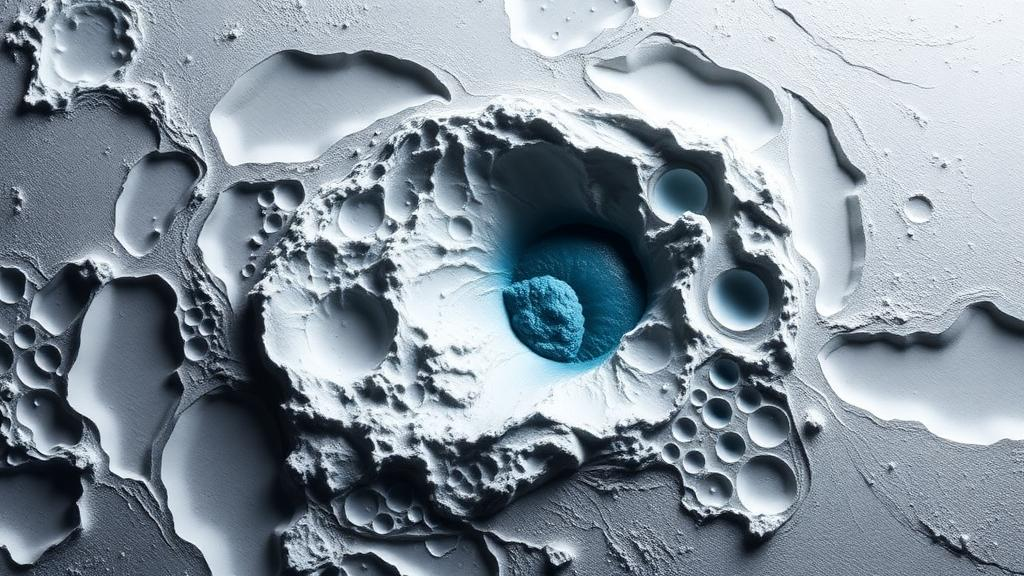
Saturn’s icy moon Enceladus has long stood near the top of the list of places where scientists hope to find life beyond Earth. Beneath a shell of ice that blankets the entire moon lies a global ocean of liquid saltwater, and at the moon’s south pole, that ocean leaks into space. Jets of water vapor and tiny ice particles erupt from deep fractures and climb hundreds of miles above the surface, feeding Saturn’s diffuse E ring. NASA’s Cassini spacecraft, which arrived at Saturn in 2004, repeatedly flew directly through this plume, sampling ocean-derived material without ever landing or drilling through miles of ice. Those flybys revealed salts, organic compounds, and chemical evidence of water interacting with rock on the moon’s seafloor. Now a new study published in Science Advances suggests that Enceladus may be doing future mission planners an enormous favor: the moon itself appears to sort and concentrate ocean chemistry into individual ice grains, potentially making faint molecular biosignatures far easier for a spacecraft to detect.
The research, led by Frank Postberg of Freie Universität Berlin with co-author Fabian Klenner, an assistant professor of planetary sciences at the University of California, Riverside, examined nearly 1,000 individual salt-rich ice grains recorded by Cassini’s Cosmic Dust Analyzer. What the team found was striking. Rather than each grain carrying a uniform, diluted snapshot of the ocean’s average composition, the grains displayed far greater compositional diversity than scientists had previously recognized. Some grains were dominated by sodium chloride, ordinary table salt. Others were rich in carbonates, phosphates, hydroxides, or potassium-bearing salts. The plume, in other words, is not a simple mist of seawater. It is a chemically sorted collection of fragments, each carrying a different slice of the ocean’s dissolved inventory.
“We show that each grain is not necessarily a tiny scoop of the ocean,” Klenner said. “It is more of a fragment of a much larger ocean droplet in which freezing separated the salts before that droplet broke apart.” That distinction may sound subtle, but it reshapes how every plume measurement from Cassini, and every future plume sample, should be interpreted. If a single grain represents only a fragment of a once-larger droplet, then the composition of that grain reflects a freezing history, not merely the bulk chemistry of the ocean. Reading the plume correctly means understanding the physical process that created it.
To reconstruct that process, the researchers combined Cassini data with laboratory experiments, thermodynamic calculations, and models of droplet cooling. In the laboratory, they froze droplets of alkaline salt water formulated to resemble the Enceladus ocean as scientists currently understand it. The results revealed a clear dependence on size and cooling rate. Larger droplets, which cooled relatively slowly, developed distinct salt-rich regions within themselves as different compounds crystallized and segregated at different stages of freezing. The smallest and most rapidly frozen droplets, by contrast, remained chemically uniform, locking in a more homogeneous mixture before separation could occur. Freezing rate, in effect, acts as a sorting engine.
“When these droplets freeze relatively slowly, different salts can separate into distinct regions within a single grain,” Klenner said. “For example, sodium chloride could concentrate in one region and potassium chloride in another. As the grain is accelerated through the vents, collisions with the icy walls can break it into smaller fragments with different compositions. This is the mechanism we propose.” The team’s model begins at the ocean surface, where bursting bubbles produce spray droplets. Water vapor carries those droplets upward through long cracks in the ice shell, and the journey is slow enough, thermally speaking, for the salts to separate into distinct domains within each freezing droplet. Closer to the surface, the passages narrow, the vapor accelerates, and the frozen droplets are flung along at a few hundred miles per hour. Collisions with the icy walls of the vents then shatter the partially frozen grains into micrometer-scale fragments, each inheriting the composition of the region it came from.
The implication for the search for life is profound. On Earth, concentrating a sample is one of the most labor-intensive steps in analytical chemistry. Detectors are sensitive, but the molecules of interest are often vanishingly rare, and scientists must expend considerable effort to enrich them before instruments can reliably identify them. Enceladus, according to the new findings, performs this concentration step naturally. “Enceladus actually does a lot of the work for us in preparing samples for analysis that usually take a lot of effort in chemical labs on Earth,” Postberg said. “The oceanic constituents are separated from each other and simultaneously concentrated into individual ice particles.” A future spacecraft flying through the plume would, in effect, be handed a set of pre-sorted, pre-concentrated samples generated by the moon’s own plumbing.
The same physics that segregates salts may also segregate organic molecules, and that is where the stakes rise dramatically. If organic compounds, including molecules that could serve as signatures of biological activity, partition into the same salt-rich regions during slow freezing, then those compounds may appear at elevated concentrations in only a small fraction of the plume’s ice grains. Klenner noted that related physical processes may help explain why some organic compounds have already been observed at high concentrations in just a small subset of Enceladus grains sampled by Cassini. Rather than being a nuisance, that scarcity becomes a clue: the most chemically interesting grains are the outliers, and they exist precisely because the freezing and fragmentation process concentrated rare material into a few particles.
“This tells us something important about the search for life on Enceladus,” Klenner said. “Molecular signatures of life, if present, may be concentrated in only a few grains. A future spacecraft has to find exactly those grains.” That requirement carries direct consequences for mission design. An instrument that averages its signal across many particles at once would blur the natural separation the moon has created, potentially erasing the very biosignature it was sent to find. Combining many particles into a single measurement could conceal rare compounds entirely. Analyzing grains individually, by contrast, preserves the grain-to-grain differences that carry the most information about the ocean below.
“Analyzing a large number of individual grains increases our chances of finding interesting compositions and gives us a better picture of the ocean as a whole,” Klenner said. “The most useful information is in the differences from grain to grain. Future missions should analyze as many individual grains as possible.” In practical terms, that points toward high-throughput mass spectrometry capable of characterizing large numbers of single particles during fast flybys, rather than integrating signals over swarms of grains. It also suggests that statistical approaches borrowed from other fields, in which rare events within large populations carry the decisive signal, will become central to plume science. The diversity of the grain population is not noise to be averaged away; it is the message itself.
The study reflects a broad international collaboration, with contributors based in Germany, Japan, China, the United Kingdom, and the United States, and it was supported in part by funding to Klenner from NASA and the European Research Council. For Klenner, whose laboratory at UC Riverside studies how organic molecules and possible biosignatures appear in individual ice grains and how spacecraft mass spectrometers could distinguish biological from nonbiological chemistry, the work marks a step toward a concrete strategy for one of astrobiology’s central challenges: telling a genuine signature of life apart from ordinary chemistry. Enceladus offers an ocean in contact with rock, an energy supply, and organic chemistry, the basic ingredients considered necessary for habitability. What it lacked, until now, was a known way to concentrate any faint biological signal into something a passing spacecraft could actually measure. If the freezing-and-fragmentation mechanism described in the new paper holds, the moon has been preparing its own samples all along, sorting its ocean into millions of tiny, chemically enriched messengers and launching them into space for anyone with the right instruments to read.
Subject of Research: Compositional segregation of salt-rich ice grains in the Enceladus plume and its implications for detecting biosignatures
Article Title: Saturn’s moon offers clues in search for extraterrestrial life
Article References: Saturn’s moon offers clues in search for extraterrestrial life. (n.d.). Original publication
Image Credits: AI Generated
DOI: Not provided
Keywords: Enceladus, Saturn, Cassini, astrobiology, biosignatures, ice grains, ocean world, plume, mass spectrometry, salt segregation, Science Advances, search for life
Cite Scienmag News
Violet Maxwell. (October 3, 2026). Enceladus May Sort Its Ocean Chemistry Into Grains, Easing the Hunt for Life. Scienmag. https://scienmag.com/enceladus-may-sort-its-ocean-chemistry-into-grains-easing-the-hunt-for-life/
Violet Maxwell. "Enceladus May Sort Its Ocean Chemistry Into Grains, Easing the Hunt for Life." Scienmag, 3 October 2026, https://scienmag.com/enceladus-may-sort-its-ocean-chemistry-into-grains-easing-the-hunt-for-life/. Accessed 3 October 2026.
Violet Maxwell. "Enceladus May Sort Its Ocean Chemistry Into Grains, Easing the Hunt for Life." Scienmag. October 3, 2026. https://scienmag.com/enceladus-may-sort-its-ocean-chemistry-into-grains-easing-the-hunt-for-life/


