


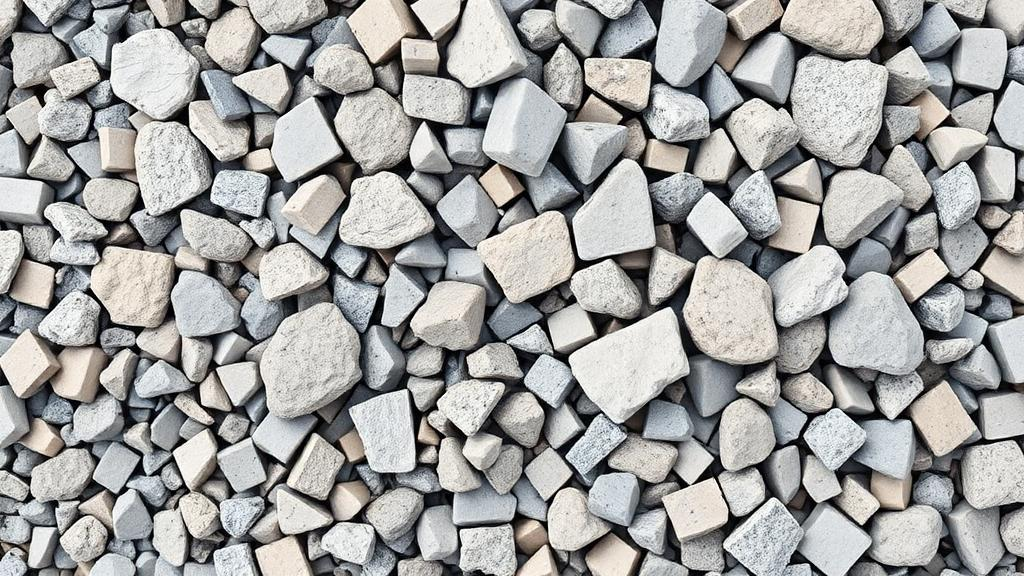
Every year, the global construction sector churns out more than 3.57 billion tons of construction and demolition waste, a mountain of shattered concrete, brick, and mortar that mostly ends up in landfills or low-grade road fill. Recycling this rubble back into fresh concrete has long been an obvious goal for a circular economy, but the recycled aggregates produced from demolition waste carry a stubborn flaw: a coating of weak, porous adhered mortar that degrades the strength and durability of any new concrete made with them. Now, a research team from CSIR-Central Building Research Institute in Roorkee and the Thapar Institute of Engineering and Technology in Patiala, India, reports a surprisingly elegant fix. Instead of stripping that old mortar away with aggressive chemicals, they treat the aggregates with oxalic acid, a mild organic acid, and let a protective mineral layer grow on the surface. The result, published in Environmental Science and Pollution Research, is recycled aggregate concrete that is dramatically stronger than anything conventional acid treatments have delivered.
The core problem with recycled aggregates is well understood. When old concrete is crushed, fragments of the original natural stone remain encrusted with hydrated cement paste, the soft, capillary-rich residue of the demolished structure. This adhered mortar is far weaker and more porous than the parent rock, so it acts as a built-in weak zone. Water penetrates readily, the interfacial transition zone between aggregate and new cement paste is compromised, and the resulting concrete loses compressive strength, tensile strength, and long-term durability. Previous strategies have attacked the problem in various ways: mechanical grinding, thermal treatment, carbonation, polymer impregnation, and, most directly, acid soaking. But the acids used so far have mostly been strong inorganic acids such as hydrochloric acid and sulfuric acid, and the literature shows these can do as much harm as good, dissolving cementitious phases deep inside the aggregate and undermining its structural integrity.
The Indian team, led by Anchal Aggarwal together with Sanjeew Kumar Singh and Gaurav Goel, took a different chemical route. They chose oxalic acid, an organic acid with the formula C2H2O4, best known as the compound that gives rhubarb its sharp taste and, less glamorously, as a chief constituent of kidney stones. The choice is chemically shrewd. When oxalic acid meets the calcium-rich phases of cement mortar, it does not simply dissolve them; it reacts with calcium ions to precipitate calcium oxalate, an insoluble crystalline salt that deposits directly on the aggregate surface. Rather than etching the aggregate away, the treatment converts the troublesome outer mortar into a dense, mineralized skin. The researchers describe this as surface activation rather than surface removal, a conceptual shift that turns out to be the key to the method’s success.
To understand exactly what the acid was doing at the microscale, the team subjected the treated aggregates to a battery of advanced characterization techniques, including X-ray diffraction, field-emission scanning electron microscopy with energy-dispersive X-ray spectroscopy, Fourier-transform infrared spectroscopy, thermogravimetric analysis, and transmission electron microscopy with elemental mapping. Together, these tools painted a consistent picture. The treated surfaces were coated with calcium oxalate crystals, calcium had been redistributed across the interfacial region, and pozzolanic crystalline deposits had formed, all of which contribute to a denser, better-bonded interface between the recycled aggregate and the surrounding cement paste in fresh concrete. In effect, the treatment builds a chemically compatible bridge between old mortar and new cement rather than leaving a porous, weak seam.
The mechanical evidence was equally striking. In impact tests, oxalic acid-treated aggregates outperformed aggregates treated with sulfuric acid by 4.6 percent and hydrochloric acid-treated aggregates by 5.9 percent, confirming that the organic treatment preserves and even enhances aggregate integrity where inorganic acids degrade it. Water absorption, the single most telling indicator of aggregate porosity, told a similar story. Untreated recycled aggregates absorbed 3.68 percent water by weight, a figure that dropped to 2.80 percent after sulfuric acid treatment and 2.75 percent after hydrochloric acid treatment. Oxalic acid pushed the figure down to 2.45 percent, evidence of genuine surface pore refinement and reduced accessible porosity rather than mere surface cleaning.
The most consequential results came when the treated aggregates were cast into concrete and tested at 28 days. Compared with concrete made from untreated recycled aggregates, the oxalic acid-treated material showed a 29.5 percent increase in compressive strength and a 35.2 percent increase in splitting tensile strength. Those are not incremental gains; they represent the difference between recycled aggregate concrete that must be derated and blended with virgin stone and concrete that can genuinely compete with conventional mixes in structural applications. The authors attribute the superior performance to the combined effects of adhered mortar modification and the formation of a calcium oxalate-rich surface, emphasizing that the benefit comes not from simply washing the old mortar away but from chemically transforming it into something useful.
Beyond raw performance, the choice of oxalic acid carries practical and safety advantages that could matter enormously for industrial adoption. Concentrated hydrochloric and sulfuric acids are among the most hazardous reagents in routine industrial use, demanding corrosive-resistant equipment, specialized storage, and rigorous worker protection protocols. Oxalic acid, while still requiring sensible handling, is comparatively less hazardous to store and manage, which lowers both operational costs and the regulatory burden of scaling the process to the enormous throughputs that aggregate processing plants demand. For an industry that consumes billions of tons of material annually, even modest simplifications in chemical handling translate into significant economic and safety dividends.
The environmental case was reinforced by a preliminary screening-level carbon and life-cycle assessment, which indicated a potential environmental advantage for the oxalic acid route relative to conventional treatments. Life-cycle thinking is essential here, because a treatment that improves concrete strength but imposes a heavy chemical or energy footprint would simply shift the environmental burden rather than reduce it. The screening assessment suggests that the mild conditions, lower hazards, and improved durability of the resulting concrete combine to make the overall proposition favorable, though the authors are careful to frame this as a preliminary, screening-level result rather than a definitive full life-cycle audit.
The work also fits into a broader and rapidly evolving research landscape. Other groups have pursued accelerated carbonation of recycled aggregates, slag-coated carbonation, nano-silica hydrophobic treatments, cement slurry coating, and thermo-mechanical upgrading, each with its own trade-offs in cost, energy, and scalability. Calcium oxalate chemistry itself has been gaining attention in materials science, from biomimetic conservation treatments for carbonate building stones to newly developed oxalate-activated calcium silicate cements, suggesting that the Indian team’s approach taps into a wider vein of promising mineral chemistry. What distinguishes the new study is its application of that chemistry directly to the adhered mortar problem, converting the recycled aggregate’s greatest liability into a strengthening feature.
If the process can be scaled economically, the implications for urban mining and circular construction are considerable. Cities effectively sit atop vast above-ground mines of demolished concrete, and technologies that upgrade this waste into high-performance raw material could simultaneously relieve landfill pressure, reduce demand for virgin sand and gravel extraction, and cut the carbon intensity of new construction. The authors position oxalic acid treatment as a sustainable route to producing high-performance recycled aggregates for circular concrete applications, and their data lend that claim real substance. Much work remains, from optimizing acid concentration and treatment duration to validating long-term durability in field structures, but the central insight is likely to endure: sometimes the best way to deal with a weak surface is not to remove it, but to grow a better one in its place.
Subject of Research: Oxalic acid surface activation of recycled construction and demolition waste aggregates for high-performance circular concrete
Article Title: Upcycling of construction and demolition waste by oxalic acid surface activation of recycled aggregates: a novel processing approach
Article References: Aggarwal, A., Singh, S. K., & Goel, G. (2026). Upcycling of construction and demolition waste by oxalic acid surface activation of recycled aggregates: a novel processing approach. Environmental Science and Pollution Research. https://doi.org/10.1007/s11356-026-38250-5
Image Credits: AI Generated
DOI: 10.1007/s11356-026-38250-5
Keywords: construction and demolition waste, recycled aggregates, oxalic acid, calcium oxalate, concrete, circular economy, surface activation, water absorption, compressive strength, life-cycle assessment, sustainable construction, adhered mortar
Cite Scienmag News
Violet Maxwell. (October 3, 2026). Oxalic Acid Turns Construction Rubble Into High-Performance Concrete Aggregate. Scienmag. https://scienmag.com/oxalic-acid-turns-construction-rubble-into-high-performance-concrete-aggregate/
Violet Maxwell. "Oxalic Acid Turns Construction Rubble Into High-Performance Concrete Aggregate." Scienmag, 3 October 2026, https://scienmag.com/oxalic-acid-turns-construction-rubble-into-high-performance-concrete-aggregate/. Accessed 3 October 2026.
Violet Maxwell. "Oxalic Acid Turns Construction Rubble Into High-Performance Concrete Aggregate." Scienmag. October 3, 2026. https://scienmag.com/oxalic-acid-turns-construction-rubble-into-high-performance-concrete-aggregate/


