


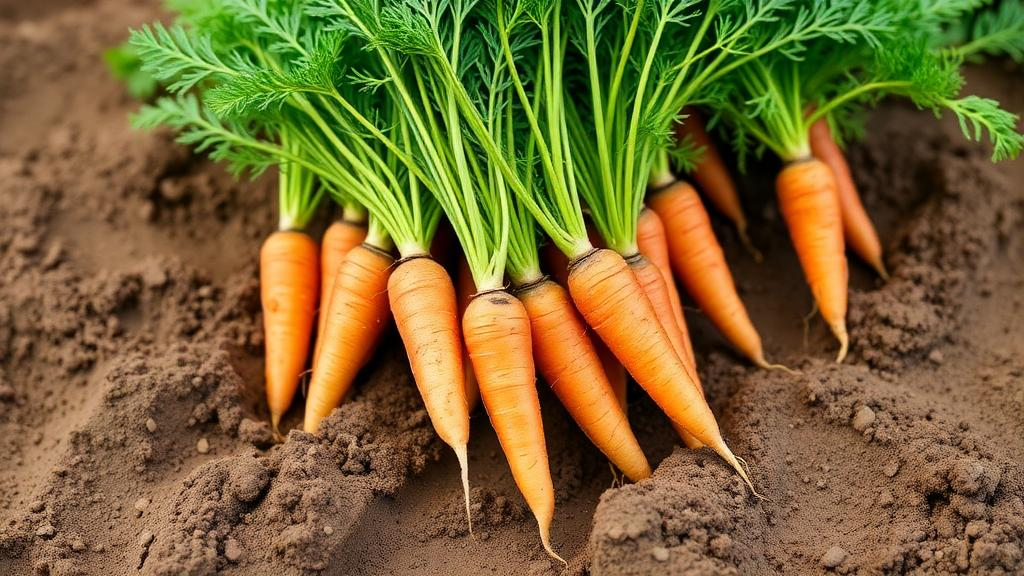
Carrots are usually thought of as a root crop, but a new study from Nigeria argues that the leafy tops matter just as much as the taproots beneath the soil, and that the best fertilizer strategy depends entirely on which part of the plant a farmer is trying to sell. In a 12-week greenhouse-style experiment published in Discover Sustainability, researchers at the University of Nigeria, Nsukka, together with a colleague at the University of Delta, Agbor, compared organic manure, inorganic fertilizer, and a combination of the two on the Kuroda carrot variety. Their results reveal a striking split: the combined approach, known as integrated nutrient management, produced the tallest plants and the heaviest leafy biomass, while straight inorganic fertilizer produced the longest and heaviest taproots. For smallholder farmers in the global South who face volatile fertilizer prices and unreliable supply chains, the finding suggests there is no single winner, only goal-oriented choices.
The research team, led by Clara U. Nwankwo and corresponding author Michael E. Ikehi, set out to answer a practical question that has grown more urgent in recent years. Global disruptions to fertilizer supply chains have sent prices soaring and left many farmers in developing regions unable to afford synthetic nutrients at the recommended rates. At the same time, demand for carrot foliage as livestock feed has been rising, turning what was once agricultural waste into a marketable secondary product. The authors frame this as a dual-market challenge: optimize nutrients for the taproot, optimize them for the leaves, or find a middle path. Their experiment was designed to test all three possibilities under identical conditions so the outcomes could be compared directly.
The methodology was deliberately straightforward. The researchers used a completely randomized design with three replicates, growing the Kuroda carrot variety over a 12-week period in four treatment groups. One group served as an unamended control, receiving no nutrient additions at all. A second received poultry manure, representing the organic option. A third received NPK 15:15:15, a balanced synthetic fertilizer supplying nitrogen, phosphorus, and potassium in equal proportions, representing the inorganic option. The fourth received a combination of poultry manure and NPK, representing integrated nutrient management. Data were analyzed using means, and analysis of variance was applied to test the null hypotheses at the 0.05 significance level, the conventional threshold in agricultural science for judging whether differences between treatments are likely to be real rather than the product of random variation.
When it came to what happens above the ground, the integrated treatment dominated. Carrots grown with the combined poultry manure and NPK treatment reached an average height of 34.39 millimeters, taller than those grown with inorganic fertilizer alone at 28.54 millimeters, organic manure alone at 32.35 millimeters, and the untreated control at 26.39 millimeters. Leaf biomass followed the same pattern, with the integrated treatment producing a value of 12.23, compared with 11.37 for organic manure, 9.10 for inorganic fertilizer, and 8.44 for the control. The pattern makes agronomic sense: organic manures release nutrients slowly as they mineralize, while synthetic fertilizers deliver an immediate pulse, and combining the two gives plants both a steady background supply and readily available nitrogen during peak vegetative growth.
Below the ground, however, the ranking flipped. Carrots grown with inorganic NPK fertilizer alone developed the longest taproots, averaging 17.86 millimeters, and the heaviest taproots, averaging 59.52 grams. The integrated treatment came in second at 14.84 millimeters and 54.15 grams, followed by organic manure at 13.35 millimeters and 42.48 grams, and the control at 11.55 millimeters and 31.25 grams. In other words, the synthetic fertilizer delivered roughly 90 percent more root weight than doing nothing at all, while the organic treatment delivered about 36 percent more. For a farmer whose income depends on selling graded taproots at market, those numbers carry real economic weight, and they explain why synthetic fertilizers have remained attractive even as their cost and availability have become less predictable.
The statistical analysis added an important layer of nuance to these numbers. While the integrated treatment produced numerically higher values for leaf biomass, the differences among treatments for that parameter did not reach statistical significance at the 0.05 level. Root tuber performance, by contrast, showed a statistically significant difference among treatments, meaning the advantage of inorganic fertilizer for taproot length and weight is unlikely to be a fluke of this particular experiment. The authors are careful to acknowledge this distinction, and it matters for how the findings should be used. A farmer choosing a fertilizer strategy to boost foliage would be making a decision on weaker statistical ground than one choosing a strategy to boost roots, and future replication studies could help firm up the biomass conclusions.
One of the more intriguing results concerns the organic treatment. Although integrated nutrient management produced the tallest plants and the highest leaf biomass score, the authors note that organic manure application alone was associated with a higher optimum harvestable root yield in their interpretation of the results, positioning it as a viable option for growers who want to avoid synthetic inputs altogether. Poultry manure is widely available and inexpensive in many parts of the global South, often generated as a byproduct of the region’s rapidly expanding poultry industry. Recycling it onto vegetable fields closes a nutrient loop, reduces waste disposal problems, and improves soil organic matter over time, benefits that extend beyond a single season’s yield even if they are harder to capture in a 12-week trial.
The broader context of the study is what gives it its urgency. The authors write that amid global fertilizer supply chain disruptions and the emerging dual-market demand for carrot taproots and leafy biomass, optimizing nutrient management is now essential for sustainability. Imported synthetic fertilizer exposes farmers in the global South to currency fluctuations, shipping delays, and geopolitical shocks that they have little power to influence. Integrated nutrient management offers a partial hedge, because a farmer who can meet part of the crop’s nutrient demand from local manure needs to purchase less synthetic product, reducing both cost and risk. The study’s results suggest that this hedge does not necessarily cost much in yield terms, since the integrated treatment was statistically comparable or superior in most measured parameters.
The dual-market angle is equally significant for the economics of smallholder carrot production. If the goal is cultivating carrots primarily for leafy biomass destined for livestock feed, the integrated treatment emerges as the optimal strategy in this experiment, maximizing the above-ground vegetative parameters that define that harvest. If the goal is the traditional taproot market, inorganic fertilizer remains the top performer, though organic manure offers a respectable and more affordable alternative. This goal-oriented framing is a departure from the usual framing of the organic-versus-conventional debate, which tends to ask which approach is universally better. The Nigerian team’s data suggest the more useful question is which approach is better for a specific product, market, and risk profile.
The study, conducted by researchers in the Department of Agricultural Education at the University of Nigeria, Nsukka, the Department of Environmental Management and Toxicology at the University of Delta, Agbor, and the Department of Home Economics and Hospitality Management at the University of Nigeria, received no specific financial support and was published as open access research. The authors conclude that adopting targeted organic and integrated nutrient management practices could provide sustainable, goal-oriented pathways to optimize agricultural production while buffering domestic farming in the global South against global challenges in food production. For a crop as familiar and widely grown as the carrot, that is a quietly radical proposition: the future of sustainable vegetable farming may depend less on choosing sides in the fertilizer debate than on matching the nutrient strategy to the harvest a farmer actually intends to bring to market.
Subject of Research: Comparative effects of organic, inorganic, and integrated nutrient management on carrot growth and yield
Article Title: A comparative analysis of organic, inorganic manures, and integrated nutrient management in carrot growth and yield in the global south
Article References: Nwankwo, C. U., Ikehi, M. E., Ashikodi, M. O., Ugwu, E. I., Nosakhare, D. O., & Ifeanyieze, F. O. (2026). A comparative analysis of organic, inorganic manures, and integrated nutrient management in carrot growth and yield in the global south. Discover Sustainability. https://doi.org/10.1007/s43621-026-04876-1
Image Credits: AI Generated
DOI: 10.1007/s43621-026-04876-1
Keywords: carrot, Daucus carota, integrated nutrient management, poultry manure, NPK fertilizer, leafy biomass, root yield, sustainable agriculture, global South, soil fertility, livestock feed, fertilizer supply chain
Cite Scienmag News
William Thompson. (October 3, 2026). Carrot Farming Study Finds Fertilizer Strategy Should Match the Harvest Goal. Scienmag. https://scienmag.com/carrot-farming-study-finds-fertilizer-strategy-should-match-the-harvest-goal/
William Thompson. "Carrot Farming Study Finds Fertilizer Strategy Should Match the Harvest Goal." Scienmag, 3 October 2026, https://scienmag.com/carrot-farming-study-finds-fertilizer-strategy-should-match-the-harvest-goal/. Accessed 3 October 2026.
William Thompson. "Carrot Farming Study Finds Fertilizer Strategy Should Match the Harvest Goal." Scienmag. October 3, 2026. https://scienmag.com/carrot-farming-study-finds-fertilizer-strategy-should-match-the-harvest-goal/


