


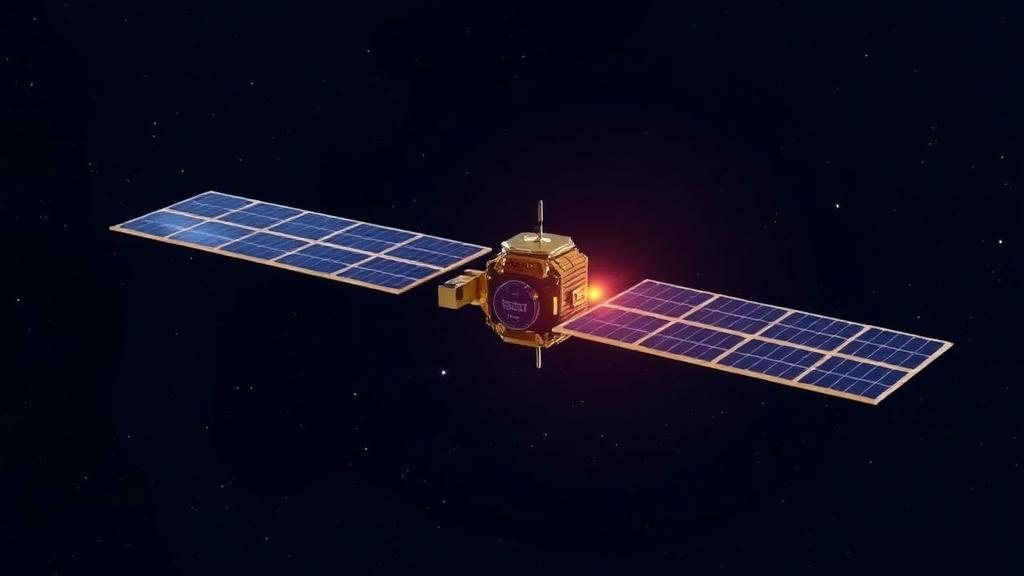
Singapore has quietly become one of the most capable small-satellite nations in Asia, and its newest orbital mission may prove to be one of its most consequential. Nanyang Technological University, Singapore (NTU Singapore) has successfully launched CRIMSON-1, the university’s fourteenth satellite, aboard a SpaceX Falcon 9 rocket on the Transporter-18 rideshare mission from Vandenberg Space Force Base in California on 1 October. Packed inside the compact spacecraft are two technologies that could reshape how future satellites generate and process power: next-generation perovskite solar cells developed in Singapore, and an artificial intelligence computing system designed to analyse images directly in orbit rather than shipping raw data back to Earth. Both experiments address fundamental bottlenecks in modern spacecraft design, and both can only be proven under the unforgiving conditions of actual spaceflight.
The mission is among the first projects supported by the National Space Agency of Singapore (NSAS) under the country’s Space Access Programme, part of the national Space Technology Development Programme. Since 2022, the Singapore government has committed S$210 million to that programme to fund research and development in space technologies and to build national capabilities. The rationale is straightforward: spaceflight heritage is the currency of the global space economy, and technologies that perform well in a laboratory still count for little until they have survived a rocket launch and operated reliably in orbit. The Space Access Programme gives Singaporean researchers and companies the chance to test advanced materials, solar cells and edge computing systems in space, accumulate flight heritage, and shorten the path from laboratory bench to commercial validation. The satellite’s operations are additionally supported by the Infocomm Media Development Authority (IMDA), which secured satellite spectrum and orbital resources from the International Telecommunication Union.
Ms Ngiam Le Na, Chief Executive of the National Space Agency of Singapore, framed the mission as a gateway for domestic innovation. “Perovskite solar cells will provide a compelling advantage over conventional solar panels – their thin, lightweight properties make them particularly well-suited for space applications, where every gram matters,” she said. “Missions like CRIMSON-1 represent a pathway for homegrown innovations to gain flight heritage needed to progress towards commercial application. By giving our researchers and companies the opportunity to test and validate their technologies in orbit, we are helping them build the credibility and track record needed to compete in the global space economy.” Her comments underscore a strategic reality: in an industry where launch costs are calculated per kilogram, a solar technology that delivers comparable power at a fraction of the mass is not a marginal improvement but a potential competitive revolution.
The solar cells aboard CRIMSON-1 were developed by NTU researchers together with Singfilm Solar, a deep-tech spin-off from the National University of Singapore. Perovskites are a class of crystalline materials with a distinctive structure that has electrified the photovoltaics community over the past decade. They can be fabricated into thin, flexible, lightweight films using commonly available and relatively inexpensive materials, and they achieve power-generation efficiencies that rival or exceed conventional silicon in laboratory settings. For satellite designers, the appeal is obvious: solar arrays are among the heaviest components of a spacecraft, and replacing rigid silicon panels with featherweight perovskite films could free precious mass budget for payloads, propellant or batteries, while flexible substrates open up new form factors for small satellites and constellations.
NTU’s involvement with these materials stretches back more than a decade to a landmark 2013 paper in the journal Science, in which a research team demonstrated that electrical charges could travel unusually long distances through perovskite materials. That finding helped explain why perovskite solar cells achieve such high efficiencies despite being made by comparatively simple fabrication processes, and it cemented NTU’s position as a pioneer in the field. In the years since, NTU researchers have scaled perovskite solar cells up towards module sizes suitable for industrial applications and developed prototypes aimed at improving both performance and long-term stability. CRIMSON-1 now takes that research programme to its most demanding test environment yet, and it also marks the first time Singfilm’s technology has flown in space.
The engineering challenge the cells must overcome is considerable. Any new solar technology destined for orbit must first survive the violent vibration and acoustic environment of a rocket launch, then endure the thermal swings of Low Earth Orbit, where a spacecraft cycles between blazing sunlight and frigid darkness roughly every 90 minutes. Radiation adds a further hazard, as high-energy particles gradually degrade semiconductor materials over time. CRIMSON-1 will assess the cells’ physical durability and efficiency after the journey from ground to space and measure precisely how much electrical power they generate in orbit. NUS Assistant Professor Hou Yi, Founder of Singfilm Solar, emphasised the significance of the flight: “This mission marks the first spaceflight of a flexible perovskite solar module built on ultrathin glass and the first deployment of a Singapore-made solar module in orbit. It will provide valuable data on how our technology performs in the harsh environment of space, helping us advance lightweight solar power for future satellites and explore its application for space-based AI data centres.”
The second major experiment aboard CRIMSON-1 tackles a different constraint of modern space operations: the bandwidth bottleneck. Conventional satellites capture images and transmit essentially everything back to ground stations, a process that consumes scarce communications bandwidth and introduces delays. CRIMSON-1 will instead test edge AI computing, in which data collected by the satellite is analysed directly on board. During the mission, the spacecraft will run AI-based image-processing tasks in orbit while researchers study how well the computing system manages heat dissipation and power consumption under heavy workloads, two of the most persistent challenges for electronics in the thermally hostile environment of space. If the approach works, future satellites could identify the most useful information before transmitting anything to Earth, dramatically reducing the volume of raw data pushed through limited satellite communication links and enabling faster responses to events on the ground.
The mission is led by NTU’s Satellite Research Centre (SaRC), the birthplace of Singapore’s satellite and space programmes and one of the few university-based centres worldwide with end-to-end capabilities spanning spacecraft engineering, launch preparation, mission control and in-orbit operations. Since the launch of X-SAT, Singapore’s first locally built satellite, in 2011, NTU has designed, built, tested and operated spacecraft ranging from small CubeSats to larger platforms, and has now launched 14 satellites into space. Its most recent previous mission, VELOX-AM, launched in July 2023 as the university’s thirteenth satellite, completed its operations and deorbited in August 2026. Data and lessons accumulated across those missions helped pave the way for CRIMSON-1 and continue to inform NTU’s development of future satellite operations. For the launch itself, SaRC scientists worked with launch integrator Exolaunch, which provided launch capacity, mission management, satellite integration and deployment services, deploying the satellite using its EXOpod Nova system.
Professor Christian Wolfrum, NTU Deputy President and Provost, highlighted the institutional breadth behind the mission. “CRIMSON-1 carries next-generation perovskite solar cells and edge AI computing into orbit. These technologies can only be validated under real space conditions, and this is what NTU’s satellite programme has been doing for three decades. CRIMSON-1 is our fourteenth mission,” he said. “What makes this possible is that NTU brings satellite engineering, artificial intelligence, and advanced materials research together in one place. The satellite was developed with local industry partners, so each mission builds capability not just in the university but across Singapore’s space sector.” That integration of disciplines under one roof is increasingly rare, and it reflects a deliberate strategy of treating space technology as a national ecosystem rather than a collection of isolated research projects.
The orbital and ground sides of the mission point toward a broader vision of AI-assisted space operations. While CRIMSON-1 tests autonomous processing aboard the spacecraft, SaRC is also exploring how artificial intelligence could help manage growing satellite fleets from the ground. Earlier this year, NTU and Japanese technology company Fusic Co., Ltd. announced a collaboration to develop AI-enabled ground systems that could assist satellite operators with mission scheduling, ground-station allocation, routine operations and earlier detection of technical problems. Together, the two efforts examine how AI could support both ends of the pipeline: processing information autonomously aboard spacecraft and helping human operators manage increasingly complex missions from Earth. Complementing SaRC’s engineering work, NTU’s Earth Observatory of Singapore applies satellite data to real-world challenges, from rapid mapping of earthquakes and floods to monitoring climate change and land subsidence. If CRIMSON-1’s perovskite cells hold up and its onboard AI performs as hoped, the mission could mark an early step toward lighter, smarter and more autonomous satellites, and perhaps, as Singfilm’s founder suggests, toward the solar-powered space data centres of the coming decades.
Subject of Research: In-orbit testing of perovskite solar cells and edge AI computing aboard the CRIMSON-1 satellite
Article Title: NTU Singapore launches CRIMSON-1 satellite to test next-gen perovskite solar cells and AI computing in space
Article References: NTU Singapore launches CRIMSON-1 satellite to test next-gen perovskite solar cells and AI computing in space. (n.d.). Original publication
Image Credits: AI Generated
DOI: Not provided
Keywords: CRIMSON-1, NTU Singapore, perovskite solar cells, edge AI computing, satellites, Low Earth Orbit, SpaceX Falcon 9, Singfilm Solar, National Space Agency of Singapore, space technology, satellite research, photovoltaics
Cite Scienmag News
Grant Pearson. (October 3, 2026). Singapore’s CRIMSON-1 satellite carries perovskite solar cells and edge AI into orbit. Scienmag. https://scienmag.com/singapores-crimson-1-satellite-carries-perovskite-solar-cells-and-edge-ai-into-orbit/
Grant Pearson. "Singapore’s CRIMSON-1 satellite carries perovskite solar cells and edge AI into orbit." Scienmag, 3 October 2026, https://scienmag.com/singapores-crimson-1-satellite-carries-perovskite-solar-cells-and-edge-ai-into-orbit/. Accessed 3 October 2026.
Grant Pearson. "Singapore’s CRIMSON-1 satellite carries perovskite solar cells and edge AI into orbit." Scienmag. October 3, 2026. https://scienmag.com/singapores-crimson-1-satellite-carries-perovskite-solar-cells-and-edge-ai-into-orbit/


