


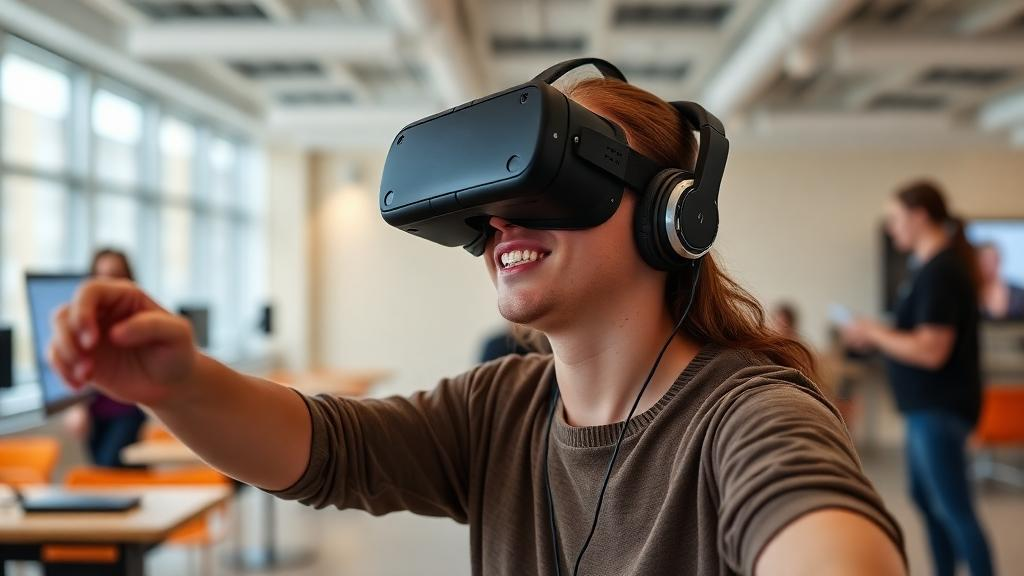
Virtual, augmented, and mixed reality have moved from the margins of educational technology to the center of university research, and a new bibliometric analysis has now quantified just how dramatic that shift has been. A team of researchers from the University of Málaga in Spain examined more than a decade of scientific output indexed in Scopus, the world’s largest abstract and citation database, and found that scholarship on immersive technologies in higher education has been growing at a pace that can only be described as exponential. The study, published in the Journal of New Approaches in Educational Research, analyzed 1,257 articles published between 2014 and 2023, and its findings reveal a field that has roughly doubled in size every two years since 2017, culminating in a record 317 articles in 2023 alone, a single year that accounted for more than a quarter of the entire decade’s output.
The methodology behind the study was deliberately rigorous. The researchers began with a Scopus search that returned 3,002 documents as of March 2024, then applied screening criteria based on the PRISMA statement, the international standard for transparent literature reviews. Non-article documents were excluded first, reducing the pool to 1,537 records, and a final selection restricted the sample to articles published within the last ten complete years. The resulting 1,257 articles were overwhelmingly in English, at 91.57 percent, with Spanish, Chinese, Russian, French, German, and Portuguese publications making up the remainder. The team then deployed VOSviewer, a specialized software tool for mapping bibliometric networks, to trace how the articles connect through shared references, co-citations, and overlapping keywords.
The technical distinction between the three technologies under study matters for understanding the field. Augmented reality overlays digital information, such as images, videos, or three-dimensional models, onto the physical environment in real time, enriching what a student sees rather than replacing it. Virtual reality, by contrast, substitutes the physical world entirely, generating simulated environments that would be difficult or impossible to experience otherwise, which allows learners to explore abstract concepts or rehearse dangerous procedures in safety. Mixed reality blends the two approaches into hybrid environments where virtual and physical elements interact. Each carries a different cognitive profile: the researchers note that shifting attention between real and virtual content can impose additional mental effort on learners, yet studies consistently show that positive effects on motivation, cognitive processing, and academic performance outweigh that cost.
Geographically, the analysis produced a striking paradox. The United States leads national output with 197 articles, or 15.67 percent of the sample, followed by China, while Asia as a whole contributed 21.8 percent of publications and Europe 22.67 percent. Yet when the researchers looked at individual authors and institutions, Spain dominated. Julio Cabero of the University of Seville emerged as the most prolific author with 13 articles, and the University of Seville itself topped the institutional ranking with 24 publications. A tightly collaborating team from the Catholic University of Ávila, formed by Vergara, Fernández-Arias, and Antón-Sancho, collectively produced nearly thirty articles. Seven of the nine most prolific authors in the field are based in Spain, with only two exceptions: Guido Makransky of the University of Copenhagen and Roland Del Maestro of McGill University, both of whom carry the strongest individual citation metrics, with Makransky holding an H-index of 30 and Del Maestro an H-index of 53.
The subject areas in which these articles are indexed tell their own story. Social sciences led with 589 articles, a figure that reflects the field’s educational core, but computer science followed closely with 432 and medicine with 284, while engineering contributed 256. Because Scopus allows multi-classification, these totals exceed the raw article count, but the pattern is clear: immersive reality research in universities sits at the intersection of pedagogy, technology, and clinical training. The journal landscape reinforces this picture. Education and Information Technologies published the most articles at 23, followed by a cluster of educational technology journals including Computers and Education, Interactive Learning Environments, and Virtual Reality, alongside medical titles such as Journal of Surgical Education and BMJ Open. Applying Bradford’s Law of scattering, the team found that just 42 journals, about 6 percent of the total, form a specialized core, while 60 percent of journals carrying this research have only low specialization in the topic.
Citation analysis revealed what actually drives influence in the field. The most cited article, by Akçayir and Akçayir in 2017, is a systematic review of augmented reality’s advantages and challenges in education, and it has accumulated 1,168 citations. The second most cited, by Radianti and colleagues in 2020, reviews immersive virtual reality applications in higher education and holds the highest citation intensity per year. A meta-analysis by Merchant and colleagues from 2014 on virtual reality’s effectiveness across K-12 and higher education ranks third. Beyond these syntheses, the most influential empirical work concentrates on health sciences: studies of augmented reality’s effects on students’ laboratory skills, virtual reality’s role in science lab simulations, and comparative effectiveness trials of both technologies in medical anatomy education. Bibliographic coupling, which links articles that share references, identified Makransky’s Copenhagen team as the most influential cluster, with the highest total link strength in the network.
Co-citation analysis, which measures how often authors are cited together, added a second layer of insight. The University of Seville pair of Cabero and Barroso showed the strongest co-citation intensities, at 1,082 and 888 respectively, confirming their stature in educational science, while Richard Mayer of the University of California and Makransky followed closely, reflecting the dominance of cognitive theories of multimedia learning in how the field frames its questions. Keyword co-occurrence analysis then mapped the field’s conceptual terrain. Of the 6,719 keywords attached to the sample, 54 appeared together more than 30 times, forming four thematic clusters. Beyond the expected Boolean anchors of virtual reality and augmented reality, the most conceptually significant terms were learning, teaching, e-learning, immersive virtual reality, and, tellingly, motivation and anxiety, alongside methodological descriptors such as controlled study and human experiment.
That emphasis on motivation and anxiety points to where the research frontier is heading. The study’s authors conclude that emerging research is increasingly oriented toward the psychological factors that shape learning with immersive resources, not merely whether the technologies work. Motivation research spans both virtual and augmented reality across disciplines from physical education to language learning, while a parallel strand investigates how virtual reality training programs can reduce anxiety, including social anxiety, public speaking fear, and anxiety-phobic disorders in university students. The analysis also documents the field’s sensitivity to external shocks: the COVID-19 pandemic, which forced universities online, significantly accelerated adoption and expanded the applicability of immersive resources across all educational levels, with particular emphasis on higher education and health sciences training.
The researchers acknowledge limitations, chiefly the decision to rely on Scopus alone, excluding databases such as Web of Science, ERIC, and SciELO to avoid duplicate records and preserve consistent indexing quality, and they note that a different time frame could have shifted the observed trends. Still, their conclusions are unambiguous. Virtual and augmented reality are now established components of the digital resource landscape in universities, with 84 percent of the decade’s articles published in just the last five years. To translate that scholarly momentum into educational practice, the team argues, institutions must invest in infrastructure, resources, and teacher training, since a persistent lack of digital competencies among faculty remains a significant barrier to creating learning situations that genuinely exploit these technologies. Future work, they suggest, should pair bibliometric mapping with systematic reviews targeting specific disciplines, examining outcomes such as academic performance, motivation, and attention, so that the next decade of immersive reality research builds deliberately on the evidence base this analysis has now charted.
Subject of Research: Bibliometric analysis of virtual, augmented, and mixed reality research in higher education
Article Title: Virtual, augmented, and mixed reality in the University environment: an analysis of scientific production
Article References: Magaña, E. C., Ariza, A. C., Ruiz-Palmero, J., & Guillén-Gámez, F. D. (2025). Virtual, augmented, and mixed reality in the University environment: an analysis of scientific production. Journal of New Approaches in Educational Research, 14(1), Article 8. https://doi.org/10.1007/s44322-025-00027-y
Image Credits: AI Generated
DOI: 10.1007/s44322-025-00027-y
Keywords: virtual reality, augmented reality, mixed reality, higher education, bibliometrics, Scopus, educational technology, immersive learning, health sciences education, motivation, anxiety, scientific production
Cite Scienmag News
Courtney Benton. (October 3, 2026). Immersive Reality Research in Universities Doubles Every Two Years, Landmark Study Finds. Scienmag. https://scienmag.com/immersive-reality-research-in-universities-doubles-every-two-years-landmark-study-finds/
Courtney Benton. "Immersive Reality Research in Universities Doubles Every Two Years, Landmark Study Finds." Scienmag, 3 October 2026, https://scienmag.com/immersive-reality-research-in-universities-doubles-every-two-years-landmark-study-finds/. Accessed 3 October 2026.
Courtney Benton. "Immersive Reality Research in Universities Doubles Every Two Years, Landmark Study Finds." Scienmag. October 3, 2026. https://scienmag.com/immersive-reality-research-in-universities-doubles-every-two-years-landmark-study-finds/


