


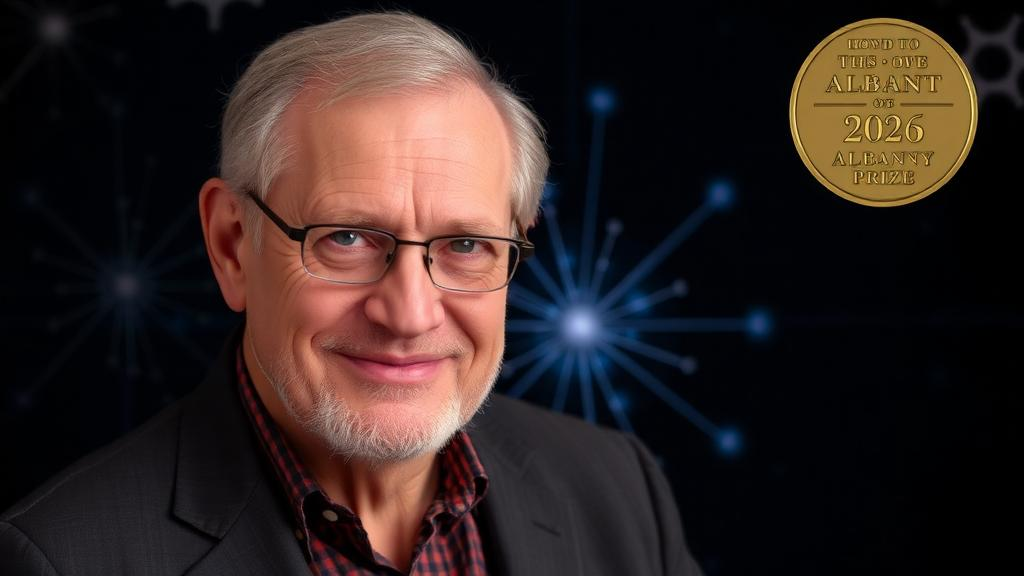
One of the most consequential accidents in the history of molecular biology has once again been recognized at the highest level. Tony Hunter, PhD, American Cancer Society Professor and holder of the Renato Dulbecco Chair at the Salk Institute for Biological Studies in La Jolla, has been named a recipient of the 2026 Albany Prize in Medicine and Biomedical Research, one of the largest and most prestigious science awards in the world. Albany Medical College selected Hunter together with UCLA oncologist Dennis Slamon, MD, PhD, honoring the two scientists for cancer biology discoveries that, in the words of the awarding institution, have together saved millions of lives worldwide. The prize carries a cash award of $500,000, funded through a landmark philanthropic commitment designed to keep the honor running for a century.
The Albany Prize has been awarded annually since 2001 and was established by the late Morris “Marty” Silverman, whose vision was to celebrate scientists whose work exemplifies the “bench to bedside” arc of modern biomedical research: fundamental discoveries made at the laboratory bench that ultimately translate into treatments that measurably improve the lives of patients across the country and around the globe. That mission is underwritten by a $50 million gift commitment from the Marty and Dorothy Silverman Foundation to Albany Medical Center, a commitment that guarantees the prize can be conferred for 100 years and has helped build its reputation to a level often described as approaching that of the Nobel Prize. Past recipients read like a roster of modern biomedical history, including former National Institute of Allergy and Infectious Disease director Anthony Fauci, CRISPR pioneers and Nobel Laureates Emmanuelle Charpentier and Jennifer Doudna, and mRNA vaccine pioneers and Nobel Laureates Katalin Karikó and Drew Weissman, among many others. Hunter’s inclusion in that company reflects the sheer reach of a single biochemical insight made more than four decades ago.
That insight concerns a molecular switch known as tyrosine phosphorylation. Phosphorylation, the process by which enzymes attach phosphate groups to amino acids within proteins, is one of the cell’s most fundamental control mechanisms, a way of flipping proteins between functional states in response to signals. For years, scientists knew that phosphate groups could be attached to the amino acids serine and threonine. What Hunter discovered in 1979, quite by accident, was that phosphate could also be linked to a third amino acid: tyrosine. The finding revealed an entirely new class of regulatory enzymes, the tyrosine kinases, which add phosphate groups to tyrosine residues and in doing so help govern how cells grow, divide, and communicate with their surroundings.
The discovery itself is a textbook example of serendipity rewarding careful observation. Hunter was conducting an experiment to separate the amino acids in a viral protein, a routine analytical procedure that depended on a buffer, a solution used to control acidity. Unknowingly, he used a buffer with a pH of 1.7 instead of the intended 1.9. That tiny difference in acidity, a shift of just two-tenths of a pH unit, altered the chemical behavior of the phosphorylated amino acid in his sample just enough to expose what had previously been hidden: a phosphate group sitting on a tyrosine residue. Had the pH been exactly as planned, the modification might have gone undetected. “A gratifying outcome of this set of experiments on a simple chicken tumor virus,” Hunter later wrote of the episode in a 2015 perspective published in the Proceedings of the National Academy of Sciences, a wry acknowledgment that a humble reagent error had opened a vast new field of cancer biology.
What followed the 1979 landmark study was a career of persistent, systematic elaboration. Hunter went on to write and publish many additional papers on this new protein kinase family, methodically characterizing how tyrosine kinases work and how they are controlled. Through that sustained curiosity, he came to a realization that would transform medicine: tyrosine kinases become overactive in many human cancers. When the molecular switches that regulate cell growth become stuck in the on position, cells proliferate uncontrollably. Identifying tyrosine phosphorylation therefore did more than add a line to biochemistry textbooks; it handed cancer researchers a specific, druggable target. If overactive tyrosine kinases drive malignancy, then molecules designed to block those enzymes might stop tumors in their tracks.
That logic produced one of the great success stories of modern oncology. In 2001, the U.S. Food and Drug Administration approved imatinib, known commercially as Gleevec, the first in a revolutionary class of drugs called tyrosine kinase inhibitors. Imatinib transformed the treatment of chronic myelogenous leukemia, converting what had been a terminal disease into a highly manageable condition for many patients. It was the proof of principle that Hunter’s foundational discovery could be turned directly into lifesaving therapy. Today, more than 100 cancer drugs that block overactive tyrosine kinases exist, all of them tracing their conceptual origin to Hunter’s identification and characterization of the tyrosine kinase family. Few basic science discoveries can claim a pharmacological legacy of that scale, and it is precisely this bench-to-bedside trajectory that the Albany Prize was created to honor.
Hunter shares the 2026 prize with Dennis Slamon of UC Los Angeles, whose own cancer biology discoveries have likewise translated into therapies with global impact. The pairing of the two laureates underscores a theme that runs through the Albany Prize’s history: the award seeks scientists whose laboratory insights have demonstrably reached patients. In Hunter’s case, the chain of translation runs from a chicken tumor virus experiment in 1979, through decades of enzymology and signal transduction research, to a pharmacopoeia of kinase inhibitors now deployed in clinics worldwide. Gerald Joyce, MD, PhD, president of the Salk Institute, praised Hunter’s approach to science in announcing the honor. “Tony’s dedication to curiosity-driven research has made him an irreplaceable asset at Salk and in science at large,” Joyce said. “His commitment to foundational discovery has transformed cancer biology and treatment, and we look forward to celebrating this honor with him.”
Remarkably, the discovery that anchors this award is not the endpoint of Hunter’s career but a chapter in its middle. The year 2025 marked his 50th at the Salk Institute, where he remains an active researcher, pursuing his own collaborations and projects while taking evident pride in training the next generation of cancer biologists and life sciences researchers. His perspective on the unfinished nature of biology is one he shares directly with his students. “When I’m teaching students, I say an awful lot has already been discovered, but an awful lot remains unknown. I’m sure that new biological principles will emerge that we can’t even imagine right now,” Hunter said in a 2023 feature in Inside Salk magazine. “I’m excited because there will always be new things to be discovered for as long as I’m alive.” It is a sentiment that captures the ethos of curiosity-driven research that colleagues credit for his longevity and productivity at the bench.
The Albany Prize adds a distinguished new item to an already crowded shelf of accolades. Hunter’s earlier honors include the Wolf Prize in Medicine, the Gairdner Foundation International Award, the Louisa Gross Horwitz Prize, the National Cancer Institute Outstanding Investigator Award, the American Association for Cancer Research Lifetime Achievement Award in Cancer Research, the Sjöberg Prize for Cancer Research, the Prince Mahidol Award, and the Dr. Paul Janssen Award for Biomedical Research. He has also been elected a fellow of the American Association for Cancer Research, a Member of the American Philosophical Society, a fellow of the Royal Society of London, a Member of the National Academy of Sciences, a fellow of the American Academy of Arts and Sciences, and a Member of the National Academy of Medicine. Each of these recognitions, like the Albany Prize itself, circles back to the same origin: a two-tenths-of-a-pH-unit error in 1979 that revealed how a phosphate group on a single amino acid could unlock the molecular logic of cancer, and ultimately the drugs that hold it in check for millions of patients.
Subject of Research: Recognition of Tony Hunter's discovery of tyrosine phosphorylation and its role in targeted cancer drug development
Article Title: Salk scientist Tony Hunter receives 2026 Albany Prize
Article References: Salk scientist Tony Hunter receives 2026 Albany Prize. (n.d.). Original publication
Image Credits: AI Generated
DOI: Not provided
Keywords: Tony Hunter, Albany Prize, tyrosine phosphorylation, tyrosine kinases, cancer drugs, imatinib, Gleevec, Salk Institute, chronic myelogenous leukemia, signal transduction, biomedical research award, Dennis Slamon
Cite Scienmag News
Nathaniel Bowman. (October 3, 2026). Tyrosine Phosphorylation Pioneer Tony Hunter Wins 2026 Albany Prize. Scienmag. https://scienmag.com/tyrosine-phosphorylation-pioneer-tony-hunter-wins-2026-albany-prize/
Nathaniel Bowman. "Tyrosine Phosphorylation Pioneer Tony Hunter Wins 2026 Albany Prize." Scienmag, 3 October 2026, https://scienmag.com/tyrosine-phosphorylation-pioneer-tony-hunter-wins-2026-albany-prize/. Accessed 3 October 2026.
Nathaniel Bowman. "Tyrosine Phosphorylation Pioneer Tony Hunter Wins 2026 Albany Prize." Scienmag. October 3, 2026. https://scienmag.com/tyrosine-phosphorylation-pioneer-tony-hunter-wins-2026-albany-prize/


