


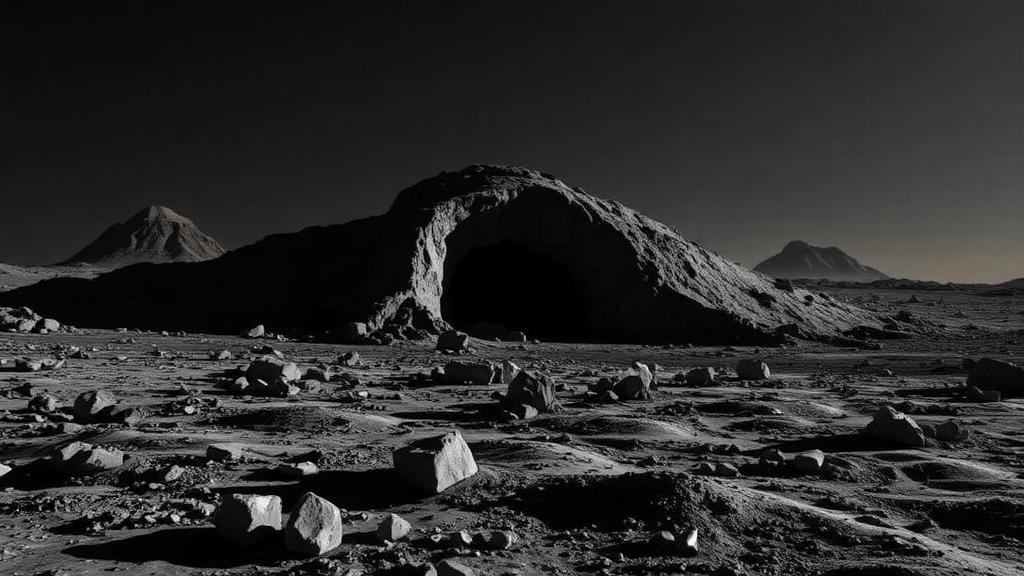
NASA has selected a proposal led by the Planetary Science Institute to answer one of the most tantalizing questions in lunar science: does a vast underground cave extend beyond the dark opening of a pit on the Moon’s near side? The project, funded through NASA’s Payloads and Research Investigations on the Surface of the Moon, or PRISM, program, will deliver a suite of geophysical instruments to the lunar surface aboard a spacecraft provided by a Commercial Lunar Payloads Services provider. If the team’s suspicions are correct, the hidden void they are searching for could one day serve as a natural shelter for astronauts, shielding them from cosmic radiation and the brutal temperature swings that make the lunar surface one of the most hostile environments in the solar system.
The mission, known as the Geophysical Instruments for Marius Lunar pit Investigation, or GIMLI, is led by Than Putzig, Associate Director and Senior Scientist at the Planetary Science Institute. PSI is partnering with Honeybee Robotics, a Blue Origin company, which will build much of the equipment and instrumentation and help integrate it onto a lander and rover supplied through the CLPS initiative. The effort will also be carried out in partnership with the Norwegian Space Agency, which is providing the mission’s ground-penetrating radar. Co-Investigators from Boise State University, Johns Hopkins University, the Lunar and Planetary Institute, and the University of Oslo round out a team that spans two continents and multiple disciplines.
The target of the investigation is the Marius Hills Pit, a large hole punched into one of the most volcanically diverse regions on the Moon. Like other lunar pits discovered by orbiting spacecraft, MHP may be a skylight, an opening into a subsurface cavity that formed during ancient volcanic activity. From orbit, scientists have gathered compelling evidence that caves and lava tubes may thread their way beneath the Moon’s surface, but orbital data alone cannot settle the question of what lies beyond the pit’s rim. GIMLI is designed to find out directly, by measuring the subsurface from the ground for the very first time at this site.
Putzig, who has spent much of his career probing planetary interiors with radar and geophysical methods, described the mission as the fulfillment of a long-held ambition. He noted that it has long been a desire of his to reintroduce intentional active-source seismic methods to planetary science, a technique that has essentially not been used since the Apollo astronauts conducted the first seismic surveys on the Moon more than five decades ago. Combining that method with ground-penetrating radar and gravity measurements, he explained, will allow the team to achieve a much better understanding of subsurface properties, including the anticipated detection of a lava tube extending away from the Marius Hills pit.
The technical approach is a masterclass in complementary geophysics. Ground-penetrating radar will transmit electromagnetic pulses into the regolith and record the echoes returned by buried boundaries between rock layers, revealing changes in composition and structure at shallow depths. Seismic sensors, energized by an active source rather than waiting for natural moonquakes, will measure how elastic waves travel through the ground, exposing voids and density contrasts that radar might miss. A gravimeter will detect the minute gravitational signature of an empty space beneath the surface, since a large cavity produces a measurable local deficit in mass. Cameras, meanwhile, will image the surface terrain and the exposed walls of the pit itself, tying the subsurface measurements to visible geology.
Together, these instruments will not only search for an underground void extending from the Marius Hills Pit; if such a void exists, they will also help determine its size. That distinction matters enormously for future human exploration. A cave large enough to shelter hardware and habitats would be a strategic asset for any long-term lunar presence, offering protection from radiation, micrometeorite impacts, and the roughly 300-degree Celsius temperature swings between lunar day and night. Confirming the dimensions and stability of such a space from the surface would transform it from an orbital curiosity into a mapped destination.
Honeybee Robotics will serve as the commercial partner to PSI, providing project management services and building the instrumentation for the active-source seismic system, the gravimeter, and the cameras. The company will also work to integrate all of the instruments onto the lander and rover and, together with PSI, will lead their operations on the lunar surface. The division of labor reflects a growing model in lunar exploration, in which government scientists team up with commercial aerospace firms to fly sophisticated payloads on robotic missions at a fraction of the cost of traditional flagship programs.
Crucially, the mission’s scientific value does not hinge entirely on finding a cave. Even if GIMLI fails to detect a lava tube beneath the surface, the data it collects could still resolve an important mystery: how did the pit form in the first place? Measurements of the surrounding subsurface will speak to the origin of MHP and provide a far better understanding of the geology and volcanic history of the site. The pit walls themselves expose layers of regolith and lava flows that are normally hidden underground, and studying those layers could reveal how lava once traveled across the Moon and whether long stretches of time separated successive eruptions.
The team is also looking beyond the pit itself. The Marius Hills region preserves a long history of volcanic activity, and the interiors of any potential underground spaces could hold a record of the processes that shaped the Moon’s volcanic plains. Gareth Morgan, PSI Senior Scientist and Deputy Principal Investigator on the GIMLI program, explained that confirming a substantial lava tube would give scientists insight into how volcanism operated on the Moon. Lava tubes are a common feature of basaltic volcanism on Earth, he noted, so identifying them on the Moon means researchers could apply knowledge of such terrestrial caves to better understand lunar history.
For the Planetary Science Institute, the selection marks a milestone in its evolution from an organization known primarily for orbital data analysis to one leading surface operations on another world. PSI Director and CEO Amanda Hendrix called GIMLI the type of ambitious planetary science that PSI was built to pursue, saying that Putzig and his team have taken a scientific question the institute has been studying from orbit and developed a way to investigate it directly on the Moon. She expressed excitement about partnering with NASA and Honeybee Robotics to learn more about the Moon and its volcanic past. If the instruments perform as designed, humanity may soon peer, for the first time, into the hidden architecture beneath one of the Moon’s most enigmatic openings, and perhaps take an early step toward making a lunar cave humanity’s first off-world shelter.
Subject of Research: Investigation of a potential lunar lava tube at the Marius Hills Pit using surface geophysical instruments under NASA's PRISM program
Article Title: PSI-led team selected for NASA PRISM program to explore potential lunar cave
Article References: PSI-led team selected for NASA PRISM program to explore potential lunar cave. (n.d.). Original publication
Image Credits: AI Generated
DOI: Not provided
Keywords: Moon, lunar caves, lava tubes, Marius Hills Pit, NASA PRISM, CLPS, Planetary Science Institute, Honeybee Robotics, ground-penetrating radar, seismology, gravimetry, lunar volcanism
Cite Scienmag News
Grant Pearson. (October 2, 2026). NASA Mission Will Hunt for a Hidden Lava Tube Beneath the Moon’s Surface. Scienmag. https://scienmag.com/nasa-mission-will-hunt-for-a-hidden-lava-tube-beneath-the-moons-surface/
Grant Pearson. "NASA Mission Will Hunt for a Hidden Lava Tube Beneath the Moon’s Surface." Scienmag, 2 October 2026, https://scienmag.com/nasa-mission-will-hunt-for-a-hidden-lava-tube-beneath-the-moons-surface/. Accessed 2 October 2026.
Grant Pearson. "NASA Mission Will Hunt for a Hidden Lava Tube Beneath the Moon’s Surface." Scienmag. October 2, 2026. https://scienmag.com/nasa-mission-will-hunt-for-a-hidden-lava-tube-beneath-the-moons-surface/


