


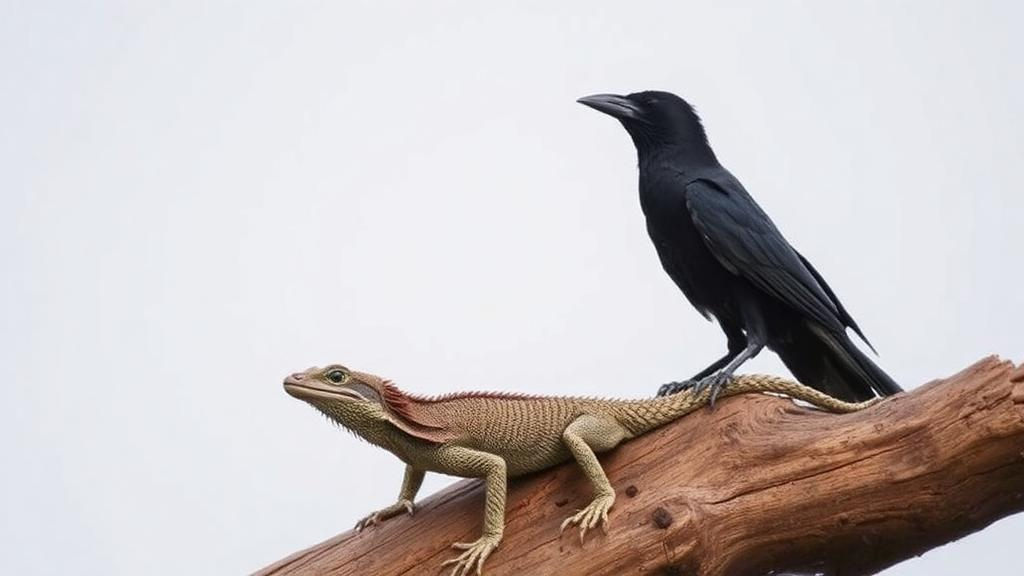
In the bustling streets of Dodoma, Tanzania’s rapidly growing capital, a sleek grey-and-black bird has become an unlikely ecological villain. The Indian house crow (Corvus splendens), a native of the Indian subcontinent that hitchhiked its way across shipping routes and trade networks to East Africa, has established itself as one of the most successful invasive birds on the planet. Now, a new study published in Discover Ecology reveals just how deeply this opportunistic predator has woven itself into the daily lives of Dodoma’s residents, and how its appetite for lizards may be quietly rewiring the city’s food webs. The research, led by Kelvin Ngongolo of the University of Dodoma together with Gideon Mmbando and Kasim Sakran Abass, combines community surveys with systematic field sampling to paint one of the most detailed pictures yet of an urban invasion in progress.
The scale of local awareness is striking. When the researchers interviewed 394 residents across urban and peri-urban neighborhoods, every single respondent recognized the Indian house crow as a presence in their surroundings. Nearly three-quarters reported encountering the birds every single day, most often in residential areas where the crows scavenge around food waste and rubbish dumps. The average flock size reported by residents fell predominantly in the moderate range of six to fifteen birds, though many described flocks exceeding fifteen individuals. This near-universal recognition is not merely trivia about a common backyard bird; it reflects the crow’s profound integration into human-modified landscapes, where garbage, open food disposal, and ornamental trees such as Peltophorum pterocarpum provide ideal foraging and nesting opportunities.
Lizards, the study’s focal prey, are equally familiar to Dodoma’s residents. Almost 99 percent of respondents were aware of lizards in their vicinity, and more than half reported seeing them daily. Seven species were identified across the study, with the Kenyan rock agama (Agama linotus), the tree skink (Trachylepis planifrons), and the tropical house gecko (Hemidactylus mabouia) among the most commonly encountered. These reptiles are far more than background wildlife. Lizards regulate insect populations, serving as natural pest control in gardens and agricultural areas, and they in turn constitute an essential food source for birds of prey, snakes, and other higher trophic levels. Any pressure on lizard populations therefore risks cascading effects throughout the ecosystem, a concern that motivated the research team to quantify the crow’s predatory impact.
The community’s observations were unambiguous. Roughly 68 percent of respondents knew that Indian house crows prey on lizards, and 69 percent reported that lizard numbers in their area had declined, a perception they attributed largely to crow predation. Most witnesses reported observing predation events about once a year, though a quarter of respondents saw attacks weekly. Interestingly, these perceptions did not differ significantly between urban and peri-urban respondents, suggesting that the crow’s predatory reputation extends across the entire urban-rural gradient. The researchers also documented an economic dimension: previous work in Dodoma has shown that the crows inflict losses on poultry farmers by killing chicks and eggs, with predation peaking between April and August, and studies from Zanzibar have linked the species to the spread of pathogens affecting humans and livestock.
To move beyond perception, the team deployed a rigorous field protocol. They established four one-kilometer line transects in each of two study sites: Makulu Ward in the city center, representing the urban environment, and Ng’ong’ona Ward on the outskirts, representing the peri-urban zone. Along each transect, five sampling points were spaced 200 meters apart, and at each point, teams of five observers spent ten minutes searching for lizards within a 50-meter radius while simultaneously recording crow numbers, by sight or by call when visibility was poor. Each point was visited four times, generating 160 systematic observations conducted during daylight hours when Dodoma’s predominantly diurnal lizards are active basking and foraging. The researchers also logged human activities, distances to buildings, roads, rubbish dumps, and rock outcrops, capturing the habitat context in which these predator-prey interactions unfold.
The field results delivered a genuine surprise. Contrary to the expectation that heavy crow predation would suppress lizard populations, the urban site with the highest crow abundance also harbored the richest lizard community. Urban Shannon-Wiener diversity reached 1.51, compared with 1.12 in peri-urban areas, and evenness and Margalef species richness followed the same pattern. Crows themselves were far more abundant in the city center, averaging 9.5 birds per sampling point against just 2.3 in the peri-urban zone, a statistically significant difference. Across all samples, the team recorded 204 individual lizards, with Brook’s gecko (Hemidactylus brooki) dominating at 98 individuals, followed by substantial populations of the Kenyan rock agama and the tropical house gecko.
How can lizards thrive alongside their predator? The authors point to the ecological concept of the generalist advantage. Urban environments offer a mosaic of microhabitats, walls, rock piles, gardens, and varied thermal environments, that favor adaptable generalist species over habitat specialists. Greater food availability, diverse refuges, and the microclimatic heterogeneity created by buildings may allow urban lizard populations to sustain themselves despite elevated predation. This pattern echoes findings from around the world: studies in the United States have shown that reptile and amphibian diversity can correlate positively with habitat patch size and complexity in cities, even as long-term monitoring reveals gradual declines in common species. Yet the picture is not uniformly rosy. Research in Ghana on the West African rainbow lizard (Agama picticauda) found that urbanization narrows dietary niches and worsens body condition, a reminder that apparent abundance can mask subtle physiological costs.
The predation data complicate the story further. Urban areas experienced significantly higher predation rates on lizards, averaging around 12 percent more than peri-urban sites, even though the overall abundance of crows across the full dataset did not differ dramatically between zones in the community-reported comparisons. This suggests that the intensity of predator-prey interaction, rather than predator numbers alone, determines the ecological pressure on lizard populations. Dense crow concentrations in the city center, sustained by abundant food waste, may concentrate hunting effort precisely where lizards are most visible and active. The result is a paradoxical urban ecosystem in which both predator and prey flourish, but the balance between them is tilted by human-generated resources that would not exist in a natural landscape.
The study’s recommendations are pragmatic and community-centered. The authors call for targeted crow control in lizard-rich zones, including localized deterrents, controlled culling, and nest removal where predation pressure is highest. Equally important are habitat interventions: increasing ground cover, securing tree hollows, and, crucially, minimizing the open waste dumps that act as crow cafeterias. Waste management, the researchers emphasize, is not merely a sanitation issue but a biodiversity conservation tool. They also urge training local communities to monitor crow-lizard interactions, discouraging the deliberate feeding of crows, and engaging residents in citizen science reporting, an approach made feasible by the extraordinary baseline awareness the surveys documented. Strengthening local policies on invasive species, and incorporating traditional ecological knowledge into management plans, could align conservation goals with community livelihoods.
What emerges from Dodoma is a nuanced portrait of invasion ecology in the Anthropocene. The Indian house crow is neither a simple villain nor a harmless newcomer; it is a highly intelligent, adaptable opportunist whose fortunes are entangled with human waste, urban growth, and global trade. Its impacts ripple outward from lizards to poultry farms to public health, with documented losses to farmers and its role in spreading diseases such as cholera, typhoid, and salmonella reported in the wider region. Genetic studies suggest that invasive crow populations harbor high diversity from multiple introduction events, making them formidable adversaries for eradication programs. Yet the Dodoma study also shows that communities are watching, aware, and ready to participate in solutions. In a world where urbanization and biological invasions increasingly intersect, the fate of Dodoma’s lizards may depend less on the crows themselves than on how the city manages its waste, its habitats, and its relationship with the wild creatures sharing its streets.
Subject of Research: The impact of invasive Indian house crows on lizard abundance, diversity, and community perceptions in Dodoma, Tanzania
Article Title: Community awareness and the impact of invasive Indian house crows on lizard abundance and diversity in Dodoma, Tanzania
Article References: Ngongolo, K., Mmbando, G., & Abass, K. S. (2025). Community awareness and the impact of invasive Indian house crows on lizard abundance and diversity in Dodoma, Tanzania. Discover Ecology, 1(1), Article 3. https://doi.org/10.1007/s44396-025-00003-y
Image Credits: AI Generated
DOI: 10.1007/s44396-025-00003-y
Keywords: invasive species, Indian house crow, Corvus splendens, lizard diversity, urban ecology, predation, Tanzania, Dodoma, community awareness, biodiversity conservation, waste management, Shannon-Wiener index
Cite Scienmag News
Margaret Porter. (October 2, 2026). Invasive House Crows Are Reshaping Lizard Life in Tanzania’s Capital. Scienmag. https://scienmag.com/invasive-house-crows-are-reshaping-lizard-life-in-tanzanias-capital/
Margaret Porter. "Invasive House Crows Are Reshaping Lizard Life in Tanzania’s Capital." Scienmag, 2 October 2026, https://scienmag.com/invasive-house-crows-are-reshaping-lizard-life-in-tanzanias-capital/. Accessed 2 October 2026.
Margaret Porter. "Invasive House Crows Are Reshaping Lizard Life in Tanzania’s Capital." Scienmag. October 2, 2026. https://scienmag.com/invasive-house-crows-are-reshaping-lizard-life-in-tanzanias-capital/


