


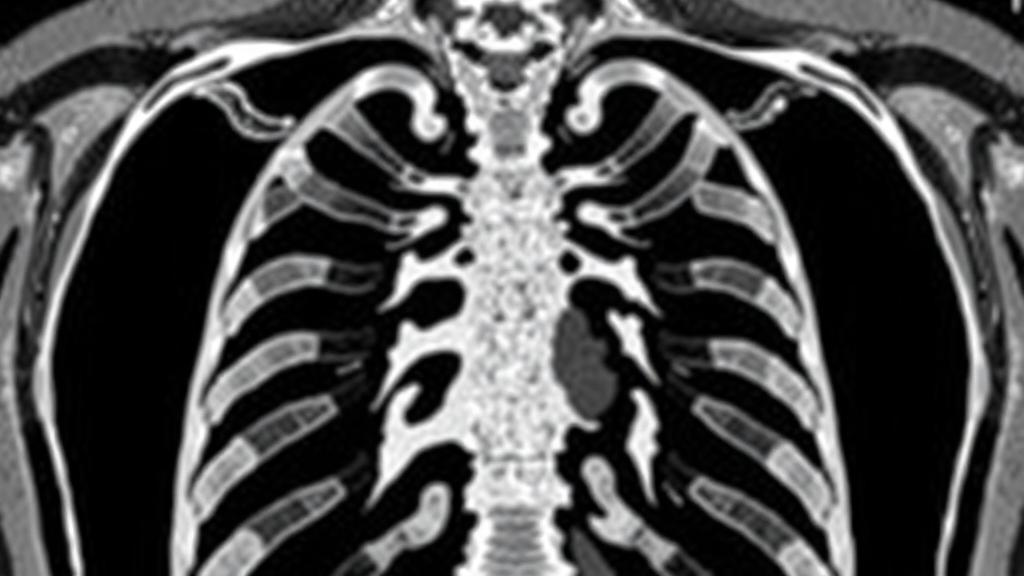
Every broken rib tells a story, and the passage of time is written into the way it heals. For forensic investigators, that story can mean the difference between justice and uncertainty: knowing whether a fracture is three days old or three weeks old can help establish when an injury occurred, whether it matches a reported timeline of abuse, or whether conflicting accounts of an accident hold up. The problem has always been that this judgment rests almost entirely on the trained eye of a radiologist or forensic expert squinting at CT images, and different experts often reach different conclusions. Now a team of researchers in China has built a deep learning model that reads the age of rib fractures directly from chest CT scans, and it does so with an accuracy that surpasses human experts, estimating fracture age with a mean error of just under eight days.
The study, published in the International Journal of Legal Medicine, was led by Wen-tao Xia of the Academy of Forensic Science in Shanghai, together with co-first authors Ya-ning Sun and Lei Wan and their colleagues. Rather than building a system that performs a single narrow task, the team designed a multi-task learning model based on a three-dimensional residual neural network, known as 3D-ResNet18. A single network simultaneously performs three distinct jobs: it predicts the numerical age of a fracture in days, it classifies the fracture into its healing stage, and it identifies the type of fracture present. This architecture matters because the three tasks are deeply intertwined. The radiological signs that indicate a fresh fracture are the same biological processes that define its healing stage, and forcing the network to learn all three objectives at once encourages it to extract richer, more generalizable features from the image data than a single-purpose model could.
To train and validate the model, the researchers assembled a multicenter dataset of 1,848 rib fractures identified on chest CT scans. Multicenter data is a crucial ingredient in medical artificial intelligence because images acquired on different scanners, with different protocols and from different patient populations, vary in subtle ways. Models trained on data from a single hospital frequently fail when deployed elsewhere, a phenomenon that has undermined many promising AI tools. By drawing training examples from multiple sources and then testing the model on an external dataset it had never seen, the team directly addressed the generalizability question that separates laboratory demonstrations from clinically useful systems. The external test confirmed that the model’s performance held up beyond the institutions where it was developed.
The headline numbers are striking. In the fracture age prediction task, the model achieved a mean absolute error of 7.94 days, meaning that on average its estimate of how long ago a fracture occurred was off by less than eight days. In head-to-head comparison, human expert evaluation of the same fractures produced a mean absolute error of 10.65 days. The gap of more than two and a half days may sound modest, but in forensic contexts, where the difference between a fracture sustained during a documented incident and one sustained weeks earlier can determine the outcome of a case, that improvement carries real weight. For the healing stage classification task, the model reached an accuracy of 71.18 percent, and in the fracture type classification task it achieved 94.71 percent, a level of performance that approaches the reliability of specialized detection systems.
Underneath these results lies a biological story that the algorithm has effectively learned to read. When a rib breaks, the body initiates a predictable cascade of repair. In the earliest phase, hemorrhage and inflammation dominate, and the fracture line itself may be barely visible on CT. Over the following days and weeks, soft callus forms around the fracture ends, followed by hard, mineralized callus that gradually bridges the gap. Eventually the callus remodels, and the bone slowly returns toward its original architecture. Each of these stages leaves a distinct radiological signature: changes in fracture line sharpness, callus density and volume, and eventual bony union. Radiologists have long used these signs to make rough estimates of fracture age, but the transitions are gradual and their appearance varies with patient age, bone density, and health status. A convolutional neural network processing volumetric CT data can, in principle, detect patterns in these transitions that are too subtle or too distributed for consistent human recognition.
The choice of a 3D architecture is technically significant. Rib fractures are inherently three-dimensional injuries, and the diagnostic cues they present may span multiple consecutive CT slices. A two-dimensional network analyzing each slice in isolation would discard that spatial context. By feeding volumetric patches through a 3D residual network, the model can integrate information along the length of the rib and across the fracture site, capturing the full morphology of callus formation and fracture line evolution. The residual connections within ResNet18, a now-classic design that allows gradients to flow through very deep networks during training, help the model learn fine-grained image features without succumbing to the training instabilities that plagued earlier deep architectures. The study was implemented using MONAI, an open-source framework for medical deep learning, reflecting the growing standardization of tools in this field.
The forensic implications extend well beyond rib fractures alone. The cited literature surrounding this work paints a sobering picture of why objective fracture dating is needed. Radiologists have documented imaging patterns of thoracic injuries in survivors of intimate partner violence, and separate studies have examined the radiological appearance of physical elder abuse and nonaccidental injury in the elderly. Missed rib fractures on initial trauma CT scans are a recognized problem with both clinical and forensic consequences. In cases of suspected abuse, the timing of injuries is often central to the investigation: a fracture consistent with the account given by a caregiver supports one narrative, while a fracture that predates or postdates the reported incident undermines it. Prior research has even documented self-inflicted long bone fractures in insurance fraud cases, where dating an injury could expose deception. A reproducible, quantitative tool for fracture dating gives investigators and courts evidence that does not depend on which expert happened to review the scan.
The new model also builds on a clear trajectory of prior work. Earlier studies by some of the same research community demonstrated that convolutional neural networks could detect and classify rib fractures on CT with high accuracy, and a separate multicenter study showed that a radiomics-based combined model could estimate rib fracture age from CT scans. Work from other groups has applied deep learning to estimate time-since-injury in pediatric fractures, one of the most sensitive applications in forensic radiology. The present study advances this line of research by combining age regression, healing stage classification, and fracture type identification in a single multi-task framework, and by demonstrating that the combined model outperforms manual expert evaluation on the age estimation task in external testing.
Limitations and caveats remain, as they do for any medical AI system. The raw data could not be publicly shared because of participant privacy, ethical restrictions, and legal constraints, though the authors state that de-identified data are available upon reasonable request subject to ethics approval and a data use agreement. Fracture healing is known to vary with factors such as age and bone mineral density, and the model’s performance across the full spectrum of patient populations and healing conditions will require continued scrutiny as the tool moves toward practical use. The study protocol was approved by the Ethics Committee of the Academy of Forensic Science with a waiver of informed consent, and the work was supported by China’s National Key R&D Program and several national and Shanghai-level research grants.
Still, the direction of travel is unmistakable. Artificial intelligence systems have already proven themselves at detecting rib fractures, localizing them anatomically, and flagging injuries that tired human readers miss. With this study, the same technology now demonstrates that it can read the clock embedded in healing bone more precisely than the experts who trained the field. For emergency physicians triaging trauma patients, for forensic pathologists reconstructing the sequence of events in a death investigation, and for child protection teams weighing whether an injury matches the story they have been told, a day-level estimate of fracture age delivered automatically from an existing chest CT could become a routine part of the diagnostic workflow. The rib has always kept a record of when it was broken. What has changed is that a neural network can now read that record with a precision the human eye could never consistently achieve.
Subject of Research: Deep learning estimation of rib fracture age from chest CT for forensic medicine
Article Title: A multi-task learning–based deep learning model for precise estimation of rib fracture age on chest CT
Article References: Sun, Y.-N., Wan, L., Yu, X.-Y., Wang, M.-W., Zhu, K., Li, Y.-Z., Liu, T.-A., Sheng, Y.-L., & Xia, W.-T. (2026). A multi-task learning–based deep learning model for precise estimation of rib fracture age on chest CT. International Journal of Legal Medicine. https://doi.org/10.1007/s00414-026-03962-3
Image Credits: AI Generated
DOI: 10.1007/s00414-026-03962-3
Keywords: deep learning, rib fracture, forensic medicine, chest CT, fracture age estimation, multi-task learning, 3D-ResNet18, fracture healing, artificial intelligence, legal medicine, computer vision, trauma imaging
Cite Scienmag News
Blake Davidson. (October 2, 2026). AI Reads Old Rib Fractures on CT Scans With Day-Level Precision. Scienmag. https://scienmag.com/ai-reads-old-rib-fractures-on-ct-scans-with-day-level-precision/
Blake Davidson. "AI Reads Old Rib Fractures on CT Scans With Day-Level Precision." Scienmag, 2 October 2026, https://scienmag.com/ai-reads-old-rib-fractures-on-ct-scans-with-day-level-precision/. Accessed 2 October 2026.
Blake Davidson. "AI Reads Old Rib Fractures on CT Scans With Day-Level Precision." Scienmag. October 2, 2026. https://scienmag.com/ai-reads-old-rib-fractures-on-ct-scans-with-day-level-precision/


