


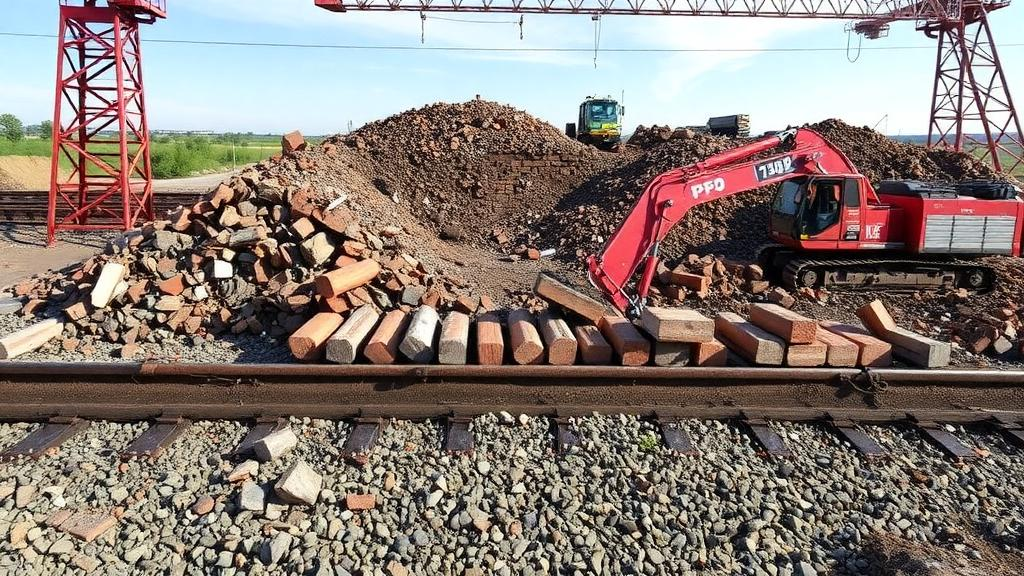
Every year, cities generate mountains of demolished brick and concrete, most of which ends up dumped in open-air landfills that consume land, pollute the environment, and in the worst cases trigger landslides and settlement problems of their own. At the same time, railway builders face a growing shortage of natural stone-based geomaterials. A new laboratory study published in Case Studies in Construction Materials suggests these two problems could partially cancel each other out: crushed brick-concrete construction waste, properly compacted, may serve as a viable fill material for railway subgrades, provided engineers respect a critical stress threshold that separates stable behavior from runaway deformation.
A team of researchers led by Jie Wang and Kunfeng Kong collected mixed demolition waste from a recycling source in Zhengzhou, Henan Province, China. The material, derived from demolished brick-concrete buildings, was crushed, screened, and cleaned of impurities before testing. Particle-by-particle analysis showed that recycled crushed stone, recycled concrete, and recycled clay brick together accounted for more than 95 percent of the mass in every size fraction examined, with impurities below 3.5 percent. Because demolition waste from brick-concrete structures naturally contains all three components mixed together rather than separated, the researchers argue this composition is representative of what recycling plants actually supply, making large-scale reuse more practical than processes demanding careful component sorting.
The material’s physical properties reveal why it behaves so differently from natural aggregates. Its water absorption of 8.5 to 9.8 percent and crushing value of 29.5 percent are far higher than those of conventional fill materials, reflecting the porous, weaker nature of recycled concrete and clay brick particles. Its optimum moisture content of roughly 13.5 percent is considerably higher than that of natural granular fills of similar gradation, while its maximum dry density of 1.827 grams per cubic centimeter is markedly lower. In practical terms, this means field crews must control moisture carefully during compaction, allow time for water to redistribute within the absorbent particles, and accept a lighter but more void-rich skeleton that is more sensitive to drainage conditions.
To characterize the material’s static strength, the team prepared cylindrical specimens 150 millimeters in diameter and 300 millimeters tall, compacted at three degrees of compaction representing well-compacted, insufficiently compacted, and relatively loose states, and tested them in a large-scale triaxial apparatus under confining pressures of 50, 100, and 150 kilopascals. The saturated drained shear tests showed clear strain-softening behavior: specimens reached a peak deviatoric stress and then weakened as shearing continued. Both peak strength and residual strength rose substantially with confining pressure and compaction. When confining pressure increased from 50 to 150 kilopascals, residual strength climbed by 106.8 percent, 87.3 percent, and 121.0 percent for specimens compacted to 96, 92, and 88 percent, respectively, demonstrating that even loosely packed waste fill gains considerable post-peak capacity when laterally confined.
The stiffness results carried a subtler message. The secant modulus at 50 percent of peak stress, a standard measure of deformation stiffness, was far more sensitive to compaction at low confining pressure than at high. At 50 kilopascals, the modulus of 96-percent-compacted specimens exceeded that of 88-percent-compacted specimens by more than 111 percent. Yet raising confining pressure from 50 to 150 kilopascals improved the modulus by only 6.8 percent for the densest specimens, compared with 77.3 percent for those at 92 percent compaction. The implication is that loosely compacted waste fill benefits enormously from lateral confinement, making it best suited to subgrade zones where surrounding material can provide strong restraint, such as well-compacted internal fill layers or track-supporting layers.
Volumetric behavior added another dimension. Under shear, the specimens first contracted slightly and then dilated, with the maximum dilation exceeding that of conventional natural subgrade fills. Denser specimens dilated more because their tight initial contacts left little room for further compression, forcing deformation to proceed through particle rotation and interlocking. Looser specimens contracted instead, densifying progressively. The researchers note that this contraction-dilation response matters for railway engineering: contraction signals ongoing settlement accumulation, while dilation indicates a well-interlocked skeleton but, near critical stress levels, may disturb interfaces with overlying ballast or track layers.
The heart of the study, however, lay in its long-term cyclic triaxial tests, which subjected specimens to 10,000 loading cycles at 1 hertz under saturated drained conditions. Here the team introduced the shear stress ratio, or SSR, defined as the applied cyclic deviatoric stress divided by the material’s static peak strength measured under identical compaction and confinement. This strength-normalized measure proved decisive. When SSR remained below roughly 0.5, cumulative plastic deformation grew slowly and stabilized as the particle skeleton compacted and rearranged. Once SSR exceeded about 0.5, the fitted curves steepened sharply and deformation accelerated toward incremental failure. Grey relational analysis confirmed SSR as the single most influential variable, ranking ahead of confining pressure and degree of compaction.
Perhaps the most striking finding concerned densely compacted specimens under high stress. At an SSR of 0.8, the final cumulative deformation of the 96-percent-compacted specimens was about 3.7 times that of the 92-percent specimens, the largest relative increase among all compaction states. The explanation lies in the dense skeleton’s limited remaining void space: once cyclic stress approaches the mobilized strength capacity, particle sliding, abrasion, and breakage are repeatedly activated, and with no room left for gradual compaction, the structure responds through dilation and abrupt loss of interlocking. Looser fills, by contrast, can still absorb cyclic deformation through progressive densification. In other words, compaction alone does not guarantee stability if the traffic-induced stress level creeps too close to the material’s strength reserve.
The resilient modulus, which quantifies the recoverable elastic stiffness under repeated loading, generally increased with compaction, confining pressure, and cyclic deviatoric stress. Dropping compaction from 96 to 88 percent reduced the modulus by roughly 13 to 25 percent across the tested stress states. But the researchers caution against a tempting misreading: a rising resilient modulus does not necessarily indicate a healthy structure. Correlation analysis across 21 matched loading conditions found only a moderate linear association between modulus evolution and final cumulative plastic deformation, meaning the recoverable and irreversible components of deformation can evolve independently. A subgrade may appear stiff while quietly accumulating permanent settlement.
From these results the authors distill a preliminary design framework: compaction near 96 percent is preferred when cyclic stresses stay within the stable range; an SSR at or below 0.30 offers a conservative reference for long-term service; the range between 0.30 and 0.50 warrants caution; and SSR at or above 0.50, associated with accelerated deformation, should be avoided under conditions comparable to those tested. The team stresses that these thresholds are laboratory observations specific to the tested gradation, moisture state, and loading regime, not universal design limits, and that field-scale and in-situ verification remain necessary. Unresolved questions include the effects of wetting-drying cycles, freeze-thaw weathering, particle breakage quantification, and varying train speeds. Still, the study offers railway engineers a concrete, stress-based recipe for turning demolition debris into dependable subgrade, a step that could simultaneously ease landfill pressure and relieve the aggregate shortage confronting infrastructure construction worldwide.
Subject of Research: Strength and deformation behavior of brick-concrete construction waste used as railway subgrade fill
Article Title: Analysis of the strength and deformation characteristics of brick-concrete construction waste used as subgrade fill
Article References: Wang, J., Kong, K., Li, Y., Lin, L., Wang, Z., Chen, F., Yao, J., Wang, M., & Xiao, Y. (2026). Analysis of the strength and deformation characteristics of brick-concrete construction waste used as subgrade fill. Case Studies in Construction Materials, 25, Article e06565. https://doi.org/10.1016/j.cscm.2026.e06565
Image Credits: AI Generated
DOI: 10.1016/j.cscm.2026.e06565
Keywords: construction waste, railway subgrade, recycled aggregates, triaxial testing, shear stress ratio, cumulative deformation, resilient modulus, strain softening, compaction, cyclic loading, geotechnical engineering, sustainable materials
Cite Scienmag News
Denise Maddox. (October 2, 2026). Demolished Bricks and Concrete Could Build Tomorrow’s Railway Subgrades. Scienmag. https://scienmag.com/demolished-bricks-and-concrete-could-build-tomorrows-railway-subgrades/
Denise Maddox. "Demolished Bricks and Concrete Could Build Tomorrow’s Railway Subgrades." Scienmag, 2 October 2026, https://scienmag.com/demolished-bricks-and-concrete-could-build-tomorrows-railway-subgrades/. Accessed 2 October 2026.
Denise Maddox. "Demolished Bricks and Concrete Could Build Tomorrow’s Railway Subgrades." Scienmag. October 2, 2026. https://scienmag.com/demolished-bricks-and-concrete-could-build-tomorrows-railway-subgrades/


