


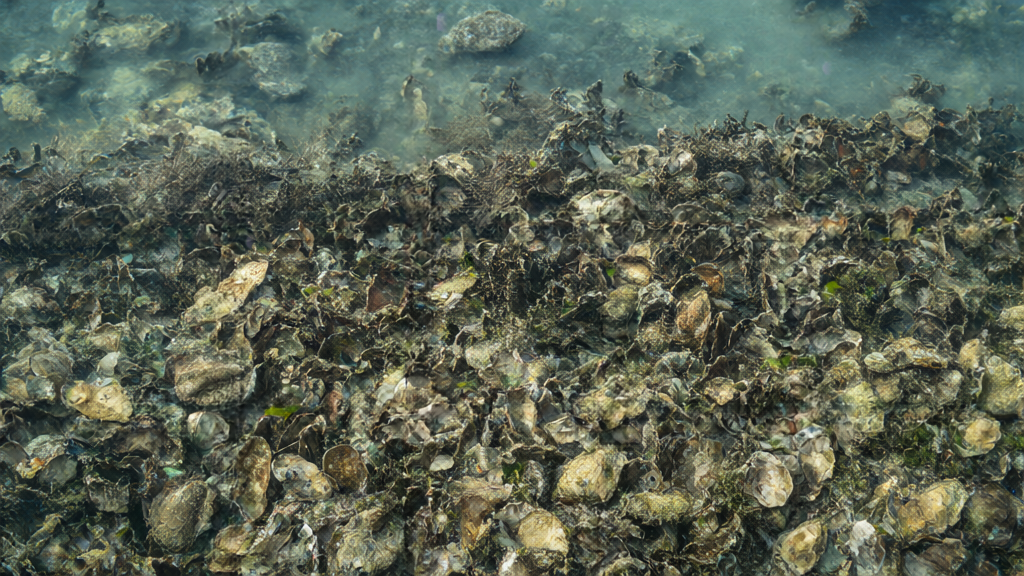
Scientists from the University of Maryland, Baltimore County (UMBC), the Smithsonian Environmental Research Center (SERC), and the National Oceanic and Atmospheric Administration (NOAA) have reported that large-scale oyster reef restoration in the Chesapeake Bay is successfully creating three-dimensional habitats. These habitats support larger and more diverse fish communities, according to a study published in the journal Ecosphere. The research provides evidence that restoration efforts are shifting underwater ecosystems from communities dominated by small, transient schooling fish to those that sustain larger, resident species.
The study focused on Harris Creek, located on Maryland’s Eastern Shore, which is described as one of the world’s largest oyster restoration projects. The site covers approximately 1.4 square kilometers. To evaluate the long-term effects of the restoration, the research team combined underwater video with high-resolution imaging sonar. They assessed reef habitat and nekton, which includes free-swimming animals such as fish and turtles, six to 10 years after the restoration was completed.
Allison Tracy, the study’s lead author and an assistant professor of marine biotechnology at UMBC, stated that the team wanted to understand precisely how restoration influences reef habitat and the fish and crabs that use it. Tracy noted that large-scale oyster reef restoration in the Chesapeake Bay has been a success and that the study adds new metrics for evaluating one of the most high-profile sites in the project. The researchers aimed to determine how the physical structure of the reefs affects the biological communities that inhabit them.
The findings indicate that the specific method of restoration matters significantly for habitat quality. Reefs restored using a stone substrate plus juvenile oysters attached to adult oyster shells, a technique known as spat-on-shell, exhibited the highest habitat scores. These reefs showed greater vertical relief and structural complexity compared to reefs restored with spat-on-shell alone or reefs that had been continuously harvested. The addition of stone substrate appears to enhance the three-dimensional structure of the reef environment.
In terms of fish populations, the restored reefs supported fewer total fish but significantly larger individual fish. The highest abundance of fish exceeding 30 centimeters in length was found on reefs restored with stone. Tracy explained that the remote monitoring tools used in the study make it unique, combining a simple GoPro-based method for studying reef habitat with a high-tech sonar survey of animals. This multi-faceted approach allowed the team to look at reef-associated animals through many different lenses to get a complete picture of the community of finfish, crabs, and rays.
The sonar data revealed a fundamental shift in how animals use these habitats. While harvested reefs and unrestored areas were dominated by small, schooling fish moving quickly through the water column, restored reefs supported more species that live and feed near the bottom. This suggests that the complex three-dimensional structure created by restored oyster reefs provides refuge and foraging opportunities for larger, commercially and ecologically valuable species. Tracy noted that large fish in particular are taking notice of restored oyster reefs, highlighting Harris Creek as one of the most valuable case studies of oyster restoration in the world.
The timing of the study was crucial for understanding restoration success. By surveying reefs at least seven years post-restoration, the researchers could assess long-term outcomes rather than immediate responses. The results indicate that Harris Creek’s restored reefs are self-sustaining, maintaining high oyster cover and structural complexity years after construction. Tracy added that the project was a powerful combination of scientists from different institutions and career stages, using the team’s mix of expertise to carry out a unique and important study.
The research connects to broader efforts to restore Chesapeake Bay’s oyster populations, which are currently at only 3 percent of historic levels due to overharvesting, disease, and environmental stressors. The study aligns with recent findings from NOAA and other collaborators, including current study co-author Jay Lazar, on large-scale oyster restoration success across the Bay system. Matthew Ogburn, the senior author on the new paper and a senior scientist at SERC, emphasized that official monitoring of large-scale restoration efforts typically only takes place three and six years after restoration. He stated that studying these reefs in the long term is needed to ensure that they continue to support oyster populations and provide habitat for other animals, and that underwater video can help fill this need.
The study’s innovative approach of merging accessible video technology with sophisticated sonar imaging offers a template for monitoring subtidal reefs in murky estuaries where traditional sampling methods face limitations. As restoration efforts expand globally, these remote sensing tools could help managers assess habitat quality and ecosystem services more efficiently and cost-effectively. By studying reef habitat years after restoration, the researchers expected to see how the efforts paid off, and the findings suggest that investing in structural complexity can accelerate the return of valuable fish communities and support the long-term health of the Chesapeake Bay.
Subject of Research: Marine Science
Article Title: Long-term oyster reef restoration shows clear success in murky waters
Article References: Long-term oyster reef restoration shows clear success in murky waters. (n.d.). Original publication
Image Credits: AI Generated
DOI: Not provided
Keywords: Oyster Restoration, Chesapeake Bay, Habitat Complexity, Nekton Communities, Ecosphere, Long-term, oyster, reef, restoration, shows, clear, success
Cite Scienmag News
Margaret Porter. (October 2, 2026). Long-term oyster reef restoration in Chesapeake Bay supports larger fish communities. Scienmag. https://scienmag.com/long-term-oyster-reef-restoration-in-chesapeake-bay-supports-larger-fish-communities/
Margaret Porter. "Long-term oyster reef restoration in Chesapeake Bay supports larger fish communities." Scienmag, 2 October 2026, https://scienmag.com/long-term-oyster-reef-restoration-in-chesapeake-bay-supports-larger-fish-communities/. Accessed 2 October 2026.
Margaret Porter. "Long-term oyster reef restoration in Chesapeake Bay supports larger fish communities." Scienmag. October 2, 2026. https://scienmag.com/long-term-oyster-reef-restoration-in-chesapeake-bay-supports-larger-fish-communities/


