


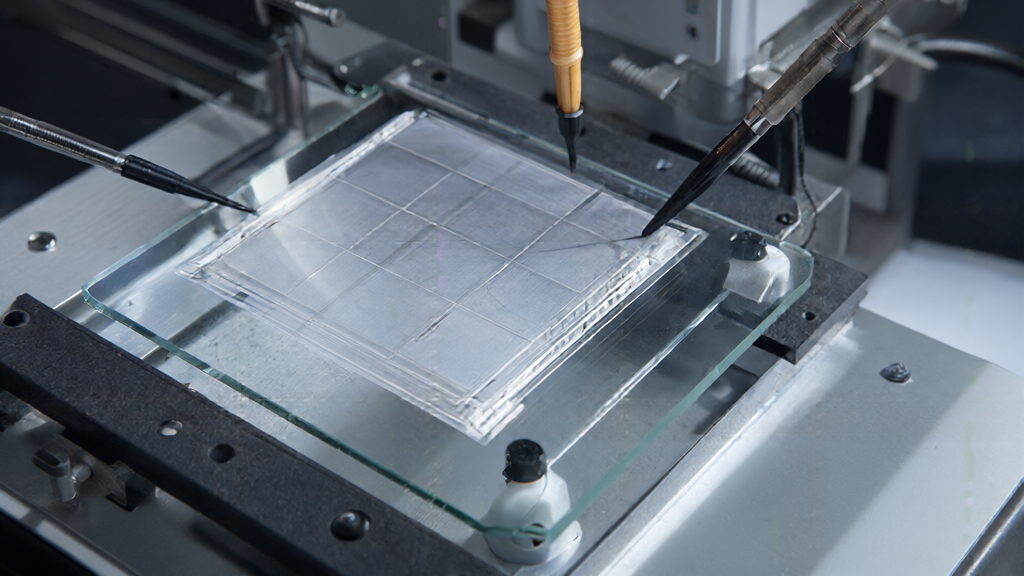
The relentless pursuit of affordable and sustainable energy sources has driven researchers to reevaluate the fundamental components of photovoltaic technology. At the heart of every solar cell lies the transparent conductive electrode, a critical layer that must simultaneously allow maximum sunlight to pass through while efficiently collecting the generated electrical current. For decades, indium tin oxide, commonly known as ITO, has dominated this niche due to its superior optical and electrical properties. However, the geological scarcity of indium and its associated high extraction costs have created a significant bottleneck in the mass production of solar panels. This economic and environmental pressure has spurred a global search for alternative materials that can match the performance of ITO without relying on rare earth elements. In a recent study published in the Journal of Materials Science, researchers from Nigeria have presented a promising solution by developing composite electrodes that combine zinc oxide with carbon nanotubes, offering a viable path toward more cost-effective thin-film solar cells.
Zinc oxide has long been considered a leading candidate to replace ITO because it is abundant, non-toxic, and possesses excellent optical transparency. Yet, pure zinc oxide films often struggle to achieve the low electrical resistance required for high-efficiency solar cells. To overcome this limitation, the research team integrated carbon nanotubes into the zinc oxide matrix. Carbon nanotubes are renowned for their exceptional electrical conductivity and mechanical strength. By weaving these nanoscale tubes into the zinc oxide structure, the researchers aimed to create a hybrid material that leverages the transparency of the oxide and the conductivity of the carbon. This composite approach represents a strategic shift in materials engineering, moving from single-component solutions to synergistic multi-material systems that address multiple performance metrics simultaneously.
The fabrication process employed in this study utilized a spin-coating technique, a method widely used in semiconductor manufacturing to deposit thin, uniform layers of material onto substrates. The researchers prepared solutions containing carbon nanotubes and zinc oxide at varying concentrations of one, two, and three milligrams per milliliter. These solutions were then deposited onto glass substrates at different rotational speeds of 1,000, 2,000, and 3,000 revolutions per minute. The spin-coating speed is a critical parameter in this process, as it determines the thickness and density of the resulting film. Higher speeds generally produce thinner films, which can enhance transparency but may compromise conductivity if the material becomes too sparse. By systematically varying both the concentration and the speed, the team was able to map out the optimal conditions for achieving the best balance between light transmission and electrical performance.
To evaluate the quality of the fabricated electrodes, the researchers employed a suite of advanced characterization techniques. Ultraviolet-visible spectroscopy was used to measure the optical transmittance, determining how much visible light could pass through the material. A four-point probe system was utilized to measure the sheet resistance, a key indicator of how easily current can flow across the surface of the electrode. Additionally, scanning electron microscopy and atomic force microscopy provided detailed images of the surface morphology, allowing the team to observe the distribution of carbon nanotubes within the zinc oxide matrix. These microscopic insights are crucial for understanding how the physical structure of the composite influences its macroscopic electrical and optical properties.
The results of the study revealed that the composite electrodes exhibited transmittance values ranging from 83.98 to 87.30 percent, which is highly competitive with standard ITO films. The sheet resistance values varied between 48.01 and 91.83 ohms per square, indicating good electrical conductivity. The researchers calculated a figure of merit for each sample, a metric that combines transmittance and resistance to provide a single value representing overall performance. The highest figure of merit recorded was 48.95, achieved at a concentration of two milligrams per milliliter and a spin-coating speed of 2,000 revolutions per minute. This specific combination yielded the optimal balance, demonstrating that there is a sweet spot in the fabrication parameters where the material performs best.
Interestingly, the conditions for maximum transmittance and minimum resistance did not align perfectly. The highest transmittance of 87.30 percent was observed at a concentration of two milligrams per milliliter and a speed of 3,000 revolutions per minute. Conversely, the lowest sheet resistance of 48.01 ohms per square was found at a concentration of one milligram per milliliter and a speed of 2,000 revolutions per minute. This trade-off is typical in materials science, where optimizing one property often requires compromising another. The researchers also calculated the normalized utilization factor, a measure of how effectively the material uses its optical and electrical capabilities. The lowest value, indicating the most efficient use of the material’s potential, was 4.72 times 10 to the power of negative three, again occurring at the two milligrams per milliliter and 2,000 revolutions per minute condition. This consistency in the optimal condition for the figure of merit and the utilization factor reinforces the reliability of the findings.
The integration of carbon nanotubes into the zinc oxide matrix appears to play a pivotal role in enhancing the electrical properties of the electrode. The nanotubes likely form a percolating network within the oxide film, providing pathways for electron transport that reduce overall resistance. Meanwhile, the zinc oxide maintains the high transparency necessary for solar cell applications. The surface morphology analysis likely showed that the carbon nanotubes were well-dispersed within the zinc oxide, preventing aggregation that could scatter light or create insulating barriers. This uniform distribution is essential for achieving the high performance metrics reported in the study. The ability to control this dispersion through the spin-coating parameters highlights the importance of process optimization in nanomaterial fabrication.
The implications of this research extend beyond the specific laboratory results to the broader landscape of renewable energy technology. As the demand for solar energy continues to grow, the need for scalable and cost-effective manufacturing processes becomes increasingly urgent. The use of solution-processed materials like the carbon nanotube-zinc oxide composite offers several advantages over traditional vacuum-based deposition methods. Solution processing is generally less energy-intensive and can be applied to flexible substrates, opening up possibilities for lightweight and bendable solar cells. Furthermore, the avoidance of indium reduces the environmental impact associated with mining and processing this rare metal. This aligns with global efforts to develop sustainable materials that minimize resource depletion and ecological harm.
Despite the promising results, the study acknowledges that further optimization is required to fully compete with established ITO technologies. The sheet resistance values, while acceptable, are higher than those of high-performance ITO films, which can achieve resistances in the single digits of ohms per square. Future research may focus on increasing the density of the carbon nanotube network or introducing additional dopants to enhance conductivity without sacrificing transparency. Additionally, the long-term stability of these composite electrodes under environmental conditions such as humidity and temperature fluctuations needs to be thoroughly investigated. Solar cells are exposed to harsh outdoor environments for decades, and any degradation in the electrode performance over time could significantly impact the overall efficiency and lifespan of the device.
In conclusion, the development of carbon nanotube-zinc oxide transparent conductive electrodes represents a significant step forward in the search for ITO alternatives. By carefully optimizing the concentration and spin-coating speed, researchers have demonstrated that it is possible to achieve favorable optical and electrical properties suitable for thin-film solar cells. The highest figure of merit and lowest normalized utilization factor obtained at specific conditions provide a clear roadmap for future fabrication efforts. As the renewable energy sector continues to expand, innovations in electrode materials will play a crucial role in reducing costs and improving efficiency. This study contributes valuable data to the field, highlighting the potential of hybrid nanomaterials to meet the demands of next-generation photovoltaic technologies. The work underscores the importance of interdisciplinary approaches that combine materials science, physics, and engineering to solve complex energy challenges.
Subject of Research: Development of carbon nanotube-zinc oxide composite transparent conductive electrodes for photovoltaic applications
Article Title: Fabrication of carbon nanotube–zinc oxide transparent conductive electrodes and evaluation for thin-film solar cells
Article References: Adio, A. B., Ajao, A. M., & Atere, A. D. (2026). Fabrication of carbon nanotube–zinc oxide transparent conductive electrodes and evaluation for thin-film solar cells. Journal of Materials Science. https://doi.org/10.1007/s10853-026-13772-y
Image Credits: AI Generated
DOI: 10.1007/s10853-026-13772-y
Keywords: carbon nanotubes, zinc oxide, transparent conductive electrodes, thin-film solar cells, spin-coating, optoelectronics, renewable energy, materials science, sheet resistance, optical transmittance, Fabrication, carbon
Cite Scienmag News
Neil Sanderson. (October 2, 2026). Researchers Evaluate Nanotube–Zinc Oxide Electrodes for Thin-Film Solar Cells. Scienmag. https://scienmag.com/researchers-evaluate-nanotube-zinc-oxide-electrodes-for-thin-film-solar-cells/
Neil Sanderson. "Researchers Evaluate Nanotube–Zinc Oxide Electrodes for Thin-Film Solar Cells." Scienmag, 2 October 2026, https://scienmag.com/researchers-evaluate-nanotube-zinc-oxide-electrodes-for-thin-film-solar-cells/. Accessed 2 October 2026.
Neil Sanderson. "Researchers Evaluate Nanotube–Zinc Oxide Electrodes for Thin-Film Solar Cells." Scienmag. October 2, 2026. https://scienmag.com/researchers-evaluate-nanotube-zinc-oxide-electrodes-for-thin-film-solar-cells/


