


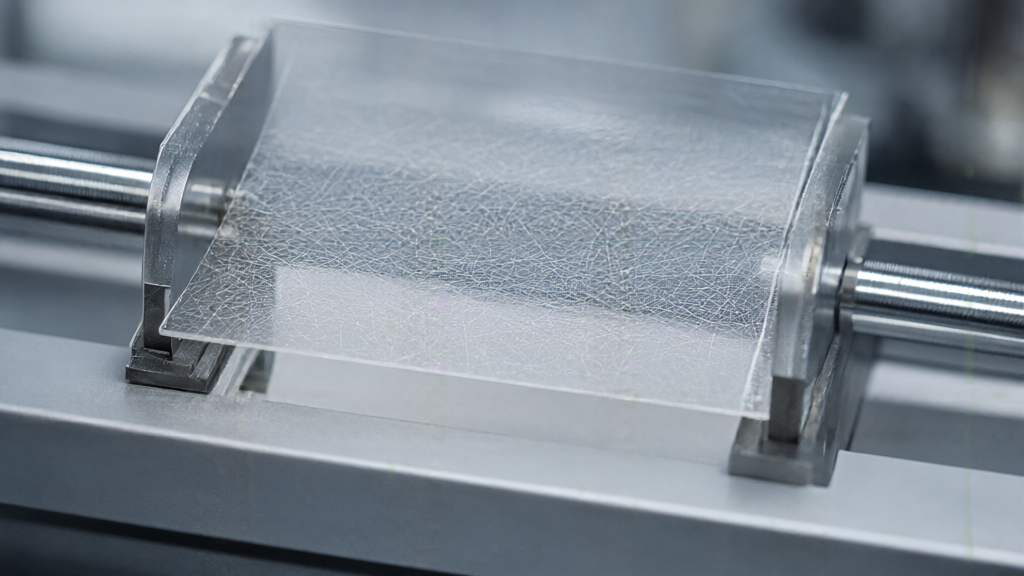
The relentless march toward faster wireless communication networks has created a persistent engineering paradox. As wireless systems use higher frequencies, the materials that carry these signals must remain stable against temperature fluctuations. Most conventional polymers expand when heated, a behavior that can distort the precise geometry of antenna components and degrade signal integrity. Researchers at The University of Tokyo and the Kanagawa Institute of Industrial Science and Technology have introduced a novel composite material designed to solve this dilemma. By combining the dielectric excellence of polytetrafluoroethylene with the structural rigidity of cellulose nanofibers, the team has created a material that actually contracts in-plane when heated, a property known as negative thermal expansion.
This breakthrough, published in Advanced Composites and Hybrid Materials, addresses a critical bottleneck in the development of next-generation telecommunications infrastructure. The material in question is a composite made from PTFE nanoparticles and cellulose nanofibers, fabricated using a straightforward aqueous casting method. The specific formulation that yielded the most promising results consisted of 75 weight percent PTFE and 25 weight percent cellulose nanofiber. This ratio was not arbitrary; it represents a delicate balance where the mechanical influence of the cellulose network overcomes the expansive tendencies of the PTFE matrix without compromising the electrical properties required for high-frequency signal transmission.
The primary challenge in designing low-dielectric materials for frequencies above 10 gigahertz is the simultaneous achievement of three distinct properties. Engineers require a low coefficient of thermal expansion to maintain dimensional stability, a low relative permittivity to minimize signal delay, and a low dielectric loss tangent to reduce energy dissipation. Historically, these properties have been mutually exclusive in polymer-based systems. PTFE is renowned for its exceptional dielectric performance, offering a low relative permittivity and minimal signal loss. However, its large positive coefficient of thermal expansion makes it unsuitable for precision components that must remain dimensionally stable under varying thermal loads.
The introduction of cellulose nanofibers into the PTFE matrix transforms this behavior. The researchers found that the in-plane coefficient of thermal expansion for the 75-25 composite was negative, measured at minus 6.1 parts per million per Kelvin. This means that as the temperature rises, the material shrinks slightly in the plane of the film. This counter-intuitive behavior is attributed to the local mechanical response of the cellulose nanofiber network. When the PTFE nanoparticles expand due to heat, they exert pressure on the surrounding cellulose network. The network, being highly rigid and anisotropic, responds by contracting in the lateral directions, effectively pulling the composite inward. This mechanism was supported by stress-temperature behavior measurements under constraint, which confirmed that the internal stresses generated by the thermal mismatch drive the overall contraction.
Despite the mechanical changes, the electrical performance of the composite remained remarkably robust. At a frequency of 40 gigahertz, the relative permittivity of the 75-25 composite was measured at 1.96. This value is slightly lower than that of a pure PTFE film, which measured 2.04. The reduction in permittivity is primarily due to the presence of air within the composite structure. Air has a relative permittivity of approximately 1, so the inclusion of air pockets in the material lowers the overall effective permittivity. This is a significant advantage for telecommunications, as lower permittivity allows for thinner substrates and reduced signal propagation delay.
The dielectric loss tangent, which indicates how much of the signal energy is lost as heat, was measured at 0.022 for the 75-25 composite. While this value is slightly higher than that of the pure PTFE film, it remains comparable to other conventional low-dielectric materials used in the industry. This suggests that the trade-off for achieving negative thermal expansion does not come at a prohibitive cost in terms of signal efficiency. The material retains the core dielectric advantages of PTFE while gaining the dimensional stability provided by the cellulose network. This combination makes it a viable candidate for high-frequency applications where thermal management is a critical concern.
The fabrication method used by the researchers is also noteworthy for its simplicity and scalability. The aqueous casting method involves mixing PTFE nanoparticles and cellulose nanofibers in water and then casting the mixture into a film. This process avoids the need for complex chemical cross-linking or high-temperature processing, which can degrade the properties of the constituent materials. The use of aqueous dispersions also aligns with broader trends in green chemistry and sustainable manufacturing. Cellulose nanofibers are derived from renewable biomass, and their use in high-performance composites offers a sustainable alternative to synthetic polymers that are derived from petrochemical sources.
The implications of this research extend beyond telecommunications. Materials with negative thermal expansion are valuable in any application where dimensional stability is paramount. This includes precision optics, aerospace components, and micro-electro-mechanical systems. The ability to tailor the thermal expansion behavior of a composite by adjusting the ratio of its constituents provides a powerful tool for materials engineers. By increasing the content of cellulose nanofibers, the researchers observed that the negative thermal expansion became more pronounced, although the relative permittivity also increased. This tunability allows for the optimization of the material for specific applications, balancing the need for thermal stability against the need for low dielectric loss.
The study highlights the potential of hybrid materials to overcome the limitations of single-component systems. By leveraging the unique properties of both PTFE and cellulose nanofibers, the researchers have created a material that is greater than the sum of its parts. The negative in-plane thermal expansion is a direct result of the synergistic interaction between the two components, a phenomenon that would not be possible with either material alone. This approach opens up new avenues for the design of advanced composites, where the mechanical and electrical properties can be independently tuned to meet the demands of emerging technologies.
As the world moves toward 6G and beyond, the need for materials that can handle higher frequencies and greater data densities will only intensify. The PTFE-cellulose nanofiber composite represents a significant step forward in meeting this challenge. It offers a practical solution to the problem of thermal expansion in low-dielectric materials, without sacrificing the electrical performance required for high-speed communication. The research underscores the importance of interdisciplinary collaboration, combining expertise in polymer chemistry, materials science, and telecommunications engineering to develop innovative solutions to complex technical problems.
Subject of Research: Development of PTFE-nanocellulose composites with negative thermal expansion for low-dielectric applications
Article Title: Polytetrafluoroethylene–nanocellulose composites with negative in-plane thermal expansion and low relative permittivity
Article References: Kamogawa, M., Daicho, K., Yamada, T., & Shiomi, J. (2026). Polytetrafluoroethylene–nanocellulose composites with negative in-plane thermal expansion and low relative permittivity. Advanced Composites and Hybrid Materials. https://doi.org/10.1007/s42114-026-02063-4
Image Credits: AI Generated
DOI: 10.1007/s42114-026-02063-4
Keywords: PTFE, Cellulose Nanofibers, Negative Thermal Expansion, Low Dielectric, Telecommunications, Composite Materials, Thermal Stability, 5G Technology, Polymer Science, Materials Engineering, Polytetrafluoroethylene, nanocellulose
Cite Scienmag News
Denise Maddox. (October 2, 2026). PTFE–Nanocellulose Composite Combines Thermal Shrinkage With Low Permittivity. Scienmag. https://scienmag.com/ptfe-nanocellulose-composite-combines-thermal-shrinkage-with-low-permittivity/
Denise Maddox. "PTFE–Nanocellulose Composite Combines Thermal Shrinkage With Low Permittivity." Scienmag, 2 October 2026, https://scienmag.com/ptfe-nanocellulose-composite-combines-thermal-shrinkage-with-low-permittivity/. Accessed 2 October 2026.
Denise Maddox. "PTFE–Nanocellulose Composite Combines Thermal Shrinkage With Low Permittivity." Scienmag. October 2, 2026. https://scienmag.com/ptfe-nanocellulose-composite-combines-thermal-shrinkage-with-low-permittivity/


