


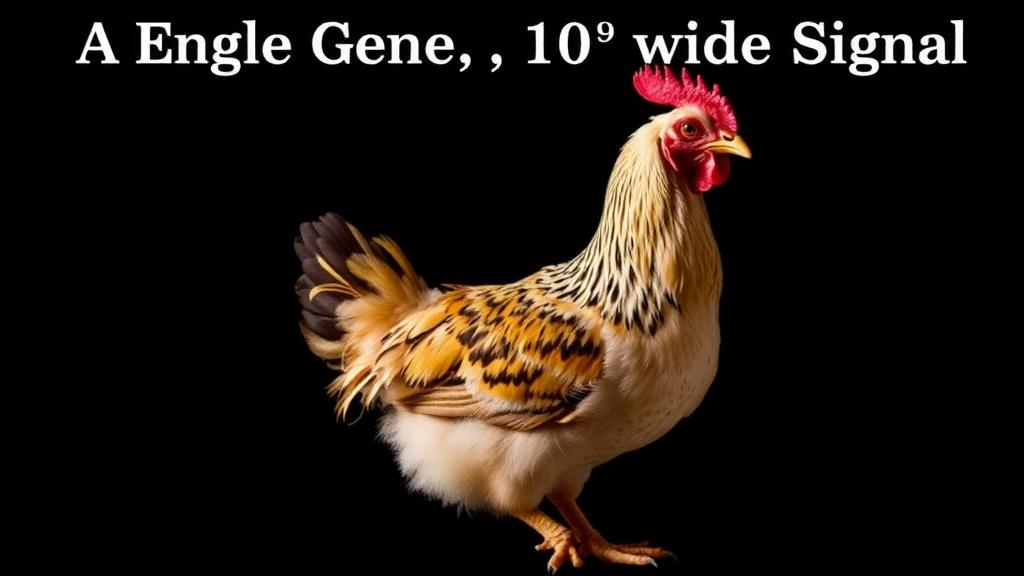
In the highlands of northwestern Iran, a hardy indigenous chicken breed known as the Marandi has quietly sustained smallholder flocks for generations, prized for its adaptability and its capacity for efficient egg production. Now, a team of researchers at the University of Tabriz has taken a close genetic look at this local treasure, asking whether variation in a single gene, RAPGEF6, might help explain differences in the birds’ growth, egg-laying performance, and reproductive characteristics. The study, published in BMC Genomics, offers a candid and methodologically careful portrait of what genetic association research looks like when it is conducted honestly in a small population — including the uncomfortable statistical truths that often remain hidden in similar work.
The research, led by Mohammad Taghi Zarrinnia together with Karim Hasanpur, Sadegh Alijani, Arash Javanmard, and Majid Olyayee, focused on 153 Marandi hens. Performance and reproductive records were collected across a suite of traits that matter enormously to layer farms: hatch weight, estimated hatch weight, weight and age at first laying, maturity weight, average egg weight, cumulative weight of the first fifty eggs, average weight of those first fifty eggs, egg-laying rate, egg mass, total egg count, feed conversion ratio, and egg weight loss, among others. The team also modeled the trajectory of egg weight over time, a repeated measurement that captures how a hen’s eggs change as her laying cycle progresses.
At the heart of the study lies RAPGEF6, which encodes Rap Guanine Nucleotide Exchange Factor 6, a protein involved in intracellular signaling pathways. The researchers genotyped single nucleotide polymorphisms, or SNPs, within this gene using a well-established laboratory technique called PCR–RFLP, or polymerase chain reaction followed by restriction fragment length polymorphism analysis. This method uses restriction enzymes that cut DNA at specific sequence motifs; when a SNP alters the recognition site, the resulting fragment lengths differ, allowing researchers to infer each bird’s genotype. Genotype frequencies within the population were then determined, providing a picture of genetic variation at the studied markers in the Marandi breed.
To analyze the data, the team deployed two complementary statistical strategies in SAS software. For the remaining growth and performance traits, they used Generalized Linear Models, a flexible framework that relates trait values to genotype categories while accounting for other sources of variation. The repeated egg weight measurements, however, demanded a more sophisticated treatment, because successive records from the same hen are not statistically independent — a hen that lays heavier-than-average eggs in one period tends to do so in the next. Ignoring this correlation inflates false confidence, so the researchers fitted eight different covariance structures to model how measurements within each bird relate to one another over time.
Those eight candidate structures spanned the standard toolkit of repeated-measures modeling: variance components, compound symmetry and its heterogeneous variant, first-order autoregressive and heterogeneous autoregressive structures, Toeplitz forms including banded and heterogeneous versions, a non-diagonal factor analytic structure, an unstructured model, and the autoregressive moving average model known as ARMA(1,1). Using SAS’s PROC MIXED procedure, the team compared how well each structure accounted for the repeated egg weight records. The ARMA(1,1) model emerged as the best performer, combining an autoregressive component, in which each measurement depends on the previous one, with a moving average component that captures short-lived shocks. Choosing the optimal covariance structure matters because it sharpens the precision of every downstream estimate, allowing a more consistent and reliable assessment of egg production patterns in the flock.
The headline association came from the Generalized Linear Model analysis: one SNP in RAPGEF6 showed a significant relationship with maturity weight, the body weight a hen reaches at maturity, with a p-value of 0.014. For the other sixteen traits examined, no significant associations emerged, with all p-values exceeding 0.05. On its face, a significant hit on a growth trait in a signaling gene might seem like a promising lead for breeders hoping to use DNA markers to accelerate genetic improvement in indigenous poultry.
But the researchers did not stop there, and this is where the study distinguishes itself. They conducted a post-hoc statistical power analysis using the GLMPOWER procedure in SAS, asking a blunt question: given the sample size of 153 hens, how likely was the study to detect an effect of the size actually observed? The answer was sobering. The analysis revealed only 5 percent power to detect the maturity weight effect — meaning that if the true association were exactly as strong as the one observed, the study would have missed it 95 percent of the time. A finding detected under such conditions is statistically unstable, and the authors explicitly label it as such.
This transparency carries lessons far beyond one Iranian chicken breed. In genetic association studies, underpowered designs are notorious for producing findings that fail to replicate, because a significant result in a low-power study is disproportionately likely to reflect an inflated effect estimate or simple chance rather than a genuine biological signal. The Tabriz team confronted this reality directly in their conclusions, stating that given the single-SNP design, the small sample size, and the severely limited statistical power, all findings should be interpreted as exploratory and preliminary. They further emphasized that no recommendations for marker-assisted selection — the breeding strategy of using DNA markers to guide selection decisions — can be made on the basis of the current data, and that validation in independent, well-powered populations is required before any practical application.
Why does this matter for the future of the Marandi chicken and indigenous livestock genetics more broadly? Indigenous breeds are reservoirs of locally adapted genetic variation, often carrying alleles suited to harsh environments, modest feed inputs, and disease pressure that commercial lines lack. Yet their genetic potential remains underexplored, and studies like this one represent early reconnaissance missions into that variation. Egg production sustainability is economically critical for layer farms, and identifying genes that influence growth and laying traits could eventually inform breeding programs that improve productivity while preserving the breed’s distinctive adaptive identity. RAPGEF6 polymorphisms, the authors suggest, may influence growth traits in Marandi chickens, offering preliminary insights into the genetic underpinnings of performance — insights that future, larger studies can now test rigorously.
The study also demonstrates the quiet power of careful statistical modeling in agricultural genomics. The finding that the ARMA(1,1) covariance structure best captured the repeated egg weight measurements is a practical contribution in its own right: it shows that for laying hens measured repeatedly across a production cycle, accounting for both the carryover between consecutive records and short-term fluctuations yields more precise estimates than simpler structures like compound symmetry. For researchers analyzing longitudinal production data in poultry and other livestock, such methodological guidance can meaningfully improve the reliability of genetic evaluations. Taken together, the study is a model of scientific candor — a report that celebrates a modest lead, quantifies exactly how fragile that lead is, and lays out a disciplined statistical framework for the larger, better-powered investigations that indigenous breed genomics will need next.
Subject of Research: Association between RAPGEF6 gene polymorphisms and egg production and growth traits in Marandi chickens
Article Title: Genetic marker analysis of RAPGEF6 gene and covariance structure modelling for egg
Article References: Genetic marker analysis of RAPGEF6 gene and covariance structure modelling for egg. (n.d.). https://doi.org/10.1186/s12864-026-13373-8
Image Credits: AI Generated
DOI: 10.1186/s12864-026-13373-8
Keywords: RAPGEF6, Marandi chicken, SNP, genetic association study, egg production, covariance structure, ARMA(1,1), PCR-RFLP, statistical power, marker-assisted selection, indigenous poultry, BMC Genomics
Cite Scienmag News
Juliet Wilcox. (October 2, 2026). A Single Gene, a Fragile Signal: What RAPGEF6 Reveals About Egg Traits in an Ancient Iranian Chicken. Scienmag. https://scienmag.com/a-single-gene-a-fragile-signal-what-rapgef6-reveals-about-egg-traits-in-an-ancient-iranian-chicken/
Juliet Wilcox. "A Single Gene, a Fragile Signal: What RAPGEF6 Reveals About Egg Traits in an Ancient Iranian Chicken." Scienmag, 2 October 2026, https://scienmag.com/a-single-gene-a-fragile-signal-what-rapgef6-reveals-about-egg-traits-in-an-ancient-iranian-chicken/. Accessed 2 October 2026.
Juliet Wilcox. "A Single Gene, a Fragile Signal: What RAPGEF6 Reveals About Egg Traits in an Ancient Iranian Chicken." Scienmag. October 2, 2026. https://scienmag.com/a-single-gene-a-fragile-signal-what-rapgef6-reveals-about-egg-traits-in-an-ancient-iranian-chicken/


