


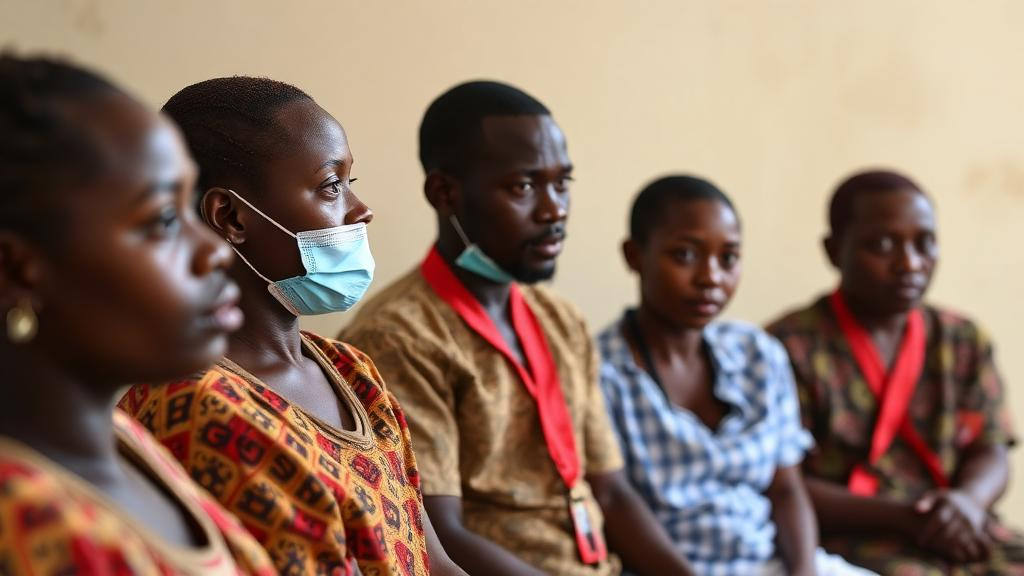
A large retrospective study from Benin has found that roughly ninety-one percent of people living with HIV-1 who are taking dolutegravir-based antiretroviral therapy have their virus suppressed, offering one of the clearest real-world confirmations yet that the World Health Organization’s 2019 recommendation to move first-line treatment onto this drug is paying off in West Africa. The research, published in BMC Infectious Diseases, analyzed viral load measurements from more than seventeen thousand patients treated across the country’s national reference laboratory system during 2024, and it also uncovered a striking gap: adults suppressed their virus far more often than children, and women achieved fully undetectable viremia far more often than men.
Dolutegravir belongs to a class of drugs called integrase strand transfer inhibitors. Rather than attacking reverse transcriptase, the enzyme that earlier generations of antiretrovirals targeted, it blocks HIV integrase, the viral enzyme that splices the virus’s DNA copy into the genome of the host cell. Because the drug binds tightly to the integrase active site and resists many common resistance mutations, it carries what virologists describe as a high genetic barrier: multiple mutations are typically required before the virus can replicate meaningfully in its presence. That property, combined with once-daily dosing and a favorable tolerability profile, is why the WHO endorsed dolutegravir-based regimens as preferred first-line therapy, and why Benin adopted the recommendation in 2019.
The new study was designed as a descriptive, cross-sectional assessment without a comparison group or a pre-dolutegravir reference cohort. The researchers, led by Edmond Tchiakpe of the University of Abomey-Calavi and Benin’s National Reference Laboratory of the Health Program Fighting Against AIDS, drew their participants from routine patients attending the laboratory program between January 1 and December 31, 2024. Viral load quantification was performed with the Abbott RealTime HIV-1 assay, a real-time polymerase chain reaction platform that counts copies of HIV-1 RNA in a milliliter of plasma. Following standard clinical definitions, a patient was classified as suppressed when the viral load was below 1,000 copies per milliliter, while any detected value at or above that threshold was treated as unsuppressed.
In total, 17,001 patients were included in the analysis. Women made up 70.3 percent of the cohort and men 29.7 percent, a distribution that mirrors the epidemiology of HIV in much of sub-Saharan Africa, where acquisition rates among women of reproductive age remain disproportionately high. Adults, who accounted for 92.1 percent of participants, were overwhelmingly treated with a backbone of tenofovir disoproxil fumarate or zidovudine combined with lamivudine and dolutegravir, written as TDF/AZT plus 3TC plus DTG. Children, 7.9 percent of the cohort, received a pediatric formulation built on abacavir or tenofovir with lamivudine and dolutegravir. Viral load and regimen data were extracted from facility registers, and the team applied univariate and multivariate logistic regression to test how regimen type, sex, and age related to virological outcomes.
The headline result is emphatic. Approximately ninety-one percent of all participants achieved viral load suppression below the 1,000-copy threshold. But that aggregate figure concealed a sharp divide between age groups: adults accounted for 92.8 percent of the suppressed patients while children represented only 7.2 percent, a difference the authors report as highly statistically significant, with a p-value below 0.0001. Among those who were suppressed, the researchers distinguished two states of residual viremia. Fully undetectable viral loads, meaning no measurable HIV-1 RNA, accounted for 68.5 percent of the suppressed group, while low-level replication viremia, detectable virus below the 1,000-copy threshold, made up the remaining 31.5 percent. That distinction matters clinically, because persistent low-level viremia can signal emerging adherence problems or the early stirrings of resistance, whereas complete suppression is the strongest guarantee of both individual health and blocked transmission.
Sex emerged as a second major axis of variation. The proportion of men with fully undetectable viral load was 24.6 percent, compared with 69.1 percent among women, a difference significant at p below 0.001. In the univariate analysis restricted to adults, men had roughly six percent lower odds of reaching an undetectable viral load than women, with an odds ratio of 0.94 and a p-value below 0.0001. Interestingly, when the analysis turned to the broader binary of suppression versus non-suppression, the sex difference largely dissolved: no statistically significant association between sex and viral load suppression was observed in the multivariable model, and male sex was associated with lower odds of undetectability with a modest adjusted odds ratio of 0.95. In children, the picture was one of parity, with boys at 3.1 percent and girls at 3.2 percent showing undetectable viremia, a difference that was not statistically significant.
The regimen comparison added a further layer. After adjusting for sex, and noting that age was entangled with regimen type and therefore excluded from the multivariable model, patients receiving the AZT or TDF backbone with lamivudine and dolutegravir had higher odds of achieving an undetectable viral load than those on the abacavir-based pediatric combination, with an adjusted odds ratio of 1.13 and a 95 percent confidence interval of 1.10 to 1.16. The same regimen was also associated with higher odds of suppression overall, at an adjusted odds ratio of 1.08 with a confidence interval of 1.06 to 1.10. The effect sizes are small, as is typical for registry-scale observational data, but the consistency across both outcome definitions suggests the difference is not merely statistical noise. It may also reflect the fact that the abacavir-containing regimen was concentrated in children, the group with the weakest suppression overall.
Why children fared so much worse than adults is a question the study raises but cannot fully answer with its descriptive design. Pediatric HIV care is notoriously difficult for reasons that have little to do with the drugs themselves. Weight-based dosing must be adjusted as children grow, pediatric formulations are less palatable and harder to stock in rural pharmacies, and young children depend entirely on caregivers to administer doses on schedule. Disclosure of HIV status to the child, a step associated with better adherence in adolescence, often happens late. The near-perfect parity between boys and girls in the pediatric cohort indicates that whatever drives the suppression gap, it operates at the level of age and care delivery rather than sex, which is itself a useful clue for program designers.
The sex gap among adults is equally consequential. Women were more likely to reach undetectable viremia, yet the study also found that the proportion of patients with viral loads above 1,000 copies per milliliter was higher in women than in men, meaning women occupied both tails of the distribution: more complete suppression, but also more overt failure. This bifurcation is consistent with patterns reported elsewhere in the region, where women engage with care earlier through antenatal screening but face interruption risks around pregnancy, postpartum periods, and partner disclosure. The authors’ finding that male sex independently predicted lower odds of undetectability, even after adjustment, suggests men’s engagement with viral monitoring itself may lag, since an undetectable result requires both adherence and regular laboratory follow-up.
For Benin’s national program, the practical message is twofold. First, the dolutegravir transition appears to be delivering on its promise at population scale, with suppression rates in adults approaching the levels seen in well-resourced settings and comfortably above the UNAIDS 95 percent suppression target’s trajectory. Second, the residual pockets of failure are now identifiable and concentrated: children on abacavir-based regimens and adults with low-level viremia rather than outright failure. Because the study was retrospective, cross-sectional, and lacked a pre-dolutegravir comparison group, it cannot definitively attribute the high suppression rates to dolutegravir alone, and the modest odds ratios around regimen and sex should be read as signals rather than proofs. Still, with seventeen thousand patients measured on a standardized platform, the dataset provides one of the most detailed snapshots to date of how integrase-inhibitor-based therapy performs in a West African national cohort, and it gives program managers a concrete map of where to direct adherence support, pediatric formulation improvements, and intensified viral load monitoring next.
Subject of Research: Real-world HIV-1 viral load suppression among patients on dolutegravir-based antiretroviral therapy in Benin
Article Title: High viral load suppression among HIV-1 infected patients receiving dolutegravir-based antiretroviral therapy in Benin, West Africa
Article References: Tchiakpe, E., Keke, R. K., Bachabi, M., & Yessoufou, A. (2026). High viral load suppression among HIV-1 infected patients receiving dolutegravir-based antiretroviral therapy in Benin, West Africa. BMC Infectious Diseases. https://doi.org/10.1186/s12879-026-14561-3
Image Credits: AI Generated
DOI: 10.1186/s12879-026-14561-3
Keywords: HIV-1, dolutegravir, antiretroviral therapy, viral load suppression, Benin, West Africa, integrase inhibitors, pediatric HIV, viremia, WHO guidelines, BMC Infectious Diseases, virological monitoring
Cite Scienmag News
Kristina Jarvis. (October 2, 2026). Dolutegravir Therapy Suppresses HIV-1 in Nine of Ten Patients in Benin. Scienmag. https://scienmag.com/dolutegravir-therapy-suppresses-hiv-1-in-nine-of-ten-patients-in-benin/
Kristina Jarvis. "Dolutegravir Therapy Suppresses HIV-1 in Nine of Ten Patients in Benin." Scienmag, 2 October 2026, https://scienmag.com/dolutegravir-therapy-suppresses-hiv-1-in-nine-of-ten-patients-in-benin/. Accessed 2 October 2026.
Kristina Jarvis. "Dolutegravir Therapy Suppresses HIV-1 in Nine of Ten Patients in Benin." Scienmag. October 2, 2026. https://scienmag.com/dolutegravir-therapy-suppresses-hiv-1-in-nine-of-ten-patients-in-benin/


