


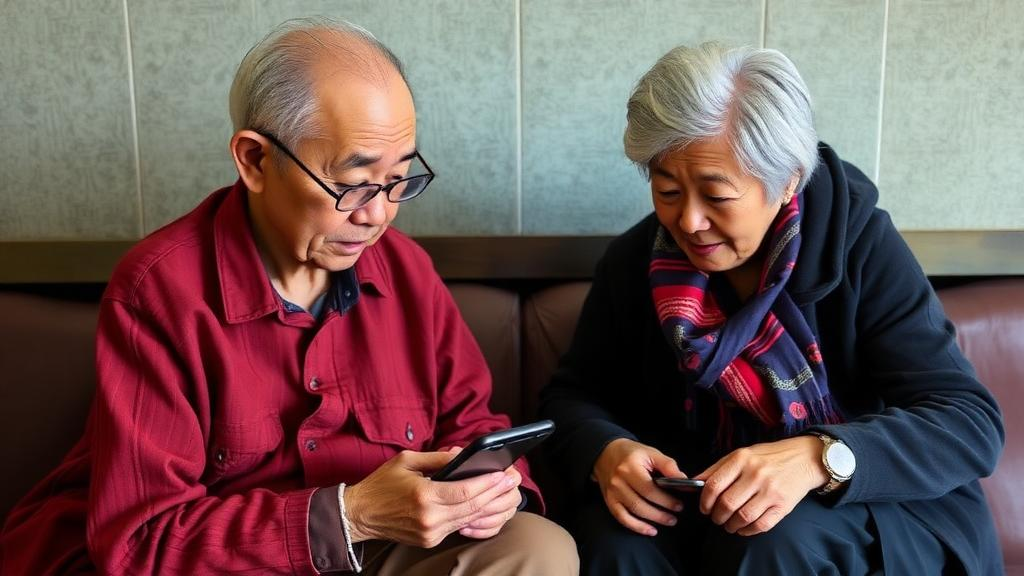
As China’s population ages at a pace matched by few countries in history, the same society is also racing through one of the most sweeping digital transformations on record. Payments, health appointments, government services, and everyday social life increasingly flow through smartphones and apps. A new study published in BMC Geriatrics examines what happens to older adults who are left behind by this transition, and its findings suggest that being digitally excluded is not a single, uniform disadvantage but a layered condition with distinct consequences for happiness and life satisfaction.
The research, conducted by Xiaona Zhang and Dan Li of the School of Public Administration at Sichuan University together with Bo Peng of Yili Normal University, breaks the broad concept of digital poverty into three separate types: digital material poverty, digital awareness poverty, and digital skills poverty. Digital material poverty refers to the lack of physical access, meaning older adults who do not own or cannot use devices such as smartphones or computers, or who lack the connectivity needed to go online. Digital awareness poverty captures a subtler deficit, describing older people who may have access to technology but do not recognize its value or feel motivated to engage with it. Digital skills poverty, the third type, describes those who have devices and interest but lack the competence to use them effectively.
This three-way classification is the analytical backbone of the study. Rather than treating the digital divide as a simple binary of connected versus unconnected, the authors argue that the barriers older adults face differ in kind, not just in degree, and that these different barriers may harm well-being through different routes. Against the backdrop of intertwined population aging and digital transformation, the study set out to quantify how each type of digital poverty affects subjective well-being, the personal assessment older adults make of their own happiness and satisfaction with life.
Methodologically, the researchers employed Ordinary Least Squares regression models to estimate the direct effects of the three types of digital poverty on subjective well-being. OLS regression is a standard statistical technique that estimates how a change in an explanatory variable, in this case the severity of a given type of digital poverty, is associated with a change in an outcome variable, here subjective well-being, while holding other measured factors constant. By estimating separate effects for material, awareness, and skills poverty, the models could reveal whether one form of exclusion matters more than another, or whether all three operate as independent drags on well-being.
The headline result is stark in its consistency: all three types of digital poverty negatively affect older adults’ subjective well-being. Whether the barrier is a missing device, a missing sense of why the digital world matters, or missing skills to navigate it, the outcome is the same direction of harm. For a rapidly aging society in which digital services are becoming the default gateway to banking, healthcare, and social contact, this finding reframes digital exclusion as a well-being issue, not merely a convenience or access issue.
But the study goes a step further by asking how this harm travels. To map the underlying mechanisms, the authors constructed a multiple mediation model, a statistical framework designed to test whether the effect of a cause on an outcome flows through intermediate variables. In this case, the mediators were online participation and offline participation, examined in their specific forms. Online participation was broken down into online life participation, online leisure participation, and online social interaction participation, while offline participation was examined through leisure and interaction participation. The logic is intuitive: digital poverty may damage well-being partly by cutting people off from activities, both screen-based and in-person, that would otherwise nourish their daily lives.
The mediation analysis identified these specific forms of online and offline participation as potential mediating pathways. In other words, older adults experiencing digital poverty tend to participate less in online life, online leisure, and online social interaction, and also less in offline leisure and interaction, and these reduced levels of participation in turn account for part of the damage to their subjective well-being. The picture that emerges is of a double exclusion: people who are digitally poor are also less engaged in the offline social and leisure fabric of their communities, and both deficits compound to lower their sense of well-being.
One result stands out from the rest for its complexity. Online leisure participation exhibited differentiated suppressing effects, a statistical pattern in which the mediator does not simply transmit the negative effect of the cause but partially counteracts or alters it depending on context. The authors interpret this as evidence that the impact of online leisure activities on the well-being of older adults may be context-dependent. Unlike online social interaction or online life participation, which appear to function as straightforward channels through which digital poverty erodes well-being, online leisure occupies a more ambiguous role, potentially buffering some effects in certain circumstances while behaving differently in others.
The study’s conclusions carry direct policy weight. The authors argue that their findings deepen the understanding of the relationship between digital poverty and subjective well-being and provide important policy implications for promoting active aging and developing a categorized, multi-layered digital inclusion policy framework. The word categorized is doing significant work here: if material poverty, awareness poverty, and skills poverty are distinct conditions with distinct mechanisms, then a one-size-fits-all digital inclusion program, say, handing out devices, will not reach the older adult whose real barrier is a lack of confidence or skills, and a training course will not help someone who cannot afford a smartphone in the first place. A multi-layered framework would instead pair hardware access programs with awareness campaigns and skills training, calibrated to the specific deficit each older adult faces.
The research arrives at a moment when the intersection of aging and digitization has become one of the defining social questions of the decade, and its framing of digital poverty as a progression, from lacking material access to lacking awareness to lacking skills, offers researchers and policymakers a vocabulary for a problem often discussed only in vague terms. The study was funded by the National Social Science Fund of China and the Fundamental Research Funds for the Central Universities of China, received ethics approval from the Ethics Committee of the School of Public Administration at Sichuan University, and was conducted with written informed consent from all participants under the standards of the Declaration of Helsinki. Published open access in BMC Geriatrics, the work invites replication in other aging societies, where the same three-layered divide between older adults and the digital world may be quietly shaping not just what people can do, but how they feel about their lives.
Subject of Research: The impact of digital material, awareness, and skills poverty on the subjective well-being of older adults in China
Article Title: From digital material poverty to digital skills poverty: the impact of digital poverty on subjective well-being among older adults in China
Article References: Zhang, X., Peng, B., & Li, D. (2026). From digital material poverty to digital skills poverty: the impact of digital poverty on subjective well-being among older adults in China. BMC Geriatrics. https://doi.org/10.1186/s12877-026-08326-5
Image Credits: AI Generated
DOI: 10.1186/s12877-026-08326-5
Keywords: digital poverty, older adults, subjective well-being, China, digital divide, digital skills, social participation, active aging, gerontology, online leisure, digital inclusion, BMC Geriatrics
Cite Scienmag News
Ophelia Keating. (October 2, 2026). Digital Poverty in Old Age: Missing Devices, Awareness, and Skills Erode Well-Being in China. Scienmag. https://scienmag.com/digital-poverty-in-old-age-missing-devices-awareness-and-skills-erode-well-being-in-china/
Ophelia Keating. "Digital Poverty in Old Age: Missing Devices, Awareness, and Skills Erode Well-Being in China." Scienmag, 2 October 2026, https://scienmag.com/digital-poverty-in-old-age-missing-devices-awareness-and-skills-erode-well-being-in-china/. Accessed 2 October 2026.
Ophelia Keating. "Digital Poverty in Old Age: Missing Devices, Awareness, and Skills Erode Well-Being in China." Scienmag. October 2, 2026. https://scienmag.com/digital-poverty-in-old-age-missing-devices-awareness-and-skills-erode-well-being-in-china/


