


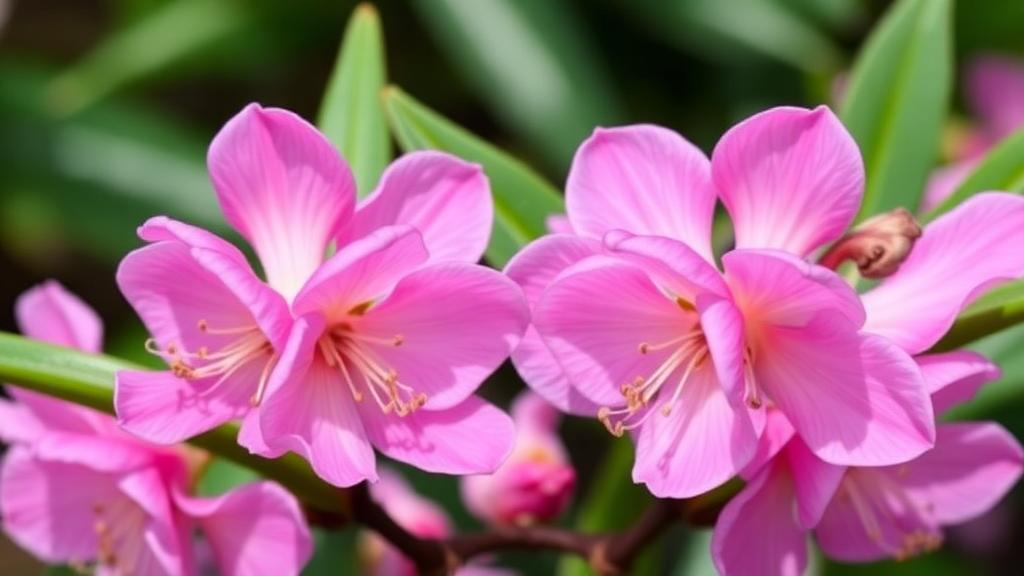
High on the wind-scoured passes of the eastern Qinghai-Tibet Plateau, botanists have documented something extraordinarily rare: a wild rhododendron that has, apparently twice and independently, evolved fully double flowers. In a study published in Ecology and Evolution, researchers report the first known double-flowered form of Rhododendron nivale, a dwarf shrub that carpets alpine scrub across the eastern plateau. The discovery is also the first documentation of double flowers anywhere in subsection Lapponica, a group within a genus of more than 1,150 species in which only four wild double-flowered taxa had ever been recorded before.
The first population was found in August 2023, during a biodiversity survey connected to the Second Comprehensive Scientific Expedition to the Qinghai-Tibet Plateau. At a mountain pass on the border between Chaya and Gonjo counties in Tibet, at 4,825 meters above sea level, the team encountered roughly 30 double-flowered individuals growing alongside normal single-flowered plants on a windward, shaded slope at the edge of rhododendron scrub. Two years later, in August 2025, a second survey in the Gexigou National Nature Reserve in Yajiang County, Sichuan, revealed a much larger population of approximately 100 double-flowered individuals at a pass 4,475 meters up, more than 800 kilometers away from the Tibetan site yet in strikingly similar habitat conditions.
The morphological changes in both populations were remarkably consistent. In the double-flowered plants, all ten stamens have been completely transformed into petals, a phenomenon known as stamen petalody, with only two or three residual anthers remaining at the edge of the outer corolla whorl. These surviving anthers still produce viable pollen, and the plants can set normal fruit. The corolla lobes are significantly thicker than those of normal plants, the style is shortened from about 16 millimeters to just 5 to 7 millimeters and bears a semi-globose stigma, and the capsules are densely covered with two layers of transparent scales rather than the single sparse layer seen in typical individuals. The calyx also shows a modification never before documented in any double-flowered rhododendron: two or three of its five lobes become strongly enlarged and leathery, reaching up to 7 millimeters.
Perhaps the most consequential difference is temporal. The double-flowered morph blooms from August to October, roughly a month later than the sympatric single-flowered plants, which flower from May to August. The researchers suggest this flowering delay may reduce temporal overlap between the two morphs and could contribute to reproductive isolation, a form of prezygotic separation that might help the double-flowered form establish and maintain itself independently in each population. In the Tibet population, individual branches bore either only double flowers or only normal flowers, with no branch producing both types, while the Sichuan population contained a few individuals with transitional floral forms in which some stamens were petaloid and others remained normal.
Those transitional forms carry important genetic implications. The authors interpret them as evidence that the double-flowered trait is likely controlled by a major genetic factor with incomplete penetrance or variable expressivity, meaning the mutation does not always produce the full phenotype in every individual. To test whether the two populations share a common origin, the team sequenced the plastid barcodes rbcL and matK from single- and double-flowered plants at both sites, assembling a 1,617-base-pair matrix of ten taxa analyzed with Bayesian, maximum-likelihood, and maximum-parsimony methods. The phylogeny recovered R. nivale as a strongly supported monophyletic group, but crucially, the double-flowered morph was not monophyletic.
Instead, the four sampled accessions resolved into two geographically structured sister pairs, one from Sichuan and one from Tibet, and within each pair the double-flowered plant was the sister to its local single-flowered counterpart rather than to the other double-flowered population. This pattern is exactly what would be expected if the double-flowered phenotype had arisen independently in each region rather than spreading from a single mutation. Combined with the more than 800 kilometers separating the sites and their nearly identical floral modifications, the genetic evidence points toward parallel evolution: the same phenotype emerging repeatedly in isolated lineages under similar selective pressures.
The authors propose a molecular explanation grounded in the ABC model of floral organ development, the classic framework describing how classes of homeotic genes specify floral organs. In this model, stamen identity in the third whorl requires joint activity of B-class and C-class MADS-box genes, and loss or downregulation of C-class function can convert stamens into petals. The complete stamen petalody and abnormal, shortened style in double-flowered R. nivale suggest that C-class genes may be affected in both whorls. Supporting this hypothesis, studies of double-flowered Japanese horticultural azalea cultivars have shown that downregulation of the AGAMOUS/PLENA homolog, together with deletion and frameshift mutations in its coding region, caused loss of C-class function and converted stamens and carpels into petaloid organs. No systematic molecular study of R. nivale’s double flowers has yet been conducted, and the authors call for transcriptomic or whole-genome resequencing comparisons between the two morphs.
Why would the same developmental program be disrupted twice, in two distant populations? The researchers point to the strikingly similar environments of both passes: strong winds, low temperatures, intense ultraviolet radiation, and a short growing season. Extreme conditions can dysregulate floral development genes, and low temperature or drought is known to affect the expression of flowering-time genes. Environmental stress can also activate LTR retrotransposons, mobile genetic elements that can cause mutations when they insert near key genes. If such elements are active in the R. nivale genome, they might independently generate similar mutations in geographically separated populations. The species’ recently assembled genome, which reveals expanded flavonoid and cuticular-wax biosynthesis gene families, positively selected UV-repair genes, upregulated cold and low-oxygen responsive transcription factors, and possible autotetraploidy, underscores how specialized this plant is for mountaintop life and how sensitive its developmental regulators may be to environmental signals.
If confirmed, the parallelism would place R. nivale among a small but growing set of plant examples of parallel evolution and parallel speciation, phenomena far better documented in animals such as threespine sticklebacks repeatedly evolving lake ecotypes, or in marine snails differentiating across wave-exposure gradients. In plants, wild rice Oryza nivara originated multiple times from its perennial ancestor across different regions, foxtail millet and other cereals independently lost seed shattering through transposable element insertions, and high-altitude populations of Arabidopsis thaliana evolved dwarfism through independent loss-of-function mutations. Well-documented cases in woody plants, however, remain extremely scarce, particularly for complex floral traits, which makes the double-flowered rhododendron a valuable new system for understanding how floral diversity arises in alpine sky-island ecosystems.
Naturally occurring double-flowered rhododendrons are exceptionally rare, and for good reason: with stamens and sometimes pistils converted to petals and anther development incomplete, sexual reproduction becomes difficult, explaining why such variants seldom persist. Yet the R. nivale plants retain enough fertility to produce viable pollen and normal fruit, and if the double flowers carry pleiotropic benefits such as attracting specific pollinators or enhancing stress tolerance, natural selection could maintain them. Beyond its evolutionary significance, the discovery holds horticultural promise, since double flowers are prized ornamental traits, and the authors emphasize that tissue culture and artificial propagation studies will be needed to preserve this natural variation. Future work combining genomics, transcriptomics, pollination ecology, and population genetics should clarify whether the harsh alpine environment truly drove this remarkable case of repeated floral reinvention.
Subject of Research: Stamen petalody and possible parallel evolution of double flowers in wild Rhododendron nivale on the Qinghai-Tibet Plateau
Article Title: First Observation of Wild Double‐Flowered Rhododendron nivale With Stamen Petaloidy and Possible Parallel Evolution
Article References: Chen, X., Deng, S., & Wang, Z. (2026). First Observation of Wild Double‐Flowered Rhododendron nivale With Stamen Petaloidy and Possible Parallel Evolution. Ecology and Evolution, 16(10), Article e74443. https://doi.org/10.1002/ece3.74443
Image Credits: AI Generated
DOI: 10.1002/ece3.74443
Keywords: Rhododendron nivale, double flowers, stamen petalody, parallel evolution, Qinghai-Tibet Plateau, ABC model, MADS-box genes, floral homeosis, alpine plants, reproductive isolation, phylogenetics, Hengduan Mountains
Cite Scienmag News
Gavin Prescott. (October 2, 2026). Rare Double Flowers Found Twice in Alpine Rhododendron Suggest Parallel Evolution. Scienmag. https://scienmag.com/rare-double-flowers-found-twice-in-alpine-rhododendron-suggest-parallel-evolution/
Gavin Prescott. "Rare Double Flowers Found Twice in Alpine Rhododendron Suggest Parallel Evolution." Scienmag, 2 October 2026, https://scienmag.com/rare-double-flowers-found-twice-in-alpine-rhododendron-suggest-parallel-evolution/. Accessed 2 October 2026.
Gavin Prescott. "Rare Double Flowers Found Twice in Alpine Rhododendron Suggest Parallel Evolution." Scienmag. October 2, 2026. https://scienmag.com/rare-double-flowers-found-twice-in-alpine-rhododendron-suggest-parallel-evolution/


