


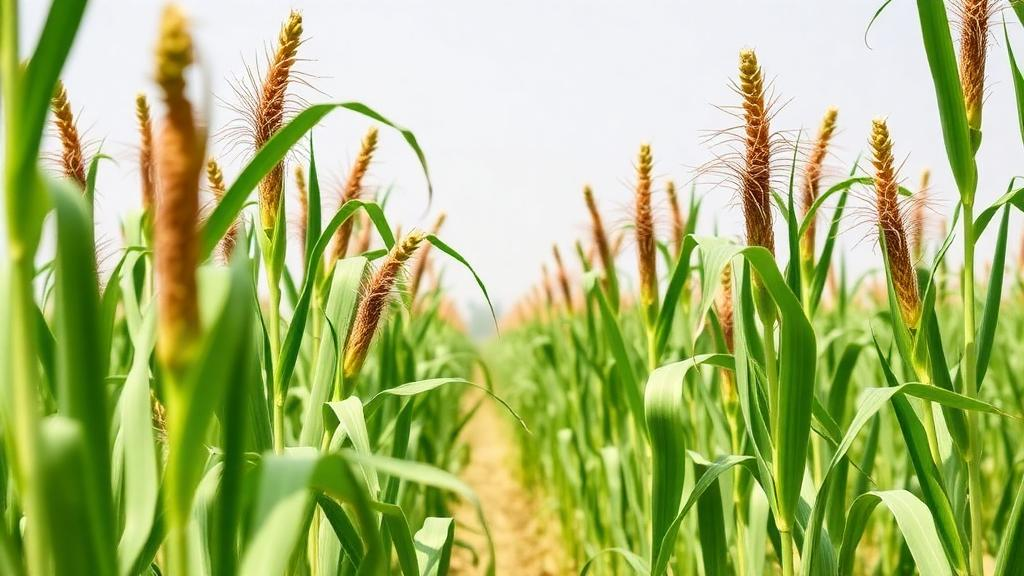
In a quiet corner of Uttarakhand, plant breeders have accomplished something that maize scientists have pursued for decades: a commercial hybrid created by crossing modern maize with its own wild ancestor. Pant Forage Maize Hybrid-1, known by its experimental designation DFH-2, has been officially described in the Indian Journal of Genetics and Plant Breeding as the world’s first single-cross inter-subspecies hybrid between maize (Zea mays L.) and teosinte (Z. mays subsp. parviglumis). Developed at Govind Ballabh Pant University of Agriculture and Technology in Pantnagar, the hybrid has now been released and notified for cultivation across large swathes of India, marking a milestone in the applied use of crop wild relatives.
The significance of the achievement lies in the genetic distance the breeders had to bridge. Teosinte, specifically the subspecies parviglumis, is the wild grass from which maize was domesticated roughly nine thousand years ago in the Balsas River valley of Mexico. Although the two subspecies are close enough to be cross-fertile, millennia of domestication and selection have left modern maize and its ancestor with profoundly different plant architectures, flowering behaviors, and growth habits. Teosinte is a highly branched, tillering plant with small, hard-cased seeds arranged in two-ranked spikes, while cultivated maize is a single-stalked giant bearing rows of naked kernels on a massive ear. Reconciling these divergent genomes in a hybrid that performs well in farmers’ fields is a formidable breeding challenge.
The formal recognition of DFH-2 came through India’s rigorous varietal release system. The Central Sub-Committee on Crop Standards, Notification and Release of Varieties of Agricultural Crops, operating under the Department of Agriculture, Cooperation and Family Welfare of the Government of India, issued notification number S.O. 4388(E) dated 8 October 2024. That notification authorizes cultivation of the hybrid in two major agro-climatic regions: the Northern Western Zone, comprising the plains of Uttarakhand along with Haryana, Punjab and Rajasthan, and the Central Zone, covering Chhattisgarh, Madhya Pradesh, Maharashtra and Uttar Pradesh. This geographic scope spans some of the most intensive dairy and livestock production areas in the country, where demand for high-quality green fodder consistently outstrips supply.
DFH-2 is designed specifically as a forage crop rather than a grain hybrid, and this distinction shapes its entire value proposition. Forage maize is harvested as whole green plants and fed to cattle and buffalo, either fresh or as silage, making total biomass rather than grain yield the economic target. According to the varietal notification published by Shivam Yadav and N. K. Singh of the Department of Genetics and Plant Breeding at Pantnagar, the hybrid delivers high green forage yield and high dry matter yield, and it holds clear advantages over the national check varieties used in Indian testing programs, namely COHM-8, J-1006 and African Tall. Those checks represent the benchmark forage materials against which every new candidate must prove itself across multiple locations and seasons.
What sets DFH-2 apart from conventional forage hybrids, however, is a suite of plant-type traits inherited from its wild parentage. The hybrid produces multiple basal and lateral tillers, an architectural feature that is rare in elite maize germplasm but characteristic of teosinte. Tillering allows a single plant to send up several productive stems from its base, effectively increasing the number of harvestable stalks per unit area without increasing seeding rate. In addition, the hybrid possesses regrowth potential, meaning that after a cut the stand can recover and produce further biomass. Taken together, these traits open the possibility of multi-cut management, in which farmers harvest the crop more than once in a season rather than taking a single terminal harvest.
The authors of the notification emphasize that this combination of changed plant type, tillering, regrowth capacity and elevated forage yield may prove especially useful for dairy farmers. India’s dairy sector depends on a reliable, year-round flow of green fodder, and shortages of quality forage are a persistent constraint on milk productivity for smallholders. A hybrid that can be cut multiple times, or that produces more tillers and therefore more leaf and stem material per plant, directly addresses the economics of fodder production. Higher dry matter yield also matters for silage making, since the energy density of fermented feed depends on the amount of dry material packed into each tonne of green chop.
From a genetic resources perspective, the release of DFH-2 also represents an important act of germplasm registration and documentation. By publishing the varietal description in a peer-reviewed journal, the breeding team has created a permanent record of the hybrid’s identity, pedigree concept and distinctive traits, which allows other breeders to request material, use it in crossing programs, and cite it in their own work. Crop wild relatives such as parviglumis teosinte are increasingly viewed as essential reservoirs of genetic diversity for traits like stress tolerance, tillering and nutritional quality, and DFH-2 demonstrates that such diversity can be moved into commercial products rather than remaining confined to gene banks and research plots.
The breeding program itself was carried out under the All India Coordinated Research Project on Maize, the national network that evaluates maize hybrids across the country’s diverse agro-ecologies before any variety can be recommended for release. The authors note that no separate funding was received during variety development beyond the support of this project framework. The varietal notification article, received in January 2026, revised in February and published online on 12 March 2026 in volume 86 of the journal, serves as the formal scientific documentation accompanying the government notification, a standard practice in the Indian varietal system that links official release with published evidence.
For the broader plant breeding community, DFH-2 offers a case study in how inter-subspecific hybridization can be converted from an academic curiosity into a deployable technology. Single-cross hybrids, produced by crossing two inbred lines, are the standard commercial format in maize because they deliver uniformity and maximum heterosis, the vigor that arises when genetically divergent lines are combined. Crossing an elite maize inbred with a teosinte-derived line introduces an even wider genetic gap, and the resulting heterosis appears to express itself in exactly the traits that forage farmers value: vegetative vigor, tillering and biomass accumulation. The trade-offs that make teosinte unsuitable for grain production, such as its small, encased seeds, are largely irrelevant in a forage crop, which is harvested before grain maturity and valued for its stems and leaves.
As DFH-2 moves into farmers’ fields across eight states, attention will turn to how its unusual plant architecture performs under real management conditions, from sowing density to cutting schedules to silage quality. The hybrid’s notification for both the Northern Western and Central zones suggests that the testing network found it stable across a wide band of environments. For a crop that began its journey with a cross between a domesticated staple and the wild grass that gave rise to it, the path from experiment to notification is a reminder that some of the most forward-looking tools in modern agriculture come from reaching back into the deepest layers of a crop’s evolutionary history.
Subject of Research: Development and release of the first maize-teosinte inter-subspecies forage hybrid
Article Title: Pant Forage Maize Hybrid-1 (DFH-2)
Article References: Yadav, S., & Singh, N. K. (2026). Pant Forage Maize Hybrid-1 (DFH-2). Indian Journal of Genetics and Plant Breeding, 86(2), 258-259. https://doi.org/10.1007/s44489-026-00013-4
Image Credits: AI Generated
DOI: 10.1007/s44489-026-00013-4
Keywords: maize, teosinte, forage hybrid, plant breeding, crop wild relatives, Zea mays, tillering, multi-cut forage, dairy farming, germplasm registration, India, varietal release
Cite Scienmag News
Alan Morgan. (October 2, 2026). World’s First Maize-Teosinte Hybrid Debuts as High-Yield Forage Crop for India’s Dairy Farmers. Scienmag. https://scienmag.com/worlds-first-maize-teosinte-hybrid-debuts-as-high-yield-forage-crop-for-indias-dairy-farmers/
Alan Morgan. "World’s First Maize-Teosinte Hybrid Debuts as High-Yield Forage Crop for India’s Dairy Farmers." Scienmag, 2 October 2026, https://scienmag.com/worlds-first-maize-teosinte-hybrid-debuts-as-high-yield-forage-crop-for-indias-dairy-farmers/. Accessed 2 October 2026.
Alan Morgan. "World’s First Maize-Teosinte Hybrid Debuts as High-Yield Forage Crop for India’s Dairy Farmers." Scienmag. October 2, 2026. https://scienmag.com/worlds-first-maize-teosinte-hybrid-debuts-as-high-yield-forage-crop-for-indias-dairy-farmers/


