


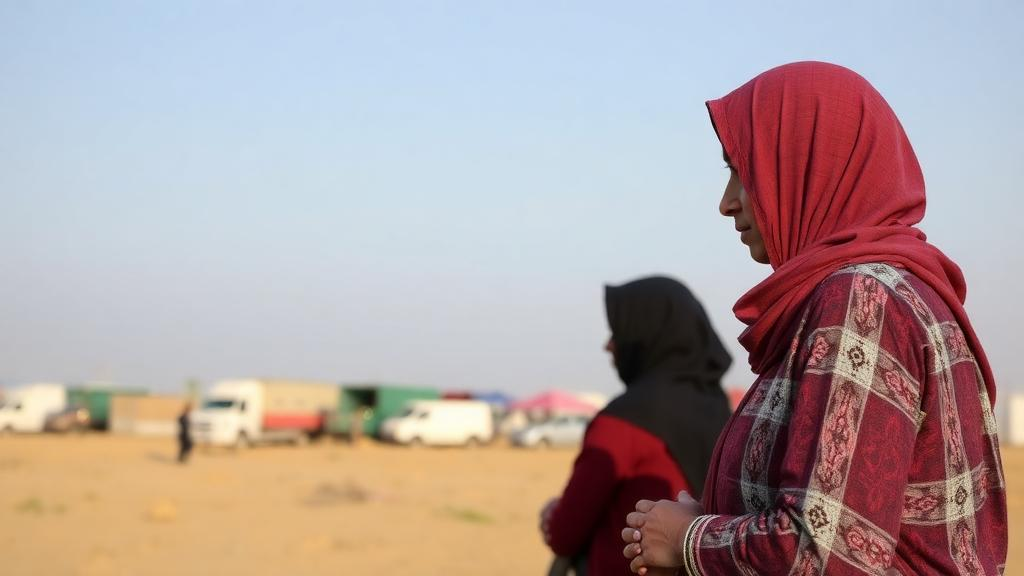
For millions of people displaced by conflict across the Middle East and North Africa, the journey does not end at a border. It continues in crowded settlements, unfamiliar cities, and the quiet spaces where grief, loss, and fear accumulate. A new peer-reviewed review published in Discover Psychology argues that the mental health and psychosocial needs of refugees living within the MENA region itself have been largely overlooked, and it sets out to change that with a conceptual, practice-oriented framework for trauma-informed and culturally responsive care tailored specifically to the region. The work, led by Eid G. Abo Hamza of the University of Sharjah and Tanta University together with colleagues at institutions spanning Canada, the United States, the United Arab Emirates, and Australia, offers what the authors describe as a roadmap for mental health providers and policymakers confronting the psychological fallout of forced displacement.
The scale of the problem is difficult to overstate. Conflict and instability across the MENA region have produced enormous numbers of refugees seeking protection in adjacent nations, often in countries that are themselves under economic and infrastructural strain. Unlike refugees resettled in high-income Western countries, those who remain within the region frequently encounter compounding adversities: social isolation, limited access to basic amenities such as clean water, shelter, and healthcare, and exposure to sexual and gender-based violence. Each of these stressors can significantly impede access to protection and psychosocial relief, creating a cascade in which the conditions that drive psychological distress also block the pathways to recovery. The review emphasizes that trauma, separation from family members, and loss of loved ones, homeland, and livelihood affect a large proportion of displaced people, and that these experiences interact with ongoing hardship in ways that Western clinical models were never designed to capture.
Trauma-informed care, the central concept of the framework, rests on a simple but transformative premise: services should be organized around an understanding of how trauma shapes behavior, trust, memory, and the body’s stress physiology. Rather than asking what is wrong with a person, trauma-informed systems ask what has happened to them. In practice, this means avoiding re-traumatization during intake and treatment, giving survivors genuine choice and control over their care, building safety and predictability into every interaction, and recognizing that symptoms such as hypervigilance, avoidance, sleep disruption, and emotional numbing are adaptive responses to extreme danger rather than signs of weakness or pathology. For refugees who have fled war, bombardment, or persecution, a clinical encounter that ignores this reality can itself become a source of harm, triggering the same threat responses the person has been struggling to escape.
What distinguishes the new framework is its insistence that trauma-informed principles cannot be transplanted wholesale from Western contexts into the MENA region. The authors argue that care must also be culturally responsive, meaning that it accounts for the values, family structures, religious beliefs, idioms of distress, and help-seeking patterns of the populations it serves. In many MENA communities, psychological suffering is expressed through somatic complaints, framed in spiritual or religious terms, or managed within extended family networks long before, or instead of, any contact with formal mental health services. Stigma surrounding mental illness can be intense, and the very concept of psychotherapy may be unfamiliar or mistrusted. A service model that ignores these realities will fail not because its clinical techniques are wrong, but because it never earns the trust required for people to walk through the door.
The review also highlights a structural blind spot in the research literature itself. While a plethora of past work has addressed refugees in non-Western contexts, comparatively fewer studies have focused on the mental health and psychosocial needs of refugees settled within the MENA region, even though the majority of the world’s displaced people from the region remain there rather than resettling elsewhere. This imbalance matters scientifically as well as practically. Most diagnostic instruments, prevalence estimates, and treatment protocols in trauma psychology were developed and validated in Western populations, and their assumptions about individual autonomy, disclosure, and the therapeutic relationship may not transfer cleanly. The authors position their framework as a corrective: a conceptual foundation built from the synthesis and interpretation of existing literature, designed to guide both future research and frontline practice in the settings where the need is greatest.
Technically, the framework operates at the intersection of several strands of psychological science. Trauma psychology contributes an understanding of post-traumatic stress, complex trauma, and the neurobiological consequences of chronic threat, including dysregulation of the hypothalamic-pituitary-adrenal axis and the heightened vigilance that shapes attention, learning, and social behavior. Migration and health research contributes the recognition that displacement is not a single event but a prolonged process, with distinct stressors at pre-departure, flight, transit, and settlement stages, each capable of compounding the last. Cultural psychiatry contributes the insight that idioms of distress, explanatory models of illness, and culturally sanctioned coping practices, including religious and communal rituals, can either support or undermine formal treatment depending on whether providers engage with them respectfully. The framework weaves these strands into guidance that is explicitly evidence-informed and culturally grounded rather than imported from any single tradition.
The practical implications reach well beyond the clinic. The authors write that the outcome of their work equips mental health providers and policymakers with strategies to address the psychological and psychosocial needs arising from forced displacement and migration in the region. That includes training frontline workers, many of whom are paraprofessionals or community members rather than licensed clinicians, to recognize signs of traumatic stress and to respond without judgment. It includes designing services that are accessible within camps and host communities, that respect gender norms while still protecting survivors of sexual and gender-based violence, and that coordinate with education, housing, and legal protection systems, since psychosocial stability depends on more than therapy alone. It also includes building family-centered and community-based interventions, reflecting the collectivist orientation of many affected communities, in which an individual’s wellbeing is inseparable from the wellbeing of the household and the social group.
The timing of the framework is significant. Displacement across the MENA region remains one of the defining humanitarian challenges of the era, and host countries have absorbed populations at a scale that strains even the most committed health systems. Mental health is often the last component of the humanitarian response to receive funding, yet untreated trauma carries long-term costs: impaired parenting, disrupted schooling, reduced economic participation, and, in some cases, the transmission of stress across generations. By framing trauma-informed care as a system-level requirement rather than a specialist luxury, the review makes an economic as well as an ethical argument. Early, culturally attuned psychosocial support, the logic runs, is far less costly than the downstream consequences of its absence.
It is worth noting the nature of the evidence behind the framework. The article is explicitly a theoretical and conceptual paper, based on the synthesis and interpretation of existing literature, and it did not involve human participants, human data, or intervention trials. That means the roadmap it offers is a starting point rather than a finished product: its principles will need to be tested, adapted, and refined through empirical studies conducted in the region, ideally in partnership with refugee communities themselves. The authors received no external financial support for the work, and the article is published open access under a Creative Commons license, making it freely available to practitioners, students, and policymakers throughout the region and beyond.
Even so, the contribution fills a conspicuous gap. By naming the specific adversities faced by refugees within the MENA region, by insisting that trauma-informed and culturally responsive care are inseparable goals, and by translating both into a framework that providers and policymakers can act on, the review shifts the conversation from whether refugee mental health matters to how it can realistically be served. For the millions of displaced people navigating life in the countries next door to the conflicts they fled, that shift, from being mainly ignored to being properly attended to, is not an academic nicety. It is the difference between services that see them and services that look past them, and it may shape the psychological recovery of an entire generation.
Subject of Research: Trauma-informed and culturally responsive mental health care for refugees in the Middle East and North Africa
Article Title: Trauma informed and culturally responsive practices for refugee care and support in the Middle East and North Africa
Article References: Abo Hamza, E. G., Al-Krenawi, A., Elbedour, S., Hamid, A. A. R. M., Al-Leheabi, S., & Moustafa, A. (2026). Trauma informed and culturally responsive practices for refugee care and support in the Middle East and North Africa. Discover Psychology. https://doi.org/10.1007/s44202-026-00828-y
Image Credits: AI Generated
DOI: 10.1007/s44202-026-00828-y
Keywords: refugees, mental health, trauma-informed care, MENA region, forced displacement, cultural responsiveness, psychosocial support, post-traumatic stress, migration and health, humanitarian response, Trauma, informed
Cite Scienmag News
Glenn Wilkins. (October 2, 2026). Rethinking Refugee Mental Health: A Culturally Grounded Framework for the MENA Region. Scienmag. https://scienmag.com/rethinking-refugee-mental-health-a-culturally-grounded-framework-for-the-mena-region/
Glenn Wilkins. "Rethinking Refugee Mental Health: A Culturally Grounded Framework for the MENA Region." Scienmag, 2 October 2026, https://scienmag.com/rethinking-refugee-mental-health-a-culturally-grounded-framework-for-the-mena-region/. Accessed 2 October 2026.
Glenn Wilkins. "Rethinking Refugee Mental Health: A Culturally Grounded Framework for the MENA Region." Scienmag. October 2, 2026. https://scienmag.com/rethinking-refugee-mental-health-a-culturally-grounded-framework-for-the-mena-region/


