


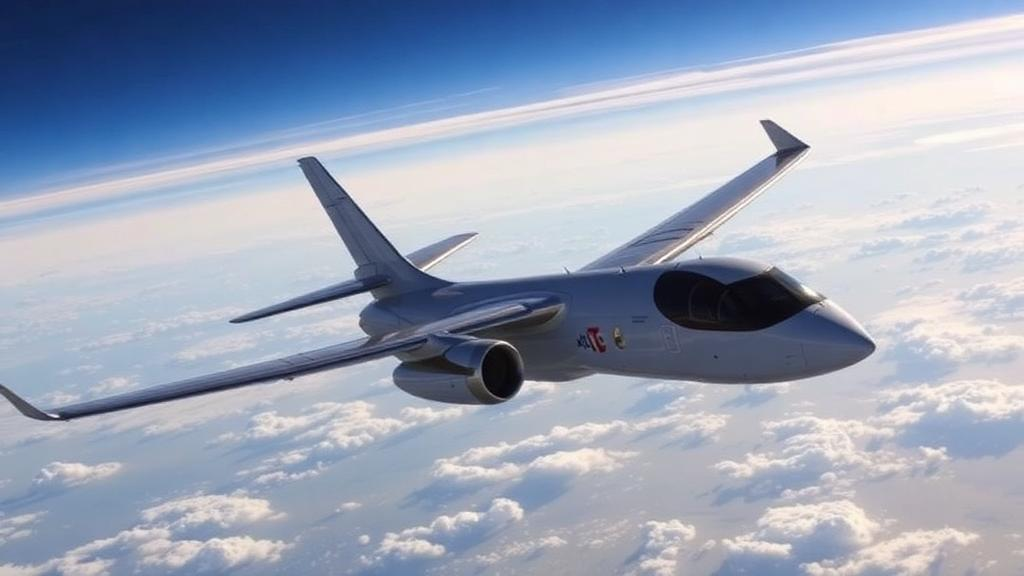
High above our heads, between roughly 10 and 25 kilometres above the Earth’s surface, the atmosphere is far from still. Invisible ripples of energy, generated when air is forced upward over mountains or by towering convective storms, rise and fall in vast wave-like patterns that can span hundreds of kilometres. These atmospheric gravity waves have fascinated scientists for decades, but a team at the University of Bath now wants to do something genuinely new with them: use them as fuel. The researchers, based in the Centre for Climate Adaptation and Environment Research, have been awarded £1.9 million by the Advanced Research + Invention Agency (ARIA) to build what they describe as a ‘stratospheric sat-nav’ — a forecasting and routing system that will allow high-altitude unmanned aircraft to surf these waves and dramatically extend their time in the air.
The project, named STRAT-NAV, forms part of ARIA’s Enduring Atmospheric Platforms Programme, a £70 million, three-and-a-half-year initiative led by Programme Director Rico Chandra. The programme has funded 18 research and development teams, all working on the same fundamental challenge: how to keep aircraft operating reliably and cost-effectively in the stratosphere for extended periods. The ambition behind the programme is considerable. Platforms capable of lingering aloft for weeks or months could provide the high-performance communications infrastructure needed for truly global connectivity, support the next generation of AI and digital services, and reduce dependence on conventional satellites, which are expensive to launch and impossible to repair once in orbit.
The aircraft at the centre of this vision are known as High-Altitude Pseudo-Satellites, or HAPS. These long-endurance vehicles fly in the stratosphere, a layer of the atmosphere that is relatively calm, above most weather, and far below orbital space. From this vantage point, a HAPS platform can deliver remote-sensing observations or communications services over a wide area, behaving in many respects like a satellite but with the crucial advantage of being recoverable, upgradable and re-deployable. Most HAPS designs are solar-powered ultralight gliders, exquisitely engineered to be as light as possible. That lightness, however, comes at a cost: the onboard battery capacity is limited, and the aircraft face acute power challenges, particularly during the long winter nights experienced at UK latitudes, when solar energy falls to its lowest levels.
This is where the Bath team sees an opportunity hiding in plain sight. Atmospheric gravity waves are created when air is forced upwards — by mountain ranges or by deep convection — and then falls back down under gravity in a wave-like motion, transferring energy through the atmosphere much as ripples transfer energy across the surface of a pond. The vertical air motions associated with these waves can be strong enough for a suitably equipped aircraft to exploit. Just as eagles ride thermals to gain altitude without flapping their wings, STRAT-NAV aims to guide HAPS platforms to soar on atmospheric gravity waves. According to the project team, the energy savings from this ‘gravity wave assist’ would be equivalent to carrying at least a 20 to 40 per cent bigger battery — at no additional cost, weight or complexity to the aircraft itself.
Dr Neil Hindley, a research fellow in the Centre for Climate Adaptation and Environment Research and the project’s lead, described the award as an exciting opportunity to translate decades of atmospheric science into a practical tool. In his words, the project could transform high-altitude aviation and unlock the stratosphere as an operating environment. He noted that atmospheric gravity waves have been studied by scientists for decades, but that until recently the community lacked the sub-kilometre-scale forecasting capability needed to predict them accurately enough to use operationally. If HAPS aircraft can be helped to navigate and exploit these naturally occurring energy sources, he argued, it could fundamentally change what is possible for long-endurance flights over the UK and beyond.
The choice of the United Kingdom as a proving ground is not accidental. The country sits beneath the undulating path of the jet stream, a fast-moving ribbon of air whose meanders are a prolific generator of gravity waves. Add the rugged mountain terrain of Wales and the Pennines, which forces air upward as weather systems pass over, and the stratospheric polar vortex that forms over the pole each winter, and the UK becomes a global hotspot for gravity wave activity. Hindley described exploiting stratospheric gravity waves as a uniquely advantageous strategy for the UK because of this geography. Crucially, the timing works in the aircraft’s favour: while available solar energy falls to a minimum during winter, gravity wave activity over the UK reaches its maximum at exactly the moment it is most needed. This seasonal complementarity between sunlight and wave energy is what could allow HAPS to operate year-round, realising the vision of an operational fleet providing services that until now have only been possible from orbit.
The technical challenge lies in the fact that gravity waves, despite containing abundant energy, are notoriously difficult to forecast and exploit. They are small in horizontal scale compared with the synoptic weather systems that drive them, often just a few kilometres across, which places them below the resolution of standard numerical weather prediction models. A HAPS aircraft therefore needs reliable, high-accuracy forecasts and intelligent routing systems to find and use these rising currents safely and efficiently. STRAT-NAV will tackle this with AI-enhanced, ultra-high-resolution, real-time atmospheric modelling, validated against observations, to forecast the gravity wave field around a HAPS platform up to 72 hours in advance. On top of the forecast layer, the project will develop platform-specific intelligent routing algorithms that maximise the energy harvested from gravity waves through soaring while maintaining the communications coverage that these aircraft exist to provide.
The programme is structured to move from simulation to the real sky. Work begins in September 2026 with model development, followed by observational campaigns in late 2026 and 2027 designed to validate the gravity-wave forecasts against direct measurements of the atmosphere. Only once the forecasts have been proven will the project progress to flight trials with HAPS industry partners later in the programme. This staged approach reflects a broader lesson from aviation history: exploiting natural atmospheric energy is not a new idea — glider pilots have ridden mountain waves and thermals for a century — but doing so autonomously, at 20 kilometres altitude, guided by machine-learned forecasts, is something genuinely novel.
One of the most commercially significant aspects of the design is its platform-agnostic nature. The gravity wave assist capability is intended to work with any HAPS platform, whether a lightweight fixed-wing aircraft or even a rotary-wing vehicle, and requires no modifications to the aircraft and no expensive ground infrastructure. That could lower the barrier to adoption across an industry in which every gram of payload and every watt-hour of battery counts. For operators, the prospect of effectively free energy harvested from the sky — savings equivalent to a battery a fifth to two-fifths larger — could be the difference between a seasonal demonstrator and a viable year-round service.
If STRAT-NAV succeeds, the implications extend well beyond the UK. A demonstrated ability to forecast and exploit stratospheric gravity waves would give long-endurance aircraft a renewable energy source that no battery chemistry or solar array can match in cost, and it would arrive precisely when solar power is weakest at high latitudes. The wider Enduring Atmospheric Platforms Programme, with its 18 funded teams and £70 million budget, is betting that the stratosphere can become a routine operating environment — a physical backbone for next-generation communications and a path to connectivity for underserved regions. The energy to make that happen, the Bath team argues, is already there, rippling invisibly through the sky, waiting to be navigated.
Subject of Research: Exploiting atmospheric gravity waves to extend the endurance of stratospheric high-altitude pseudo-satellite aircraft
Article Title: Bath receives £1.9 million funding to unlock energy hidden in the sky
Article References: Bath receives £1.9 million funding to unlock energy hidden in the sky. (n.d.). Original publication
Image Credits: AI Generated
DOI: Not provided
Keywords: atmospheric gravity waves, stratosphere, HAPS, high-altitude pseudo-satellites, University of Bath, ARIA, STRAT-NAV, long-endurance flight, atmospheric modelling, soaring, renewable energy, connectivity
Cite Scienmag News
Russell Cooper. (October 2, 2026). £1.9 Million Grant to Turn Stratospheric Gravity Waves into Fuel for High-Altitude Aircraft. Scienmag. https://scienmag.com/1-9-million-grant-to-turn-stratospheric-gravity-waves-into-fuel-for-high-altitude-aircraft/
Russell Cooper. "£1.9 Million Grant to Turn Stratospheric Gravity Waves into Fuel for High-Altitude Aircraft." Scienmag, 2 October 2026, https://scienmag.com/1-9-million-grant-to-turn-stratospheric-gravity-waves-into-fuel-for-high-altitude-aircraft/. Accessed 2 October 2026.
Russell Cooper. "£1.9 Million Grant to Turn Stratospheric Gravity Waves into Fuel for High-Altitude Aircraft." Scienmag. October 2, 2026. https://scienmag.com/1-9-million-grant-to-turn-stratospheric-gravity-waves-into-fuel-for-high-altitude-aircraft/


