


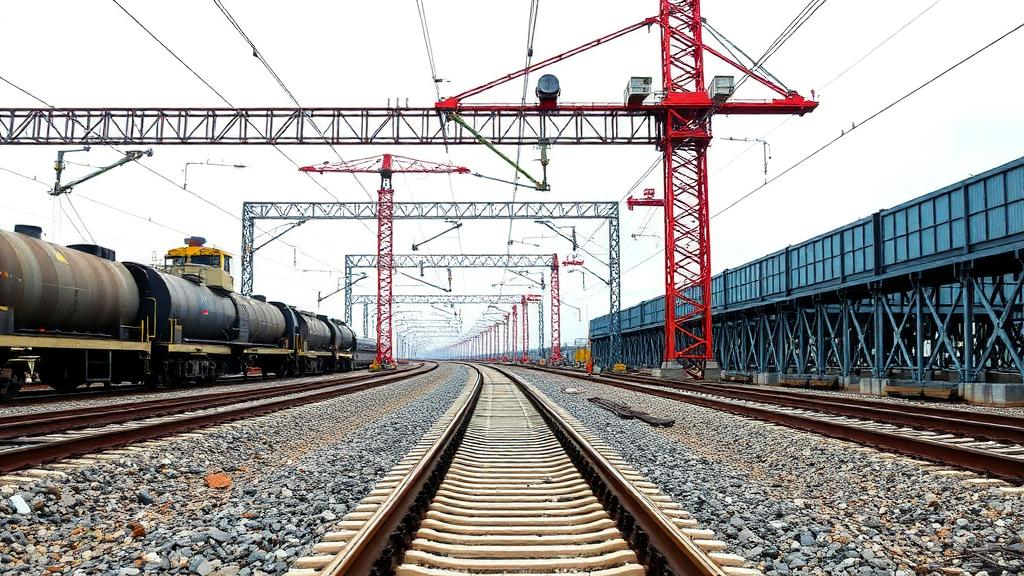
Railways have long been celebrated as one of the greenest ways to move people and freight, emitting far less carbon per passenger or tonne than road or air transport. But a new study from Thailand delivers a sobering reminder that the climate story of rail is written long before the first train rolls. When researchers tallied the greenhouse gases generated by building a 93-kilometre double-track railway, they found that nearly all of the emissions—96.19 percent—came from producing the steel, cement, concrete, and ballast embedded in the line, while the diesel-guzzling machines and site operations that physically built it accounted for a mere 3.81 percent. The finding, published in the journal Environmental Challenges, turns the spotlight away from construction sites and toward the industrial supply chains that feed them.
The research team, led by Panithi Nakhonthong and Preenithi Aksorn of Khon Kaen University, examined the Nakhon Pathom–Nong Plalai section of the Nakhon Pathom–Hua Hin double-track railway project, a State Railway of Thailand undertaking spanning roughly 93 kilometres across three provinces with a construction budget of about 8.20 billion Thai baht. Using a process-based life cycle assessment (LCA) following the ISO 14040 and 14044 frameworks, they compiled a cradle-to-gate inventory covering raw material extraction, material production, transport to site, on-site construction, and equipment energy use. The functional unit was the construction of the entire 93-kilometre section, with results reported both as total emissions and as a normalized intensity per kilometre to allow comparison with international benchmarks.
The headline numbers are striking. Building the line generated approximately 0.27 megatonnes of carbon dioxide equivalent, or about 2,941 tonnes of CO2-equivalent per kilometre. Structural work—bridges, overpasses, and other reinforced concrete and steel elements—was the single largest hotspot, contributing 67.05 percent of the total, followed by track work at 19.75 percent, station work at 10.30 percent, and earthwork at just 2.90 percent. Within the material inventory, reinforcing steel alone contributed roughly 110,535 tonnes of CO2-equivalent, rails added nearly 49,000 tonnes, and cement more than 45,000 tonnes. Ballast, hauled in enormous quantities for the track bed, contributed about 29,378 tonnes. By contrast, all the diesel fuel burned by construction machinery—more than three million litres of off-road diesel—produced only about 8,300 tonnes.
These results echo a consistent pattern documented across transportation infrastructure worldwide. Chang and Kendall’s landmark assessment of California’s high-speed rail showed that material production dominated construction emissions, and subsequent studies of Korean and Chinese high-speed lines confirmed that bridges, rails, sleepers, and concrete structures are the principal hotspots. The Thai case extends this evidence to a conventional double-track railway delivered under local procurement and supply-chain conditions, using domestic emission factors from the Thailand Greenhouse Gas Management Organization and the Thai Life Cycle Inventory database, supplemented by the international Inventory of Carbon and Energy. The consistency across such different contexts suggests that embodied carbon in steel and cement is a universal challenge for infrastructure decarbonization, not a quirk of any single country’s construction practices.
One of the study’s most instructive comparisons involves emission intensity. The Thai line’s 2,941 tonnes of CO2-equivalent per kilometre sits far below the figures reported for high-speed railways, which range from about 3,310 to a staggering 32,790 tonnes per kilometre. But the researchers caution against reading this as evidence of superior environmental performance. The decisive variable is structural composition: the Thai conventional line has an estimated bridge share of only about 10 percent, whereas the high-speed benchmarks carry 15 to 75 percent of their length on elevated structures. Bridges demand vastly more concrete and steel, and therefore vastly more embodied carbon. Headline intensity figures, the authors argue, are meaningless without accounting for what a railway is actually made of—a lesson for any policymaker tempted to rank projects by a single number.
What distinguishes this study from earlier railway LCAs is not the hotspot identification itself but the bridge it builds from measurement to management. The researchers recognize that an LCA result, however precise, does not by itself determine who should act, whether an alternative is feasible, or when an intervention should occur. To address this, they conducted semi-structured interviews with 40 experienced stakeholders—project managers, engineers, inspectors, and technicians—directly involved in the project, eliciting their views on practical mitigation measures across five life-cycle stages, from initial design through post-construction evaluation. From the literature and field observations, the team synthesized thirteen environmental intervention factors, spanning appropriate design, low-carbon and recycled material selection, construction-method choice, local sourcing to shorten transport distances, equipment efficiency, monitoring, and post-project assessment.
The interviews revealed a clear pattern of perceived priority. Early-stage measures dominated: appropriate structural design ranked first with 115 quotations, followed closely by environmentally friendly or recycled material selection with 112, and construction-method selection with 101. Exploratory correlation analysis showed strong co-occurrence among these themes, with the strongest relationship—between appropriate design and green material selection—reaching a Pearson coefficient of 0.9098. Construction-stage measures such as machine efficiency and green technology innovation, along with post-construction equipment management, attracted far less attention. The researchers are careful to stress that quotation frequency reflects perceived priority within this sample, not measured carbon savings or population-wide agreement.
The methodological heart of the paper is an intervention-screening matrix that cross-classifies LCA hotspot magnitude against stakeholder priority, assigning each combination a distinct next step. Measures that are both environmentally significant and strongly supported—such as steel- and cement-efficient structural design or lower-carbon material options—proceed immediately to quantitative LCA scenario testing and engineering feasibility assessment, and may be adopted only if a net greenhouse gas reduction is demonstrated. High-emission inputs that lack implementation support trigger a barrier, responsibility, and supply review before any scenario analysis, with the explicit rule that a measured hotspot must not be deprioritized simply because stakeholders mentioned it less often. Conversely, actions that stakeholders rate highly but which touch only minor emission flows—equipment upgrades, training, monitoring—require verification of their actual environmental leverage before any savings can be claimed. Low-priority items on both dimensions remain under periodic monitoring. This decision logic preserves the independence of the two evidence streams while preventing either from masquerading as the other.
A one-way sensitivity analysis reinforced the robustness of the core conclusions. Varying the combined reinforcing and structural steel emission factor by plus or minus 20 percent produced the largest absolute response—a 20 percent increase raising the total by roughly 31,811 tonnes of CO2-equivalent—while cement quantity changes of plus or minus 10 percent and a 50 percent proportional variation in ballast-related transport activity had smaller effects. Crucially, across all tested ranges, structural work remained the largest work-category hotspot, meaning the prioritization conclusion held even as the magnitude of the estimate shifted. The authors acknowledge limitations: the cradle-to-gate boundary excludes operation, maintenance, and end-of-life phases; the analysis rests on a single Thai project; and the deterministic stress tests provide directional sensitivity rather than statistical confidence intervals.
The practical implications reach well beyond one railway. For designers, the message is that structural optimization and material-efficient engineering offer the greatest carbon leverage, particularly for bridges and elevated structures. For contractors, the findings suggest that waste reduction, logistics planning, and rework minimization matter mainly because they curb demand for carbon-intensive materials rather than because of fuel savings. For project owners and policymakers, the framework offers a template for embedding life cycle thinking into procurement: require a baseline LCA, identify material hotspots, apply the screening matrix, and commission comparative scenarios for technical alternatives before contracts are signed. The authors emphasize that the numerical priorities cannot simply be transferred to other countries or infrastructure types—each application demands a new local inventory, context-specific thresholds, and fresh feasibility checks. But the underlying logic, that measured environmental significance and stakeholder feasibility must be kept distinct and then deliberately combined, offers a transparent and reproducible pathway for any material-intensive infrastructure project seeking genuine, verifiable carbon reductions rather than well-intentioned gestures.
Subject of Research: Life cycle assessment of greenhouse gas emissions from conventional double-track railway construction in Thailand and stakeholder-informed screening of low-carbon management responses
Article Title: Environmental challenges of railway infrastructure: linking life cycle assessment with management responses for low-carbon construction
Article References: Nakhonthong, P., & Aksorn, P. (2026). Environmental challenges of railway infrastructure: linking life cycle assessment with management responses for low-carbon construction. Environmental Challenges, 25, Article 101660. https://doi.org/10.1016/j.envc.2026.101660
Image Credits: AI Generated
DOI: 10.1016/j.envc.2026.101660
Keywords: railway infrastructure, life cycle assessment, embodied carbon, greenhouse gas emissions, steel and cement, sustainable construction, Thailand, double-track railway, stakeholder interviews, low-carbon materials, procurement, carbon footprint
Cite Scienmag News
Sloane Callahan. (October 1, 2026). Steel and Cement, Not Diesel, Dominate the Carbon Footprint of Railway Construction. Scienmag. https://scienmag.com/steel-and-cement-not-diesel-dominate-the-carbon-footprint-of-railway-construction/
Sloane Callahan. "Steel and Cement, Not Diesel, Dominate the Carbon Footprint of Railway Construction." Scienmag, 1 October 2026, https://scienmag.com/steel-and-cement-not-diesel-dominate-the-carbon-footprint-of-railway-construction/. Accessed 1 October 2026.
Sloane Callahan. "Steel and Cement, Not Diesel, Dominate the Carbon Footprint of Railway Construction." Scienmag. October 1, 2026. https://scienmag.com/steel-and-cement-not-diesel-dominate-the-carbon-footprint-of-railway-construction/


