


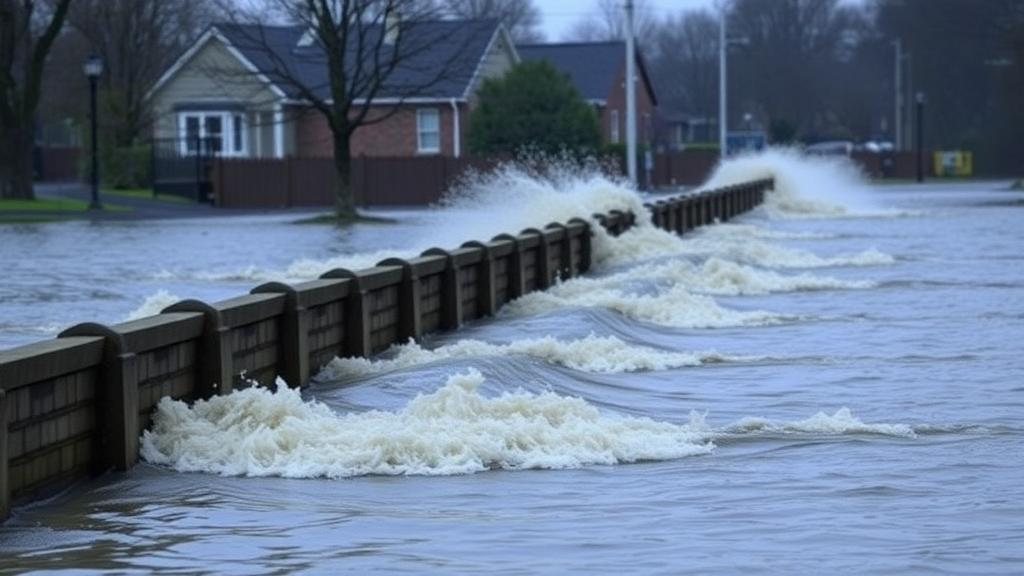
A false sense of security can be a dangerous thing, and few phenomena illustrate this better than what disaster researchers call the Safe Development Paradox. The concept describes a subtle but consequential feedback loop: when anti-flooding infrastructure such as levees is installed along a river, residents feel protected, and communities gradually begin building closer and closer to lowlands that were historically vulnerable to inundation. The infrastructure that was meant to reduce risk ends up attracting more people and property into harm’s way. Now, a team of researchers in Japan has provided one of the most detailed quantitative demonstrations of this paradox to date, using more than a century of historical data, painstakingly reconstructed terrain models, and high-resolution flood simulations focused on Marumori Town in Miyagi Prefecture.
The study, conducted by researchers at the International Research Institute of Disaster Science (IRIDeS) at Tohoku University together with colleagues at Meijo University, was published in the Journal of Hydrology: Regional Studies on September 14, 2026. The work was carried out under a comprehensive partnership agreement between the two institutions. Its central question was deceptively simple: has the flood-prevention infrastructure built over the past century actually made the residents of Marumori Town safer? Answering that question rigorously, however, required the team to overcome a long-standing methodological obstacle in flood hazard research.
The difficulty lies in the fact that multiple drivers of flood risk have changed simultaneously over the past hundred years. Rainfall patterns have shifted, river channels have been modified with embankments and other structures, and urban growth has transformed the landscape. Disentangling the contribution of man-made structural changes from the effects of a changing climate and expanding settlements is extremely challenging with observational data alone. To isolate the specific impact of engineered modifications to the terrain, the researchers turned to historical cartography. By digitizing and analyzing old maps from the Meiji era, they reconstructed the original, largely untouched natural landscape of the region as it existed before modern river engineering began, and used this as a natural baseline for comparison.
“By looking back at conditions in the Meiji era as a natural baseline, we can use models to determine whether the flood prevention infrastructure we installed is helping,” says Nilo Lemuel J. Dolojan of IRIDeS. “Surprisingly, we discovered that these ‘upgrades’ might have made things worse in some cases.” The simulations compared flood behavior across two virtual worlds: one built on the reconstructed historical terrain and one representing the present-day landscape with its modern levees and modified channels. Rainfall scenarios were then run through both versions of the catchment, allowing the team to measure precisely how the engineered changes altered flood volumes, depths, and the extent of areas exposed to inundation.
The results revealed a pattern that may sound counterintuitive but is well grounded in hydraulics. Levees are walls constructed along rivers to prevent swollen channels from spilling over their banks during heavy rain and extreme weather. During intense storms that produce widespread flooding, the simulations showed that flood volumes did indeed decrease in the modern landscape, confirming that the levees perform their intended function when water levels are high. But during lighter rainfall events, when flooding would historically have been scarce or mild, the very walls designed to protect communities trapped rainwater inside the neighborhoods, preventing it from spreading across the wider floodplain and draining away naturally. The consequence was worse inland flooding today than occurred in the same area more than a century ago under comparable light-rain conditions.
Further analysis uncovered something even more valuable for planners: a tipping point. The researchers found that there is a threshold beyond which modern terrain modifications transition from mitigating flood hazards to exacerbating them. Below that threshold, the engineered landscape reduces flood depths and volumes; above it, the same modifications intensify the hazard. The precise location of this tipping point varies for each body of water, depending on channel geometry, catchment characteristics, and the scale of the modification. Identifying where that threshold lies, the authors argue, should be a key step in deciding whether flood-prevention infrastructure is genuinely necessary for a given reach of river, or whether it may inadvertently create new hazards during more common, moderate rainfall events.
“In general, the levees are still effective during heavy rainfall. But even then, we still found exceptions,” says Shuji Moriguchi of IRIDeS. “During the unexpectedly strong 2019 Typhoon Hagibis, modern flood-control structures were completely overwhelmed.” Typhoon Hagibis, which struck eastern Japan in October 2019, produced rainfall totals that exceeded the design capacity of many flood defenses across the country, and the simulations for Marumori Town confirmed that the modern structures could not contain the extreme flows. The lesson is sobering: levees cannot keep communities completely safe under every weather condition, and their apparent reliability can itself become a source of risk when it encourages development in exposed locations.
That is precisely where the Safe Development Paradox becomes visible in the data. Although the levees were not failproof, the researchers found that nearby communities had behaved as if they were. By comparing the built-up area distribution recorded in the Meiji-era maps with present-day settlement patterns, the team documented a striking 110 percent growth in settlement area exposed to flooding. In other words, over the course of a century of infrastructure development, the amount of human development situated in locations that could be inundated more than doubled. The protective structures reduced the frequency of flooding, but the resulting confidence drew development into the floodplain, so that when defenses are exceeded, far more people and property stand in the path of the water than would have been the case in the historical landscape.
The significance of the study extends well beyond a single town in Miyagi Prefecture. Because the modeling framework separates the effects of man-made terrain modifications from the effects of climate change and urban growth, it allows for quantitative verification of the Safe Development Paradox rather than relying on anecdotal or correlational evidence. The same approach, combining reconstructed historical terrain with event-based numerical simulations, can be applied by researchers and planners in other river basins to evaluate whether existing or proposed flood defenses are delivering net benefits across the full spectrum of rainfall intensities. The method offers a way to test infrastructure decisions against the landscape that existed before engineering, providing a baseline that is often missing from modern hazard assessments.
The researchers hope to continue refining their model, and they emphasize that the ultimate goal is practical: to spark informed conversation about urban planning that reduces hazard exposure and keeps people safe. The findings suggest that flood management should not be judged solely by how it performs during catastrophic storms, but also by how it reshapes both the hydrology of moderate events and the behavior of the communities it is meant to protect. As climate change alters rainfall patterns and populations continue to concentrate in river valleys, understanding the full consequences of terrain modification, including the unintended ones documented in Marumori Town, will be essential for designing flood-risk strategies that do not quietly manufacture the disasters they were built to prevent.
Subject of Research: Quantifying how historical landform modifications, rainfall, terrain, and urban growth affect flood hazards and exposure
Article Title: Past vs. modern flood risk: Impacts of rainfall, terrain, and urban growth
Article References: Past vs. modern flood risk: Impacts of rainfall, terrain, and urban growth. (n.d.). Original publication
Image Credits: AI Generated
DOI: Not provided
Keywords: flood risk, levees, Safe Development Paradox, flood simulation, urban growth, terrain reconstruction, Meiji era, Marumori Town, Miyagi Prefecture, Typhoon Hagibis, Tohoku University, Journal of Hydrology
Cite Scienmag News
Violet Maxwell. (October 1, 2026). Century of flood defenses may be making some floods worse, simulations reveal. Scienmag. https://scienmag.com/century-of-flood-defenses-may-be-making-some-floods-worse-simulations-reveal/
Violet Maxwell. "Century of flood defenses may be making some floods worse, simulations reveal." Scienmag, 1 October 2026, https://scienmag.com/century-of-flood-defenses-may-be-making-some-floods-worse-simulations-reveal/. Accessed 1 October 2026.
Violet Maxwell. "Century of flood defenses may be making some floods worse, simulations reveal." Scienmag. October 1, 2026. https://scienmag.com/century-of-flood-defenses-may-be-making-some-floods-worse-simulations-reveal/


